📋 Table of Contents
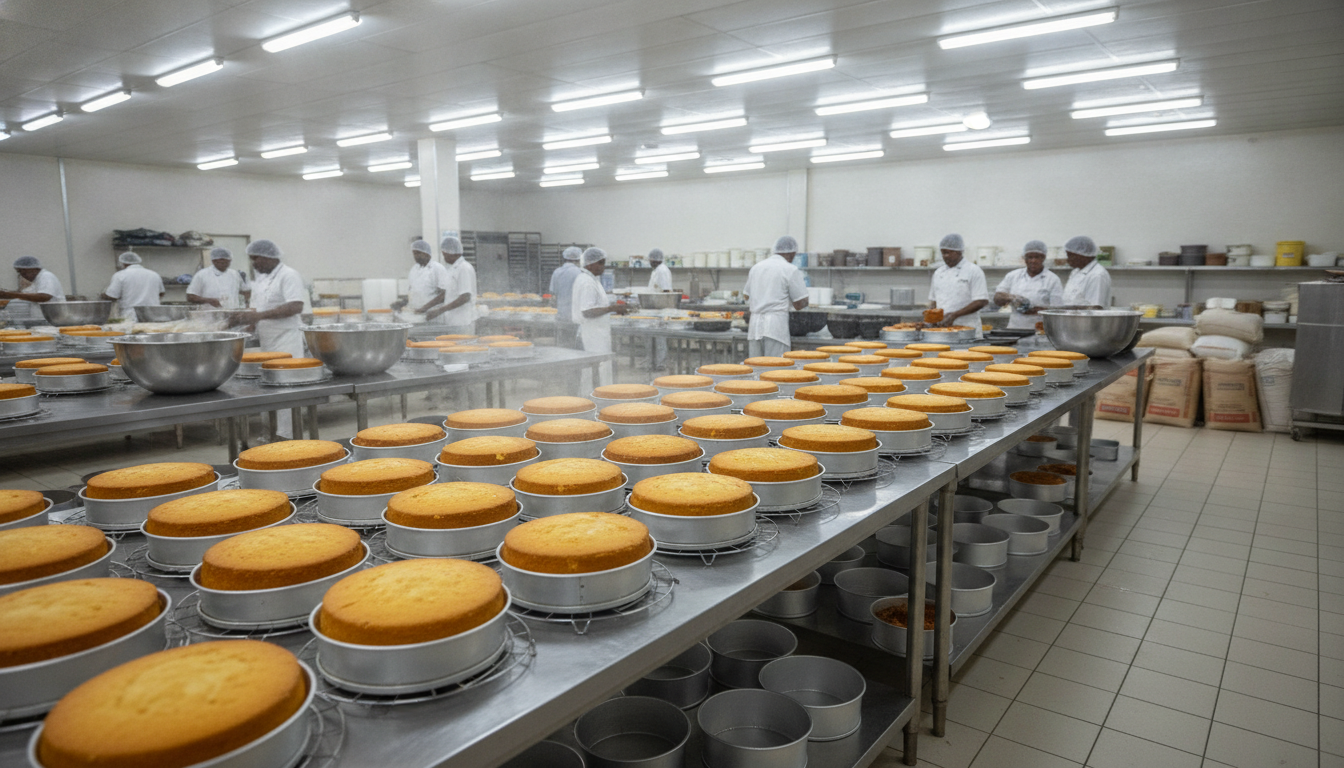
Finding a commercial round cake pan sizes bulk manufacturer that ships to Lagos, Mombasa, or Durban without forcing you into 5,000-piece minimums is harder than it should be. Bakery-supply importers in Nigeria, Kenya, and South Africa need pans that meet food-grade standards, arrive on predictable timelines, and fit both small validation orders and full-container shipments. This guide walks through the size matrix, material specs, MOQ tiers, and Africa-specific container loading so you can source with confidence.
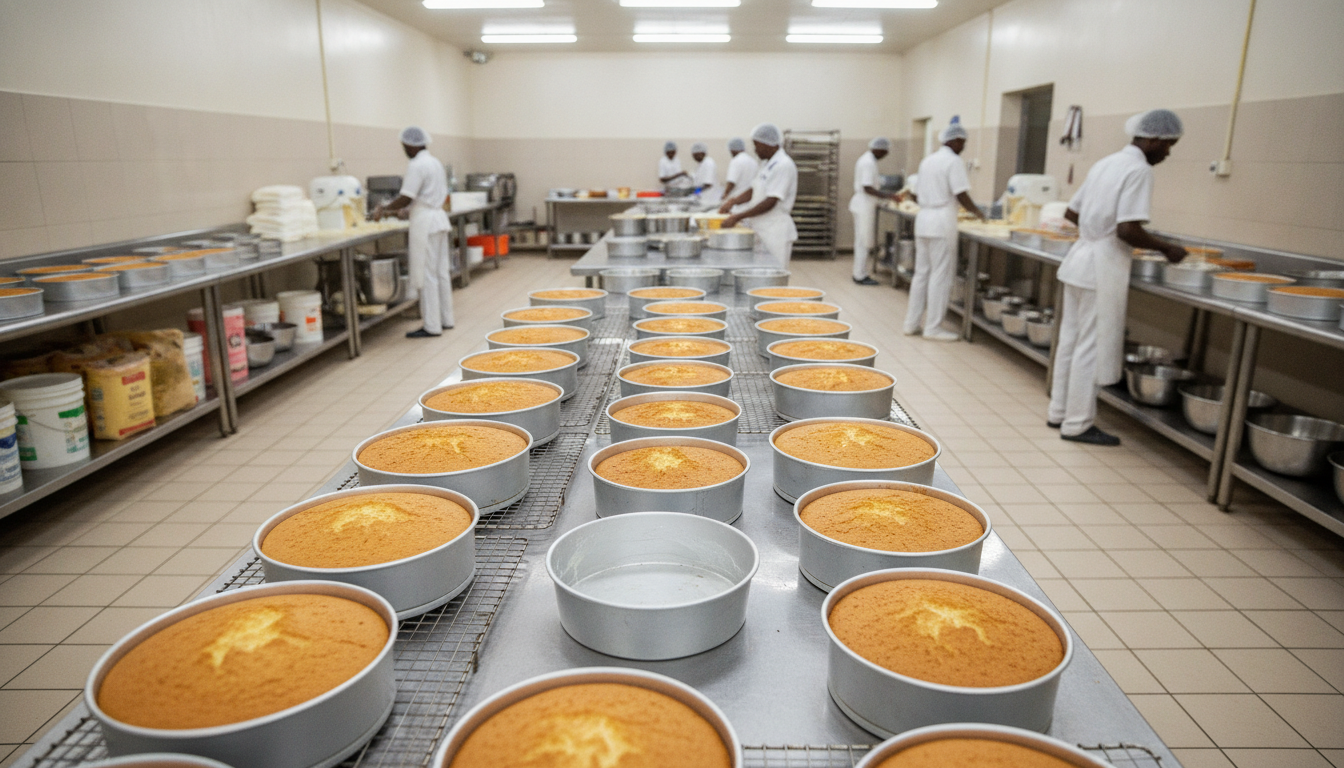
Commercial bakeries in Africa typically stock three core diameter ranges to cover birthday cakes, wedding tiers, and high-volume production runs. The most common commercial round cake pan sizes bulk manufacturer catalogs offer 6″, 8″, 10″, 12″, 14″, and 16″ diameters. Each size maps to a specific yield and customer segment.
6-inch pans serve individual celebration cakes (4-6 servings) and small-batch artisan production. 8-inch pans are the workhorse for standard birthday cakes (10-12 servings). Bakeries targeting individual consumers and small events order these in higher volumes. A typical 20-foot container holds approximately 12,000 units of 8-inch pans when stacked efficiently.
10-inch pans deliver 16-20 servings and dominate wedding-cake base tiers across Kenya, Nigeria, and South Africa. 12-inch pans (24-30 servings) suit corporate events and larger celebrations. Importers serving the wedding and catering supply chain prioritize these sizes. Container capacity drops to 8,000-9,000 units per 20-foot container due to larger footprint.
14-inch and 16-inch pans address high-volume bakery production and tiered wedding cakes. These sizes see lower turnover but higher per-unit margin. A 20-foot container accommodates 5,000-6,000 units when mixed with smaller sizes for balanced inventory.
Material choice affects baking performance, durability, and landed cost. Importers targeting professional kitchens in Lagos, Nairobi, and Johannesburg balance heat conductivity, nonstick performance, and multi-year lifespan. The three dominant materials in wholesale bakeware sets each serve distinct buyer priorities.
Aluminum pans deliver even heat distribution and lightweight handling. A 0.8 mm gauge aluminum pan weighs approximately 180-220 grams for an 8-inch diameter, reducing shipping costs per unit. Anodized aluminum finishes resist scratching and extend lifespan to 3-5 years under commercial use. Buyers prioritizing cost-per-bake favor aluminum for high-turnover production.
Carbon steel pans coated with food-grade nonstick (PFAS-free silicone or ceramic) offer quick release and easy cleanup. A 0.5 mm carbon steel 10-inch pan weighs 240-280 grams. The nonstick layer degrades after 800-1,200 baking cycles, making these suitable for bakeries with planned replacement schedules. SGS testing confirms PFAS-free coatings meet FDA food-contact standards.
Stainless steel pans resist corrosion and survive 5+ years in high-humidity tropical climates common across West Africa. A 0.6 mm stainless 12-inch pan weighs 320-380 grams. Higher initial cost (typically 30-40% above aluminum) spreads across longer service life. Importers serving hotel chains and institutional kitchens prioritize stainless for durability.
Pan depth determines batter capacity and final cake height. Professional bakers in Accra, Kampala, and Maputo specify depth based on layer-cake assembly workflows and presentation standards. Three depth categories cover most commercial applications.
2-inch depth pans produce single-layer cakes and sheet-cake portions. Batter capacity for a 10-inch × 2-inch pan is approximately 1.2 liters. These pans suit high-volume operations baking dozens of single-layer cakes per shift. Faster baking time (22-28 minutes at 175°C) increases daily throughput.
3-inch depth is the industry standard for two-layer cake assembly. A 10-inch × 3-inch pan holds 1.8 liters of batter and bakes in 32-38 minutes. This depth balances structural integrity with reasonable baking time. Importers stocking general bakery-supply stores prioritize 3-inch depth across all diameters.
4-inch depth pans serve specialty tiered cakes and tall single-layer designs. Batter capacity reaches 2.4 liters for a 10-inch × 4-inch pan. Baking time extends to 42-50 minutes, requiring precise oven calibration. Wedding-cake specialists and high-end patisseries drive demand for 4-inch depth in 12″, 14″, and 16″ diameters.
Depth impact on container loading: 2-inch pans stack 40% more efficiently than 4-inch pans. A 20-foot container holds ~12,000 units of 8″×2″ pans versus ~8,500 units of 8″×4″ pans.
Minimum order quantities determine cash-flow requirements and inventory risk. Bakery-supply importers in Nigeria, Kenya, and South Africa face different MOQ tiers depending on order stage and customization level. Shansen Bakeware operates 7 in-house bakeware lines at 500,000 units per month capacity, enabling flexible MOQ structures.
Sample validation starts at 1 piece per SKU. An importer testing three sizes (8″, 10″, 12″) in two materials (aluminum, carbon steel) orders 6 total pieces. Sampling cost includes unit price plus air-freight (typically $45-$65 for 6 pans to Lagos or Nairobi). Turnaround time is 7-10 days from payment to dispatch.
In practice: A Kenyan bakery-supply distributor validated 8″ and 10″ aluminum pans with 1-piece samples, confirmed nonstick performance and gauge thickness, then placed a 300-unit first order across four SKUs without tying up capital in untested inventory.
Small-batch orders at 30 pieces per SKU allow market testing before full commitment. Sea freight to Mombasa or Lagos adds $0.15-$0.25 per unit when consolidated with other cargo. This tier suits new importers validating local demand.
Full-container orders unlock lowest per-unit pricing and optimized freight. A 20-foot container holds 10,000-14,000 pans depending on size mix. Importers ordering 12,000 units (mixed 6″-12″ diameters) achieve 18-25% lower landed cost versus small-batch orders. Low-MOQ bakeware options bridge the gap between validation and scale.
Container routing, port clearance, and inland distribution shape total landed cost for commercial round cake pan sizes bulk manufacturer shipments to Africa. Importers in Lagos, Mombasa, Durban, Abidjan, Luanda, and Maputo face distinct logistics challenges. Shansen ships from Ningbo port with container loading optimized for African distributors.
Ningbo to Lagos Apapa transit time is 18-22 days for direct sailings, 25-30 days for transshipment routes via Lomé or Tema. Nigeria’s import duties on bakeware (HS code 7323.93) range from 20-35% CIF depending on material and finish. Importers using bonded warehouses in Lagos Free Zone defer duty payment until local distribution. Francophone markets (Abidjan, Dakar, Douala) add 3-5 days transshipment time from Lagos.
Ningbo to Mombasa direct sailings take 16-20 days. Kenya’s EAC common external tariff applies 25% duty on imported bakeware. Inland transport from Mombasa to Nairobi adds $0.08-$0.12 per kilogram. Importers serving Uganda and Tanzania route through Mombasa, adding 4-7 days overland to Kampala or Dar es Salaam.
Ningbo to Durban transit is 22-26 days. South Africa’s VAT (15%) and import duty (20% for non-SADC origin bakeware) apply at port clearance. Lusophone markets in Angola (Luanda) and Mozambique (Maputo) face 25-30 day transit times and 30-50% combined duty/VAT depending on product classification. Africa-optimized bakeware logistics reduce clearance delays through proper HS-code documentation and pre-shipment inspection.
Standard 20-foot containers accommodate 10-12 pallets (1.0m × 1.2m Euro pallets). Nested round pans stack 18-24 units high depending on diameter and depth. A well-optimized container mixes sizes to maximize cubic utilization: base layer of 16″ pans (400 units), middle layers of 10″-12″ pans (6,000 units), top layer of 6″-8″ pans (5,000 units). Total container weight stays below 22,000 kg gross to avoid port surcharges.
Commercial round cake pans range from 6 inches to 16 inches in diameter, typically in 2-inch increments. The most common sizes are 8-inch (10-12 servings), 10-inch (16-20 servings), and 12-inch (24-30 servings). Professional bakeries stock multiple sizes to serve individual celebration cakes, wedding tiers, and high-volume production runs. Pan depth options include 2-inch, 3-inch, and 4-inch to accommodate different layer-cake assembly requirements.
Aluminum (0.6-1.0 mm gauge) is preferred for even heat distribution and lightweight handling, making it ideal for high-turnover bakery production. Carbon steel with PFAS-free nonstick coating offers quick release and easy cleanup, suitable for operations with planned replacement schedules after 800-1,200 cycles. Stainless steel (0.5-0.8 mm) provides superior durability and corrosion resistance, lasting 5+ years in humid tropical climates. Material choice depends on budget, baking volume, and replacement-cycle planning.
3-inch depth is the industry standard for two-layer cake assembly, holding approximately 1.8 liters of batter in a 10-inch pan and baking in 32-38 minutes at 175°C. 2-inch shallow pans suit single-layer cakes and faster production cycles (22-28 minutes baking time). 4-inch deep pans serve specialty tiered cakes and tall single-layer designs, with batter capacity reaching 2.4 liters and baking time extending to 42-50 minutes.
Sample validation orders start at 1 piece per SKU for product testing, with 7-10 day turnaround via air freight. Small-batch market validation typically requires 30 pieces per SKU, shipped via sea freight LCL in 18-22 days. Full-container bulk orders begin at 10,000+ total units (mixed sizes), achieving 18-25% lower landed cost versus small-batch pricing. Custom OEM programs may require higher MOQs for private-label branding.
Aluminum pans excel in even heat distribution and multi-year durability (3-5 years), making them cost-effective for high-volume operations. Nonstick-coated carbon steel pans reduce cleanup time and improve release consistency, but require replacement after 800-1,200 baking cycles. Bakeries prioritizing long-term cost-per-bake favor aluminum, while operations emphasizing labor efficiency and quick turnaround prefer nonstick. SGS-tested food-grade options are available in both materials.
Ready to source commercial round cake pans with flexible MOQ and Africa-optimized logistics?
Request samples and container-load pricing →
Written by the Shansen Bakeware Export Team.
MOQ 1 set on stock configurations. Tell us what you need and we reply on WhatsApp.
Click the button below to open WhatsApp. If you're not logged in to WhatsApp Web yet, scan the QR code first — then come back here and copy the message into the chat.