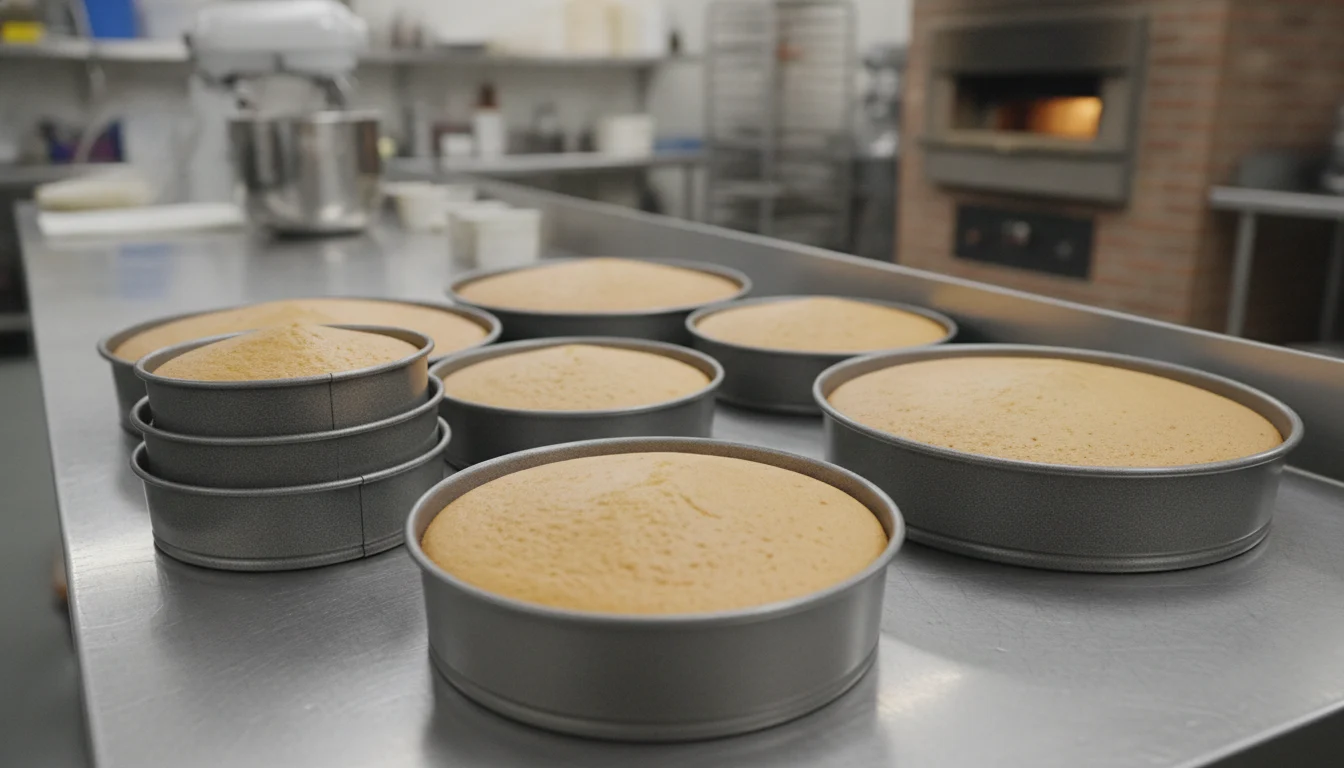
Round cake pan sizes for commercial baking typically range from 6-inch to 12-inch diameter, with 8-inch and 9-inch being the most common for layer cakes. Depth matters as much as diameter: standard round pans are 2 inches deep, while shallow pans at 1.5 inches risk overflow and deep pans at 3 inches alter baking time. For bulk procurement, verify actual measured diameter against labeled size, since mislabeling causes recipe failures and wrong batter volume.
📋 Table of Contents
Round cake pan sizes in commercial baking fall into three tiers: small-portion sizes (6-inch), standard layer-cake sizes (8-inch and 9-inch), and event or tiered-cake sizes (10-inch, 11-inch, 12-inch). The 8-inch and 9-inch diameters account for the majority of retail and food-service demand because they match boxed cake-mix volumes and standard recipe yields. Distributors stocking for bakeries, catering operations or retail chains typically prioritize these two sizes before adding smaller or larger options.
6-inch round pans serve individual or small-household portions, yielding 4 to 6 servings per layer. Bakeries use them for personal celebration cakes, tasting samples, and tiered-cake top layers. Silicone and aluminum are the dominant materials in this size because they release easily and heat quickly for shorter baking cycles. Importers targeting boutique bakeries or gift-cake segments stock 6-inch rounds alongside standard sizes.
8-inch round pans yield 8 to 10 servings per layer and fit most home ovens and commercial deck ovens without crowding. 9-inch rounds yield 10 to 12 servings and align with U.S. boxed cake-mix volumes, making them the default for home bakers and small bakeries. Both sizes use 2-inch depth as the industry standard, which accommodates typical batter rise without overflow. Our Yongkang factory runs carbon-steel 8-inch and 9-inch rounds at 500,000 units per month capacity, with SGS and FDA 21 CFR 175.300 non-stick coating verification dated 2020, 2021 and 2023.
10-inch rounds serve 12 to 16 people and function as base layers for tiered cakes or standalone sheet-style rounds for larger gatherings. 11-inch and 12-inch pans are specialty sizes for wedding cakes, catering events, and institutional food service. Aluminum is the preferred material for these larger diameters because it distributes heat evenly across the wider surface and weighs less than equivalent carbon-steel pans, reducing shipping costs for bulk orders. Buyers sourcing for event bakeries or catering-supply chains request these sizes in smaller quantities alongside higher-volume 8-inch and 9-inch stock.
Pan depth controls batter capacity, baking time, and final cake height. A 9-inch round pan at 2 inches deep holds approximately 8 cups of batter, while the same diameter at 1.5 inches holds only 6 cups. Filling a shallow pan with a recipe designed for 2-inch depth causes overflow, burnt edges, and uneven rise. Conversely, using a 3-inch deep pan with a standard recipe leaves the cake short and dense because the batter spreads thin across the base before it rises.
2-inch depth is the baking-industry baseline for round pans from 6-inch to 12-inch diameter. Recipe developers and commercial bakeries default to this measurement when writing instructions, so pans that deviate from 2 inches require batter-volume adjustments or altered baking times. Distributors stocking for general-purpose bakery supply prioritize 2-inch depth to match the widest range of recipes and reduce customer support issues related to recipe failures.
1.5-inch shallow rounds suit thin-layer cakes, tortes, and European-style sponge cakes that use less batter per layer. Professional pastry chefs use them for multi-layer assembly where each layer is thin and soaked with syrup. However, shallow pans are a niche product: buyers report frustration when pans labeled as standard 2-inch measure only 1.5 inches, because the reduced capacity causes overflow and recipe mismatches. Importers should verify actual depth with calipers before approving production samples.
3-inch deep rounds accommodate high-rise cakes, cheesecakes, and batter-heavy recipes like carrot cake or fruit cake. The extra depth prevents overflow but extends baking time by 10 to 20 percent because heat must penetrate a thicker batter column. Bakeries that specialize in tall single-layer cakes or cheesecakes stock 3-inch pans as a secondary line, not as a replacement for standard 2-inch inventory. Buyers sourcing deep pans should confirm that the coating and material can withstand longer oven exposure without degradation.
Material choice affects heat transfer, release performance, and durability across different round cake pan sizes. Carbon steel dominates 8-inch and 9-inch rounds because it heats evenly, holds non-stick coatings well, and withstands repeated commercial use. Aluminum is preferred for larger 10-12-inch pans due to lighter weight and faster heat conduction. Silicone suits smaller 6-inch pans where easy release and flexible storage matter more than rigidity.
Carbon steel pans heat evenly and retain shape under repeated thermal cycling, making them the workhorse for bakery operations running dozens of cakes per day. Non-stick coatings on carbon steel must meet FDA 21 CFR 175.300 food-contact safety limits; our 2020 SGS report verifies PFAS-free and lead-free coating on the carbon-steel line. Buyers sourcing for humid or coastal climates should confirm that the coating resists moisture-related adhesion loss, a common complaint in Lagos, Mombasa, and other port-city markets.
Aluminum conducts heat faster than carbon steel, which reduces baking time for larger-diameter pans where the batter column is wide. The lighter weight cuts shipping costs on bulk orders: a 12-inch aluminum pan weighs approximately 40 percent less than an equivalent carbon-steel pan, reducing container freight and last-mile delivery expenses. However, aluminum scratches more easily than carbon steel, so buyers should specify anodized or coated aluminum for commercial kitchens where metal utensils are common.
Silicone pans release cakes without greasing and collapse for compact storage, advantages that matter for small-portion 6-inch rounds used in boutique bakeries or gift-cake operations. Food-grade silicone must withstand 450°F (232°C) without leaching; buyers should request material-safety data sheets confirming FDA or equivalent food-contact compliance. Silicone pans lack the rigidity of metal, so they require a baking sheet underneath for stable transport to and from the oven.
Stainless steel rounds resist corrosion and maintain a polished appearance, making them suitable for display kitchens, cooking schools, and high-end retail. They cost more than carbon steel or aluminum and conduct heat less efficiently, so baking times extend by 5 to 10 percent. Distributors targeting premium segments or institutional buyers with long-term durability requirements stock stainless steel as a specialty line, not a volume product.
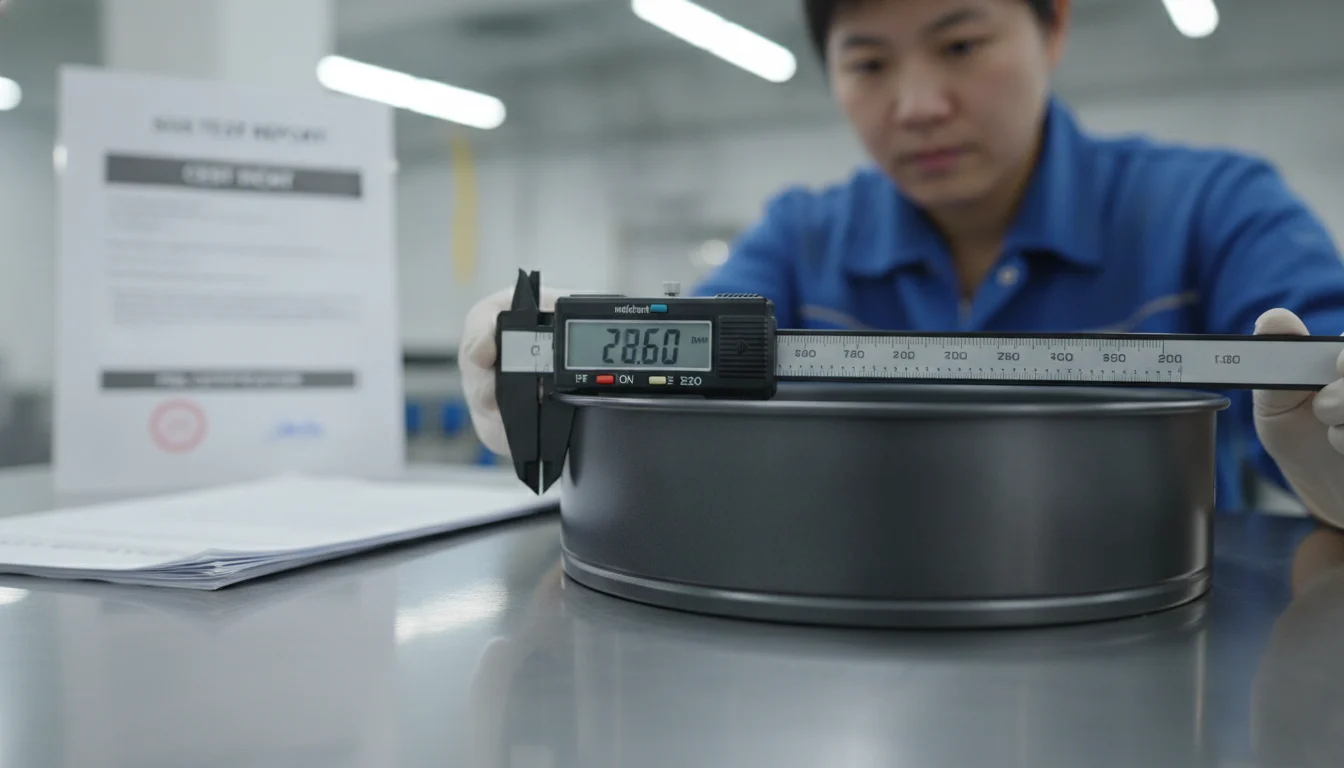
Diameter and depth mislabeling is a recurring defect in bakeware imports. Buyers report pans labeled as 9-inch measuring 8.5 inches or 9.25 inches when checked with calipers, and pans labeled as 2-inch depth measuring 1.75 inches or 2.25 inches. These discrepancies cause recipe failures, customer returns, and brand-reputation damage. Verification at the sampling stage prevents costly corrections after production.
Round cake pan diameter is measured across the top interior rim, not the exterior or the base. A pan with sloped sides will have a smaller base diameter than top diameter; the top measurement is the standard. Use a rigid ruler or digital caliper, place it across the widest interior point, and record to the nearest tenth of an inch or millimeter. Pans that deviate by more than 0.125 inch (3 mm) from the labeled size fail dimensional tolerance and should be rejected.
Depth is measured vertically from the interior base to the top rim, not from the exterior base. Place a ruler or depth gauge inside the pan and measure straight up to the rim edge. A 2-inch pan should measure between 1.95 and 2.05 inches; anything outside that range affects batter capacity and baking time. Buyers sourcing for recipe-sensitive applications like layer cakes or cheesecakes should specify depth tolerance in the purchase order and verify with calipers on pre-production samples.
Sampling each SKU at 1 set before a full order lets a distributor check coating, fit, and dimensional accuracy against local demand without tying up cash. Sampling each SKU at 1 set before a full order allows verification of coating quality and fit against local demand without tying up cash. Our metal line ships 1-piece samples with measured diameter and depth recorded on the packing slip, so buyers can verify before committing to the 500-piece production run. Sampling costs are confirmed at quotation and typically ship within the lead time for that material line.
Place the sample pan on a flat surface and press the center. A warped pan rocks or flexes, which causes uneven baking and hot spots. Carbon-steel pans thicker than 0.6 mm resist warping better than thinner gauges; aluminum pans should be at least 1.0 mm to maintain rigidity at 10-inch diameter and above. Buyers should reject samples that show visible warping or base flex, because the defect worsens with repeated heating and cooling.
Serving count depends on pan diameter, depth, and slice size. A standard 2-inch deep round cake sliced into 1-inch by 2-inch portions yields the serving counts below. Buyers stocking for retail or food-service customers use these counts to match pan sizes to typical order volumes and portion expectations.
Retail bakeries typically slice cakes into 1-inch by 2-inch portions for standard celebration cakes, while catering operations cut 1.5-inch by 2-inch or 2-inch by 2-inch portions for weddings and formal events. A 9-inch round cake sliced into 2×2-inch portions yields 6 to 8 servings instead of 10 to 12, so buyers should clarify portion expectations with their end customers before selecting pan sizes. Event bakeries often stack multiple 8-inch or 9-inch layers to increase serving count without moving to larger single-tier pans.
Multi-layer cakes use two or three rounds of the same diameter stacked with filling between layers. A two-layer 9-inch cake yields 10 to 12 servings if each layer is 2 inches tall and sliced at standard portion size. Tiered cakes combine different diameters, such as a 12-inch base, 9-inch middle, and 6-inch top, to create visual height and serve larger guest counts. Buyers stocking for wedding or event bakeries need a range of sizes in the same material and coating to ensure consistent appearance across tiers.
Bulk procurement of round cake pans requires verification beyond diameter and depth. Coating durability, dimensional consistency across production batches, packaging that prevents nesting damage, and food-safety documentation all affect landed quality and customer satisfaction. Buyers sourcing for distribution in Nigeria, Kenya, South Africa, and Francophone or Lusophone African markets should address these points during sampling and before container loading.
Non-stick coatings degrade faster in high-humidity environments common in Lagos, Mombasa, and other coastal cities. Moisture infiltrates microscopic coating defects, causing adhesion loss and rust spots on the underlying carbon steel. Buyers should request accelerated humidity testing or salt-spray test results to confirm coating performance in tropical logistics and storage conditions. Our carbon-steel line carries SGS and FDA 21 CFR 175.300 verification with PFAS-free and lead-free coating; test reports are issued per order and available on request.
A single pre-production sample may meet dimensional tolerance, but consistency across a 5,000-piece or 10,000-piece production run requires process control. Buyers should specify in-process inspection at 25 percent, 50 percent, and 75 percent of production, with calipers measurement recorded for diameter and depth. Pans that drift outside the 0.125-inch tolerance mid-production should trigger a production hold and re-tooling before the batch ships. Importers who skip in-process checks discover dimensional drift only after the container arrives, when correction costs multiply.
Round pans nest inside each other for compact shipping, but metal-on-metal contact scratches coatings and dents rims. Protective packaging options include individual poly bags, interleaved cardboard or foam separators, and shrink-wrapped stacks. Buyers should specify packaging in the purchase order and verify on pre-production samples that separators prevent coating damage during container transit. Poorly packaged pans arrive with scratched non-stick surfaces that fail quality inspection and generate customer returns.
African import authorities increasingly require food-contact compliance certificates at customs clearance, especially for kitchenware and bakeware entering Nigeria, Kenya, and South Africa. SGS or equivalent third-party test reports confirming FDA 21 CFR food-contact safety, PFAS-free coating, and lead-free materials smooth customs processing and reduce the risk of container holds. Our test reports dated 2020, 2021, and 2023 are issued per production batch and provided on request; buyers should confirm that reports will accompany the shipment before container loading at Ningbo port.
Distributors stocking multiple round cake pan sizes need flexible MOQ to test market demand without over-committing inventory capital. Our low-MOQ bakeware line allows sampling from 1 set for bakeware sets, and 1 piece for metal line samples, with 500-piece production runs per SKU. Buyers can sample 6-inch, 8-inch, 9-inch, and 10-inch rounds at 1 piece each, validate which sizes move fastest in their market, then scale production quantities accordingly. Lead time and sampling costs are confirmed at quotation based on material line and destination port.
A 9-inch round pan at 2-inch depth is the most versatile starting size because it matches U.S. boxed cake-mix volumes, yields 10 to 12 servings per layer, and fits standard home and commercial ovens without crowding. New bakeries should stock at least two 9-inch pans for layer cakes, then add 8-inch rounds for smaller orders and 10-inch or 12-inch rounds as event-cake demand grows. Carbon steel with non-stick coating offers the best balance of durability, release performance, and cost for daily commercial use.
An 8-inch round pan at 2-inch depth holds approximately 6 cups of batter, while a 9-inch round at the same depth holds 8 cups. To convert a recipe from 8-inch to 9-inch, multiply all ingredient quantities by 1.33 (or divide by 0.75). For example, a recipe calling for 3 cups of flour in an 8-inch pan needs 4 cups for a 9-inch pan. Baking time typically increases by 5 to 10 percent because the batter column is slightly thicker, so check for doneness a few minutes later than the original recipe specifies.
A 9-inch round pan holds approximately 8 cups of batter, while an 8-inch square pan holds about 8 cups as well, so they are roughly interchangeable in terms of volume. However, the round pan has a smaller base area and slightly deeper batter column, which can extend baking time by 5 minutes. Buyers stocking for general-purpose baking should offer both shapes because customers often have shape preferences for presentation, but the two sizes work as functional substitutes when volume capacity matches.
Written by the Shansen Bakeware Export Team.
Ready to verify round cake pan sizes, coating, and dimensional accuracy for your market?
Request 1-Piece Samples and Specs →
See the range: every size we make, with specs and MOQ, is on our cake pans and tins page.
MOQ 1 set on stock configurations. Tell us what you need and we reply on WhatsApp.
Click the button below to open WhatsApp. If you're not logged in to WhatsApp Web yet, scan the QR code first — then come back here and copy the message into the chat.