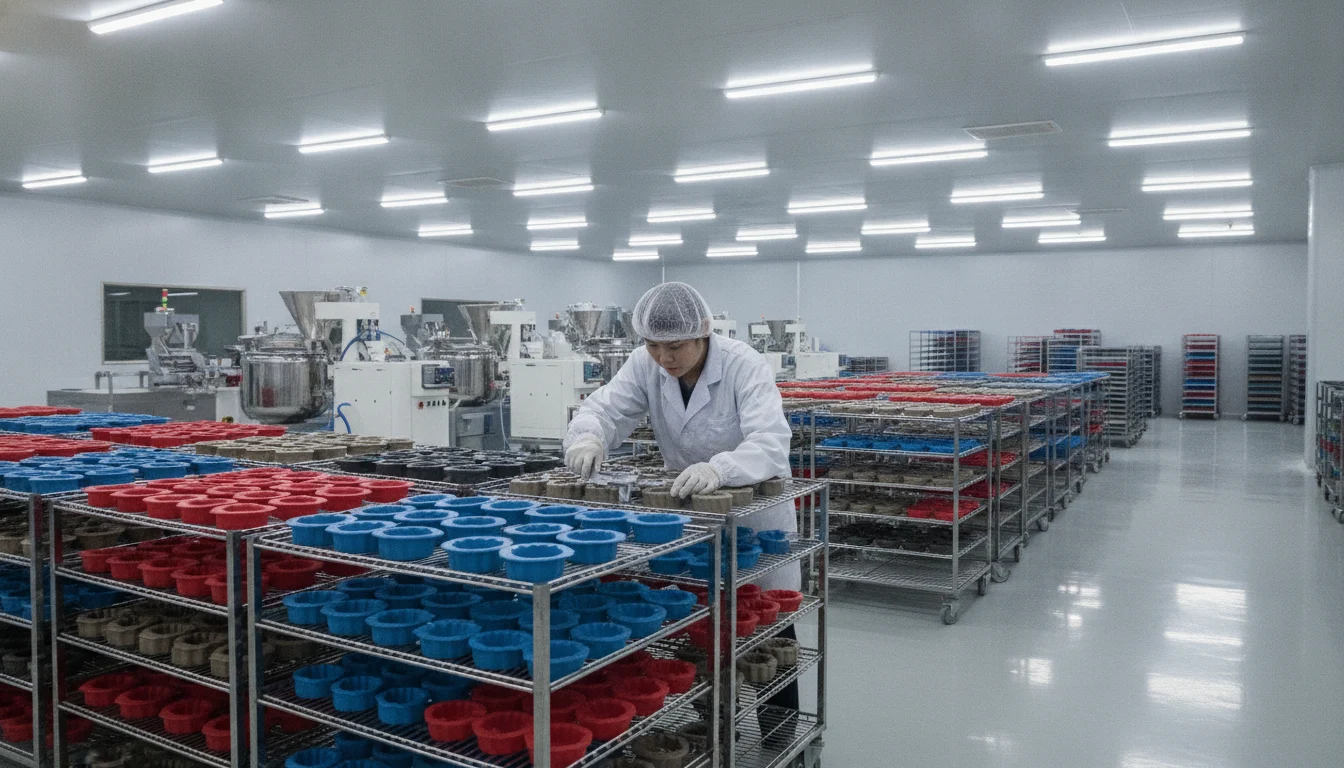
Before placing your first silicone baking mold order, ask your manufacturer to confirm food-grade certification (FDA 21 CFR 177.2600 or equivalent), continuous-use temperature range, tooling/setup fee breakdown, MOQ per design, sample-to-production consistency protocol, and what documentation they provide for customs clearance in your target market. These questions to ask silicone baking mold manufacturer before ordering prevent the most common import failures: odor complaints, heat-limit confusion, hidden tooling charges, and batch-to-batch release inconsistency.
📋 Table of Contents
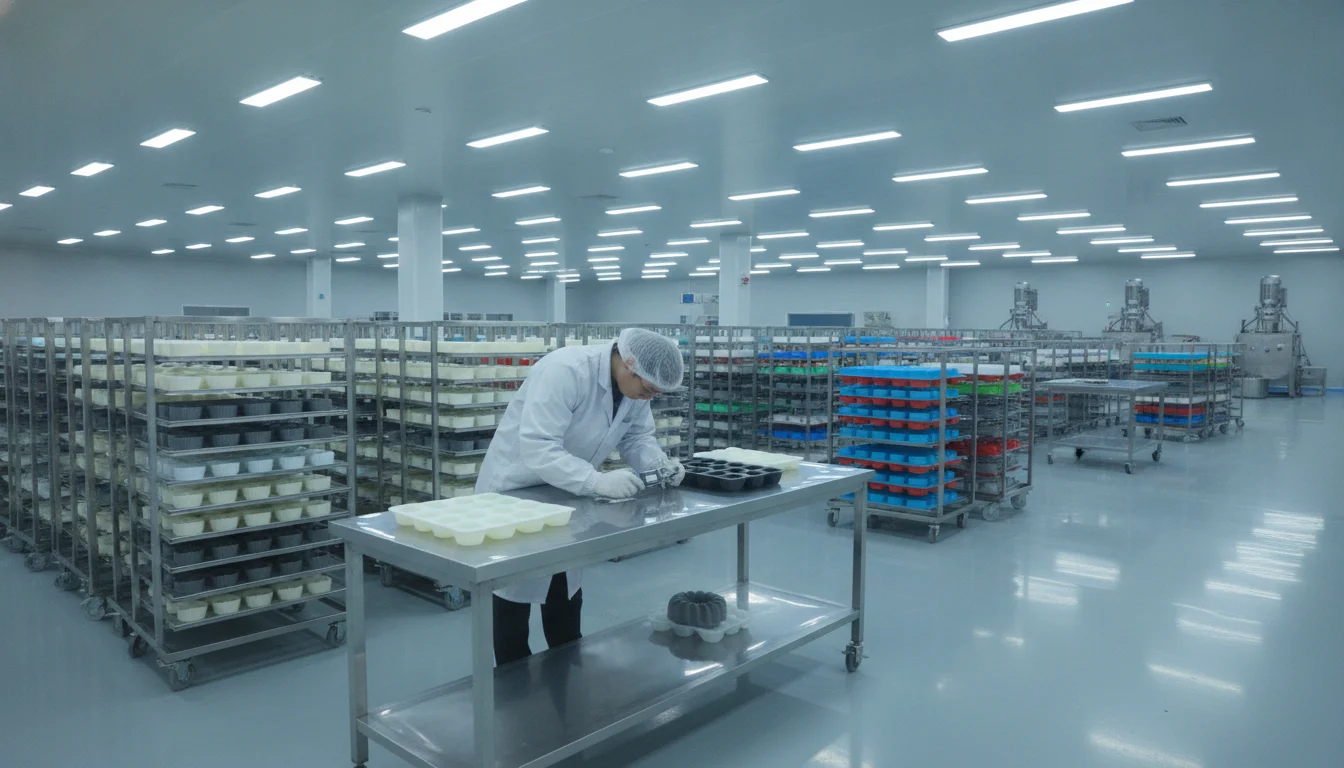
Food-grade certification is the first gate. Without it, your silicone molds may leach plasticizers, heavy metals, or volatile organic compounds into baked goods, creating liability and market-access risk. Ask the manufacturer which specific regulation their silicone complies with and request the corresponding test report.
This regulation defines extractable limits for rubber articles intended for repeated food contact. A compliant test report will show migration results for n-hexane, water, and acidic simulants under prescribed time and temperature conditions. The report should be recent (within three years) and issued by an accredited third-party lab such as SGS or Intertek.
European buyers require compliance with the plastics regulation, which sets overall migration limits and specific migration limits for authorized substances. If you plan to distribute in EU markets or to buyers who re-export there, confirm that the silicone formulation appears on the Union List and that the manufacturer holds a Declaration of Compliance.
German food law imposes stricter sensory-evaluation requirements than the broader EU framework. If your target customers are in Germany or sell to German retail chains, ask whether the molds have passed LFGB sensory and migration testing, which includes taste, odor, and color-transfer checks.
Buyers report that silicone molds sometimes arrive with a strong chemical smell and need extensive washing or curing before first use. A valid food-contact test report reduces this risk but does not eliminate it; ask whether the factory performs post-cure ventilation and what the recommended first-wash protocol is. Our team sources wholesale bakeware sets that include silicone molds tested to FDA and SGS standards, with test reports provided per production batch.
Temperature claims for silicone baking molds are often stated without context, which leads to deformation, odor release, or shortened service life when buyers assume the figure applies to continuous commercial use. The questions to ask silicone baking mold manufacturer before ordering must separate peak short-term resistance from the safe continuous-use band.
Food-grade silicone typically withstands -40°C to +230°C continuously and may survive brief exposure to +260°C without structural failure. Continuous use means the mold can endure that temperature for the full bake cycle, multiple times per day, over hundreds of cycles. Peak resistance refers to a one-time or infrequent spike that the material survives but that accelerates aging.
Bread and cake baking rarely exceed +200°C, so standard food-grade silicone suffices. High-sugar confections, caramelized crusts, and broiler finishing can push oven temperatures to +250°C, requiring platinum-cured silicone with higher thermal stability. Ask the manufacturer to specify the curing catalyst (peroxide or platinum) and the recommended maximum continuous temperature for your exact application.
Repeated heating and cooling cycles cause expansion and contraction. Over time, molds with insufficient tear strength or poor cavity-wall thickness lose dimensional accuracy, making release difficult and reducing baked-good uniformity. Request the Shore A hardness value (typically 40-60 for baking molds) and the tear-strength specification (ASTM D624 or ISO 34-1) to predict service life under thermal cycling.
Buyers say suppliers often promise temperature resistance without clarifying whether it is continuous or short-term, which creates baking failures. Confirm the continuous-use ceiling in writing and ask whether the factory has conducted accelerated-aging tests that simulate 500+ bake cycles at your target temperature.
Tooling costs for custom silicone molds range widely based on cavity count, detail complexity, and whether the mold requires a support tray or reinforcing frame. First-time buyers complain that tooling and setup fees are opaque and do not clearly say what assets, files, or prototype revisions are included. Breaking down the fee structure prevents budget overruns and clarifies what you own at the end of the project.
A transparent manufacturer will itemize the tooling invoice into mold-cavity machining, prototype sample production, and any required jigs or fixtures. Ask whether the fee includes one prototype iteration or multiple rounds of revision, because design tweaks after the first sample often trigger additional charges. Confirm whether you receive the CAD files, the physical mold tool, or both, and under what terms you can reorder using that tooling with a different supplier.
Some factories retain tooling ownership and charge a per-run setup fee on every reorder. Others transfer ownership after the first production run, allowing you to take the mold elsewhere or archive it for future use. Clarify ownership in writing before paying the tooling deposit, and ask whether the manufacturer will store the mold at no cost between orders or whether you must arrange pickup and warehousing.
The first prototype rarely matches the approved design perfectly. Cavity depth, release angle, and support-tray fit often require adjustment. Ask how many revision cycles are included in the quoted tooling fee and what the cost and lead time are for each additional iteration. A factory that limits you to one revision without upcharge may rush the approval process and deliver a suboptimal production mold.
Our custom OEM private-label bakeware service provides itemized tooling quotes that separate mold machining, prototype samples, and support-tray fabrication, with CAD file delivery included after first-article approval.
Minimum order quantities determine whether you can validate multiple SKUs before committing significant capital. Silicone mold MOQs vary by factory, cavity count, and whether the order is a repeat run using existing tooling or a new design requiring fresh setup. The questions to ask silicone baking mold manufacturer before ordering must clarify per-design minimums, not just total-order minimums.
Some manufacturers quote a 500-piece total MOQ but allow you to split that across five designs at 100 pieces each. Others enforce a 500-piece minimum per design, which locks you into a single SKU until you validate market demand. Ask whether the MOQ is per cavity configuration or per production run, and whether sample orders count toward the production MOQ or are billed separately.
First-time buyers need sample quantities to test release performance, baking consistency, and end-user acceptance before placing a bulk order. Confirm whether the factory will produce one-piece samples at a per-unit sample rate or whether you must commit to a minimum sample quantity. Ask what the sample lead time is and whether sample tooling can be reused for production or requires a separate production-mold investment.
Unit costs typically drop at 500-piece, 1,000-piece, and 5,000-piece thresholds as setup costs amortize over larger runs. Request a tiered pricing schedule that shows per-unit cost at each MOQ breakpoint, so you can model cash-flow requirements and margin impact at different order sizes. Factories that refuse to provide tiered pricing often lack the production efficiency to offer meaningful discounts at scale.
Shansen MOQ structure: Silicone bakeware sets start at 1 set per SKU for sampling. Production runs begin at 500 pieces per design for OEM orders, with container-load pricing available for Lagos, Mombasa, and West/Lusophone African port destinations.
Our low-MOQ bakeware for startups program allows one-set sampling across our seven in-house bakeware lines, so you can validate silicone, carbon steel, and stainless options without tying up working capital in untested inventory.
Buyers frequently note that samples look acceptable but the real production run varies in release performance, cavity consistency, or support-tray fit. Sample approval is not a guarantee of production quality unless the factory has documented controls that lock in the approved specification across batches. Ask how the manufacturer maintains consistency from prototype to production and between production lots.
A first-article inspection compares the first production-run unit against the approved prototype sample, measuring cavity dimensions, wall thickness, Shore A hardness, and release-angle tolerance. Request a first-article inspection report (FAIR) that documents these measurements and confirms they fall within the agreed tolerance band. The report should be signed off by both the factory QC team and your own representative or third-party inspector.
Silicone molding involves mixing, degassing, pouring, curing, and demolding. Variability at any step affects the final product. Ask what in-process checks the factory performs: mixing-ratio verification, vacuum-degassing time, curing-oven temperature logs, and post-cure dimensional inspection. Factories that rely solely on final visual inspection cannot catch process drift until an entire batch is complete.
Traceability links each finished mold to its raw-material lot, curing batch, and production date, enabling root-cause analysis if a quality issue surfaces weeks after delivery. Ask whether the factory applies batch codes or date stamps to each mold and whether they retain sample units from every production run for future reference testing. Without traceability, you cannot prove whether a defect originated in manufacturing or in downstream handling.
In practice: A Nigerian bakeware distributor approved silicone muffin-mold samples with excellent release performance, but the first 1,000-piece production run arrived with inconsistent cavity depth that caused uneven baking. The factory had no first-article inspection protocol and could not identify which curing batch caused the deviation, resulting in a full-batch rework and a three-week delay.
Silicone baking molds cross international borders as food-contact articles, which triggers specific documentation requirements in most African markets. Missing or incomplete paperwork delays clearance, incurs demurrage charges, and in some cases results in shipment rejection. The questions to ask silicone baking mold manufacturer before ordering must include what export and compliance documents the factory provides as standard and what you must arrange separately.
The commercial invoice must state the HS code (typically 3924.10 for tableware and kitchenware of plastics, though silicone may fall under 4016.99 in some jurisdictions), unit price, total value, and Incoterm. The packing list details carton count, gross and net weight, and cubic measurement. Confirm that the manufacturer provides both documents in English and in the format required by your destination customs authority.
Many African countries apply preferential tariff rates to imports from China under bilateral trade agreements or unilateral preference schemes. A Certificate of Origin (Form E for ASEAN-China FTA, or non-preferential CO for standard MFN rates) can reduce duty liability. Ask whether the factory is registered to issue COs and what the processing time and fee are.
Nigeria, Kenya, and South Africa increasingly require importers to present proof of food-contact compliance at the port of entry. A manufacturer-signed Declaration of Compliance or a third-party test report (SGS, Intertek, Bureau Veritas) satisfies this requirement. Confirm that the factory provides a signed declaration with each shipment and that the test report is recent enough to meet your destination’s validity window (typically one to three years).
Shipments on wooden pallets or in wooden crates require ISPM 15 heat-treatment certification to prevent pest introduction. If your order uses wooden packaging, ask whether the factory arranges fumigation and provides the phytosanitary certificate, or whether you must coordinate that separately with the freight forwarder.
Shansen ships from Ningbo port with container loading optimized for Lagos Apapa, Mombasa, and Francophone/Lusophone African destinations. Our export team provides commercial invoice, packing list, and SGS food-grade test reports with every shipment, and we coordinate Certificate of Origin issuance through the Yiwu trade office when preferential tariff treatment applies.
Request a third-party test report from an accredited lab (SGS, Intertek, Bureau Veritas) that confirms compliance with FDA 21 CFR 177.2600, EU 10/2011, or LFGB, depending on your target market. The report should show migration testing results for n-hexane, water, and acidic simulants under prescribed time and temperature conditions. A manufacturer-signed Declaration of Compliance alone is not sufficient, because it lacks independent verification. Confirm that the test report is recent (within three years) and that it covers the exact silicone formulation the factory will use for your production run, not a generic material sample.
Peroxide-cured silicone costs less and cures faster but can leave residual organic peroxides that cause odor and taste transfer, making it unsuitable for direct food contact. Platinum-cured silicone (also called addition-cure) uses a platinum catalyst that leaves no by-products, resulting in odorless, taste-neutral molds with better thermal stability and longer service life. For baking applications, platinum-cured silicone is the industry standard because it withstands continuous use at +230°C without degradation. Ask the manufacturer to specify the curing method in writing and to provide test data showing volatile organic compound (VOC) levels, which should be near zero for platinum-cured material.
Only if the original tooling contract grants you ownership and physical possession of the mold. Many factories retain tooling ownership and charge a per-run setup fee on every reorder, which locks you into that supplier. Before paying the tooling deposit, confirm in writing whether you will receive the physical mold tool, the CAD source files, or both, and under what terms you can retrieve the tooling if you decide to move production. Some contracts allow tooling transfer after a minimum order volume is met; others require a buyout fee. If portability is important, negotiate tooling ownership upfront and arrange for the mold to be shipped to you or to a neutral third-party warehouse after the first production run is approved.
Written by the Shansen Bakeware Export Team.
Ready to source food-grade silicone baking molds with transparent MOQs, itemized tooling quotes, and SGS-tested compliance documentation for African markets?
Request Your Silicone Mold RFQ →
MOQ 1 set on stock configurations. Tell us what you need and we reply on WhatsApp.
Click the button below to open WhatsApp. If you're not logged in to WhatsApp Web yet, scan the QR code first — then come back here and copy the message into the chat.