
The red flags of an unreliable aluminized steel pan factory include refusal to provide a live factory walkthrough, sample quality that does not match bulk production, missing mill certificates for the aluminized coating, impossibly low pricing that signals undocumented materials, and vague answers on quality-control procedures. Shansen Bakeware operates 7 in-house bakeware lines at 500,000 units per month capacity from our Yongkang, Zhejiang factory, with SGS and FDA test reports on request for every production batch.
📋 Table of Contents
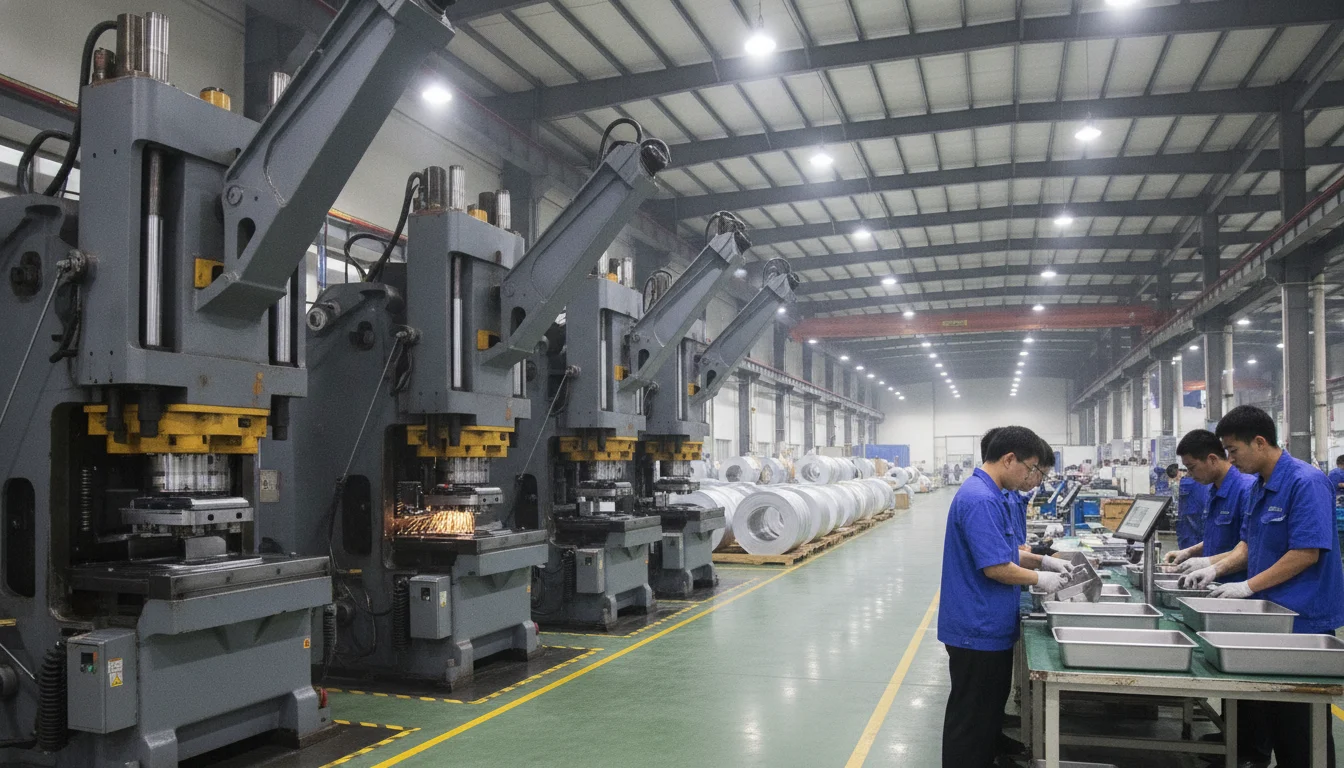
A factory that refuses to provide a live video walkthrough or recorded facility tour is one of the clearest red flags of an unreliable aluminized steel pan factory. Legitimate manufacturers with in-house stamping, coating, and assembly lines can show their equipment, raw-material storage, and quality-control stations on short notice. Trading companies and brokers cannot.
Ask for a live video call that shows the following areas in real time:
Suppliers who decline a factory walkthrough often operate as middlemen. They source pans from multiple small workshops, rebrand them, and present themselves as the manufacturer. When pressed for a video tour, they cite factory-security policies or claim the production line is too busy. A real factory welcomes transparency because it differentiates them from brokers.
Our Yongkang facility runs 7 in-house bakeware lines, including carbon steel and aluminum pan production, and we provide live walkthroughs to any buyer who requests one. The video shows our stamping presses, our raw-material warehouse with tagged coil stock, and our QC benches where every batch is inspected before packing.
One of the most damaging red flags of an unreliable aluminized steel pan factory is a mismatch between the sample pan and the bulk shipment. Importers report receiving a sample with smooth coating, consistent thickness, and good heat distribution, only to discover that the bulk order uses thinner substrate, uneven coating, or a different finish that causes sticking and warping.
Before approving a sample, measure the substrate thickness with a caliper and document the coating finish with close-up photos. Request that the supplier provide a sample retention agreement stating that the bulk order will match the approved sample in material grade, coating weight, and dimensions. Include a clause allowing third-party inspection at the factory before shipment, with the right to reject any batch that deviates from the locked sample.
When buyers source wholesale bakeware sets from our Yongkang factory, we stamp each approved sample with a batch code and keep a reference unit in our QC archive. The bulk production uses the same substrate coil lot, the same stamping die, and the same coating formula, verified by our in-line thickness gauges and adhesion tests.
Unreliable factories switch to cheaper materials after sample approval to preserve margin. They assume the buyer will not inspect the bulk shipment closely or will accept the goods to avoid delays. By the time the importer discovers the mismatch, the container is already at the destination port, and the supplier refuses to replace the defective pans.
In practice: A Lagos-based kitchenware distributor approved a 9-inch aluminized steel cake pan sample with 0.6 mm substrate, then received a 500-unit bulk order with 0.4 mm substrate that warped at 180°C, generating returns from bakery customers and a 30% revenue loss on that SKU.
A legitimate aluminized steel pan factory provides mill certificates for every coil of substrate they purchase. The mill certificate specifies the base steel grade, the aluminized coating weight in grams per square meter, the heat-treatment process, and the coil batch number. Suppliers who cannot produce this documentation are sourcing from unverified scrap dealers or using off-spec material that does not meet food-contact safety standards.
Suppliers who provide generic certificates that do not match the production batch, or who claim the mill certificate is confidential, are hiding material substitution. Another warning sign is a certificate with no mill logo, no authorized signature, or no traceable batch code. Some brokers download sample mill certificates from the internet and present them as their own, but the coil numbers and production dates do not align with the actual shipment.
We source aluminized steel coils from verified mills in Zhejiang and Jiangsu provinces, and we provide the original mill certificate with every production order. The certificate is cross-referenced with the coil batch tag in our raw-material warehouse, and buyers can verify the coil number during a factory visit or video walkthrough.
Pricing that sits far below the market average is one of the clearest red flags of an unreliable aluminized steel pan factory. Aluminized steel coil, stamping, coating, and export logistics have known cost floors. When a supplier quotes a price that undercuts these baselines, they are either using substandard materials, skipping quality-control steps, or planning to substitute cheaper components after the deposit is paid.
Request a detailed cost breakdown that itemizes raw material, processing, packaging, and export logistics. Compare the quoted substrate thickness and coating weight against the mill certificate. If the supplier cannot explain how they achieve a lower price, or if they cite vague efficiencies, the quote is likely based on hidden substitutions.
Importers who source low-MOQ bakeware for startups often encounter brokers who quote aggressively low prices to win the order, then deliver pans with thinner substrate or no non-stick coating. The importer discovers the defect only after the goods are shipped, and the broker disappears or refuses to replace the batch.
When a supplier gives vague or evasive answers about their quality-control process, it signals that they do not have a mature QC system or that they outsource production to uncontrolled workshops. Reliable aluminized steel pan factories describe specific inspection steps, measurement tools, and acceptance criteria for each production stage.
Responses like “We check everything carefully” or “Our team has many years of experience” provide no verifiable detail. Another red flag is a supplier who claims they perform SGS or FDA testing but cannot provide the test-report number, the testing lab location, or the specific standard referenced in the report.
At our Yongkang factory, every production batch undergoes three inspection stages: raw-material verification when the coil arrives, in-line thickness and coating checks during stamping, and final visual and dimensional inspection before packing. We use digital calipers calibrated to ±0.02 mm, and we record thickness measurements for every tenth pan in a batch. Buyers can request copies of our filled-out inspection checklists and photos of the QC station during a factory walkthrough.
Many suppliers on B2B platforms present themselves as factories but are actually trading companies or brokers. They aggregate products from multiple small workshops, apply their own branding, and handle export paperwork. The problem arises when quality issues emerge, because the trading company has no control over the actual production process and cannot fix defects or replace rejected batches.
Sourcing directly from the factory eliminates broker markup, reduces communication delays, and gives the buyer direct access to production planning and quality control. When defects occur, the factory can remake the batch or adjust the process. A trading company must negotiate with the workshop they sourced from, which adds time and often results in no resolution.
Buyers who source custom OEM private-label bakeware need direct factory access to control branding, packaging, and quality standards. Trading companies cannot provide this level of customization because they do not own the production equipment or the formulation process.
Use this checklist to verify any aluminized steel pan supplier before placing a deposit or production order. Each step addresses one of the red flags of an unreliable aluminized steel pan factory and provides a concrete verification method.
Schedule a video call and ask the supplier to show their stamping equipment, raw-material storage, coating line, and QC station in real time. Record the call and verify that the equipment matches the product catalog.
Request the mill certificate for the aluminized steel coil used in your order. Verify that the certificate includes the steel grade, coating weight, coil batch number, and mill logo. Cross-check the batch number against the coil tags visible in the factory walkthrough.
Measure the sample pan’s thickness, weight, and coating finish. Document these values in a sample-approval form and require the supplier to sign a statement that the bulk order will match the approved sample in all material and dimensional parameters.
Request a copy of the supplier’s business license and confirm that the registration category is “manufacturing” or “industrial,” not “trading.” Check that the registered address matches the factory location shown in the walkthrough.
Ask for SGS or FDA test reports that match the exact product SKU and production batch you are ordering. The report should reference FDA 21 CFR 175.300 for food-contact coatings and should be dated within the past two years. Verify the report number with the testing lab if possible.
Calculate the raw-material cost based on current aluminized steel coil prices and the substrate thickness specified in the sample. If the supplier’s quote sits below this cost floor, request a detailed breakdown and investigate where the savings come from.
Hire an independent inspection company to visit the factory and inspect the finished goods before they are loaded into the container. The inspector should verify substrate thickness, coating adhesion, edge finish, and packaging quality against the approved sample.
Importers shipping to Lagos Apapa, Mombasa, or West African ports benefit from pre-shipment inspection because it prevents defective goods from tying up capital and warehouse space. Our team coordinates with SGS and Bureau Veritas inspectors at our Yongkang facility and provides full access to the production floor and finished-goods warehouse.
Request a copy of the supplier’s business license and confirm that the registration category is manufacturing or industrial, not trading or import-export. Schedule a live video walkthrough and ask to see the stamping equipment, raw-material warehouse with tagged coil stock, and quality-control station. Cross-check the factory address on the business license against the location shown in the video. Verify that the manufacturer name on the commercial invoice matches the factory name on the business license.
A legitimate aluminized steel bakeware factory provides SGS test reports and FDA 21 CFR 175.300 compliance documentation for food-contact coatings. The test reports should match the exact product SKU and production batch you are ordering, not generic catalog reports from unrelated orders. Request the report number and verify it with the testing lab if possible. The factory should also provide mill certificates for the aluminized steel substrate, showing the base steel grade, coating weight in grams per square meter, and coil batch number for traceability.
Unreliable factories switch to cheaper materials after sample approval to preserve margin. They assume the buyer will not inspect the bulk shipment closely or will accept the goods to avoid delays. Common substitutions include thinner substrate gauge, lower aluminized coating weight, generic non-stick spray instead of food-grade silicone, and cut edges instead of rolled rims. To prevent this, measure the sample pan’s thickness with a caliper and document the coating finish with close-up photos. Require the supplier to sign a sample retention agreement stating that the bulk order will match the approved sample in material grade, coating weight, and dimensions, and arrange third-party inspection at the factory before shipment.
Need help verifying an aluminized steel pan supplier or sourcing factory-direct bakeware for your distribution network?
Request a Factory Walkthrough →
Written by the Shansen Bakeware Export Team.
MOQ 1 set on stock configurations. Tell us what you need and we reply on WhatsApp.
Click the button below to open WhatsApp. If you're not logged in to WhatsApp Web yet, scan the QR code first — then come back here and copy the message into the chat.