
To verify a bakeware factory’s ISO9001 certificate is authentic, search the certificate number and legal company name in the IAF CertSearch database (iaf.nu) or the issuing certification body’s public register, confirm the certification body holds valid accreditation from an IAF-recognized national body, and cross-check that the certificate scope explicitly covers bakeware manufacturing-not just trading or warehousing-at the exact factory address listed on your pro forma invoice.
📋 Table of Contents
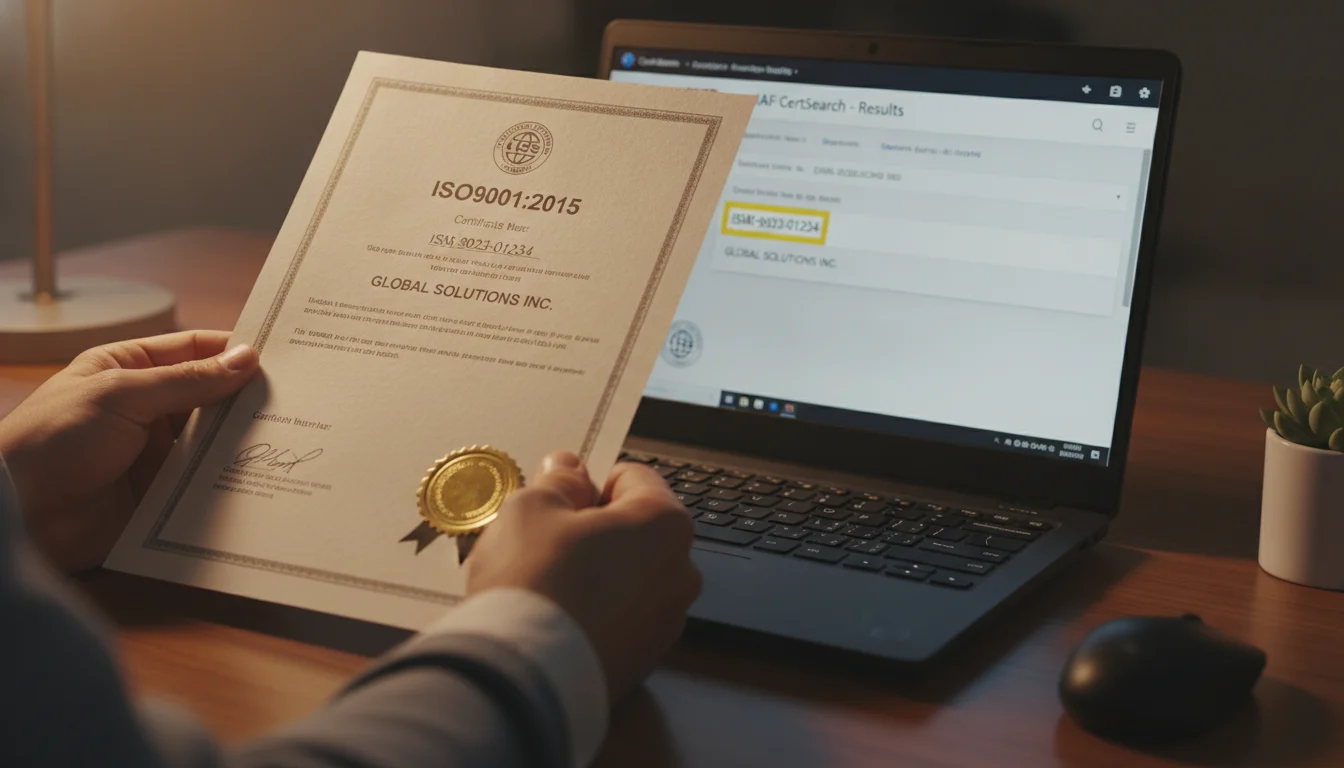
Importers across Nigeria, Kenya, South Africa, and Francophone and Lusophone African markets report discovering that a supplier’s ISO9001 certificate was forged, expired, or issued to a different legal entity only after goods shipped with quality defects. An authentic ISO9001 certificate confirms that an independent third party audited the factory’s quality-management system against the ISO9001 standard, but the certificate itself proves nothing unless you verify its authenticity, scope, and current status before you commit working capital to an order.
Buyers who skip verification face three common risks. First, a forged or altered certificate means no independent audit occurred, so the factory’s quality controls may not exist. Second, a certificate issued to a trading company rather than the manufacturing facility gives you no assurance about the actual production site. Third, an expired or suspended certificate indicates the factory failed a surveillance audit or let accreditation lapse, signaling process breakdowns that directly affect your order quality.
ISO9001 is a quality-management-system standard, not a product standard. The certificate confirms that the factory documents, monitors, and continuously improves its internal processes-design control, supplier management, production planning, inspection, corrective action, and management review. It does not certify that a specific baking pan meets food-contact safety limits or that a silicone mold is PFAS-free; those require separate product-level test reports such as SGS or FDA 21 CFR compliance.
The International Accreditation Forum maintains IAF CertSearch, a public database aggregating certificates issued by accredited certification bodies worldwide. To verify a bakeware factory’s ISO9001 certificate, navigate to iaf.nu and enter either the certificate number or the factory’s legal company name exactly as printed on the certificate. The database will return the certificate holder, certification body, issue date, expiry date, accreditation mark, and scope of certification.
A valid result shows the certificate number, the legal entity name, the certification body that issued it, the accreditation body that oversees that certification body, the issue and expiry dates, and the scope. If the search returns no result, the certificate may be forged, the certification body is not accredited under an IAF-recognized arrangement, or the certificate was withdrawn or suspended. Cross-check the legal company name character by character; a single-character difference can indicate a shell company using a name similar to a legitimate manufacturer.
If the certificate does not appear in IAF CertSearch, search the certification body’s own public register using the issuer name printed on the certificate. Obtain the certification body’s website address independently through a search engine rather than clicking a link provided by the supplier, then locate the certificate registry or verification portal. If the certificate still does not appear, request written confirmation from the certification body using contact details you sourced independently, not those supplied by the factory.
ISO itself does not issue or verify ISO9001 certificates; only independent certification bodies accredited by national accreditation bodies recognized through IAF multilateral arrangements can issue valid certificates. A certificate issued by an unaccredited body or a body whose accreditation was withdrawn carries no third-party assurance and should be treated as worthless for supplier-qualification purposes.
Every valid ISO9001 certificate displays the logo of the certification body and the accreditation mark of the national accreditation body that oversees it. Common accreditation marks include CNAS (China National Accreditation Service), UKAS (United Kingdom Accreditation Service), ANAB (ANSI National Accreditation Board, United States), and DAkkS (Deutsche Akkreditierungsstelle, Germany). Search the accreditation body’s public directory to confirm that the certification body listed on the certificate holds current accreditation for ISO9001 quality-management-system audits.
The accreditation body itself must be a signatory to the IAF Multilateral Recognition Arrangement (MLA) for its accreditation to carry international recognition. Visit the IAF website and download the current list of MLA signatories, then confirm that the accreditation body shown on the certificate appears on that list. If the accreditation body is not an IAF MLA signatory, the certificate is not internationally recognized, and you have no assurance that the audit met ISO19011 auditing standards.
The certificate scope defines which products, processes, and facilities the ISO9001 audit covered. A certificate with a scope limited to “trading and distribution of kitchenware” or “warehousing of metal products” tells you nothing about the factory’s bakeware manufacturing quality controls, because the audit did not assess production processes. To protect your order, confirm that the scope explicitly lists bakeware, cookware, or metal kitchenware manufacturing at the facility address where your goods will be produced.
Many exporters hold ISO9001 certificates for their sales office or trading company, not their production facility. The scope will state “design, procurement, and sales of bakeware” or “import and export of kitchenware,” which means the audit covered order management and supplier coordination but not casting, stamping, coating, or assembly. Request a copy of the certificate and read the scope section word by word; if it does not mention manufacturing, fabrication, or production, the certificate does not cover the factory floor.
A certificate scope that lists “manufacture of aluminum cookware” may not cover silicone bakeware or carbon-steel baking pans if those product lines were added after the audit. Similarly, a scope covering “metal fabrication” is too generic to confirm bakeware-specific quality controls such as food-contact coating inspection or non-stick-layer thickness measurement. The scope should name the product categories you are ordering, and the certificate issue date should postdate the factory’s entry into those categories.
ISO9001 certificates are typically valid for three years, but certification bodies conduct annual or semi-annual surveillance audits to confirm ongoing compliance. A certificate may show a future expiry date yet be suspended or withdrawn if the factory failed a surveillance audit, refused to close a non-conformance, or stopped paying certification fees. Checking only the printed expiry date is insufficient; you must verify the certificate’s current status in the certification body’s live database.
Most accredited certification bodies publish suspension and withdrawal notices on their website or in their certificate registry. Search the certification body’s public database using the certificate number, then check for status flags such as “suspended,” “withdrawn,” “expired,” or “transferred.” A suspended certificate means the factory has a defined period to correct non-conformances before the certificate is withdrawn; a withdrawn certificate means accreditation was revoked and the factory no longer holds valid ISO9001 certification.
Request a copy of the most recent surveillance audit report or ask the certification body to confirm the last audit date. If the last audit occurred more than 12 months ago and the next surveillance audit is overdue, the certificate may be at risk of suspension. Factories that delay surveillance audits often do so because they know they will fail, signaling process breakdowns that will affect your order quality and lead time.
The legal company name and facility address on the ISO9001 certificate must exactly match the manufacturer name and production-site address on your pro forma invoice, purchase order, and bill of lading. A mismatch indicates that the certificate holder is a different legal entity from the exporter, meaning the certified quality-management system does not govern the facility producing your goods.
Obtain the factory’s business registration certificate or company license from the local commerce bureau, then compare the registered legal name character by character with the name on the ISO9001 certificate. In China, for example, the legal entity name will end in 有限公司 (Co., Ltd.) or 厂 (factory); a mismatch in the suffix or a missing character indicates the certificate belongs to a sister company, holding company, or unrelated entity. At Shansen Bakeware, the ISO9001 certificate would list Yongkang Ningbo Kitchenware Factory (永康市宁博厨具厂), the legal manufacturing entity, not a separate trading company.
The facility address printed on the certificate scope must match the production site where your bakeware will be manufactured. Request a factory video showing the facility entrance sign, business license displayed inside, and production lines, then compare the address on the entrance sign with the address on the certificate. If the certificate lists a head-office address in one city but your goods will be produced at a branch factory in another province, the certificate does not cover your production site, and you have no ISO9001 assurance for your order.
After completing the database searches and document cross-checks above, contact the certification body directly using contact details you obtained independently to request written confirmation that the certificate is valid, current, and issued to the legal entity and facility address on your purchase order. This final step closes the verification loop and creates an audit trail proving you exercised due diligence before placing the order.
Do not use the phone number, email address, or website link printed on the certificate or provided by the supplier; a sophisticated counterfeit certificate will include fake contact details that route to an accomplice who confirms the certificate’s authenticity. Instead, search for the certification body’s name in a search engine, navigate to the official website, and use the contact information published on the “Contact Us” or “Certificate Verification” page. Send your confirmation request to that independently sourced email address, and request a reply from an official company domain, not a free email service.
Your email to the certification body should include the certificate number, the legal company name exactly as printed on the certificate, the facility address, the scope of certification, and the issue and expiry dates. Ask the certification body to confirm that the certificate is currently valid, that no suspension or withdrawal is in effect, that the last surveillance audit was completed on schedule, and that the certificate scope covers bakeware manufacturing at the facility address listed. Request a written reply on official letterhead or a digitally signed email, and retain that reply in your supplier-qualification file.
ISO does not issue, verify, or maintain a registry of ISO9001 certificates. ISO is the standards-development organization that publishes the ISO9001 standard, but only independent certification bodies accredited by national accreditation bodies can audit factories and issue certificates. To verify a certificate, search the IAF CertSearch database or contact the certification body listed on the certificate using independently sourced contact details, not ISO.
An accredited ISO9001 certificate is issued by a certification body that holds accreditation from a national accreditation body recognized through the IAF Multilateral Recognition Arrangement, meaning the certification body’s audit process was independently assessed for competence and impartiality. A non-accredited certificate is issued by a body that has not undergone that independent assessment, so you have no third-party assurance that the audit met ISO19011 auditing standards or that the factory’s quality-management system complies with ISO9001 requirements.
The verification process is identical regardless of your location or the factory’s country. Search the certificate number and legal company name in IAF CertSearch at iaf.nu, confirm that the certification body holds accreditation from CNAS or another IAF-recognized body, validate that the scope covers bakeware manufacturing at the production-site address, check the certification body’s public database for suspension or withdrawal, and request written confirmation from the certification body using contact details you sourced independently. African importers can also escalate verification through local conformity-assessment bodies or chambers of commerce if the certification body does not respond.
Ready to source wholesale bakeware sets from a factory with verifiable SGS and FDA test reports on file?
Request test reports and production specs →
Written by the Shansen Bakeware Export Team.
In practice: Requesting a 1-piece sample from the metal line and a 1-set sample from the silicone line before a 500-piece OEM production run lets a distributor verify coating quality and dimensional accuracy against the pro forma invoice spec without committing working capital to a full container.
MOQ 1 set on stock configurations. Tell us what you need and we reply on WhatsApp.
Click the button below to open WhatsApp. If you're not logged in to WhatsApp Web yet, scan the QR code first — then come back here and copy the message into the chat.