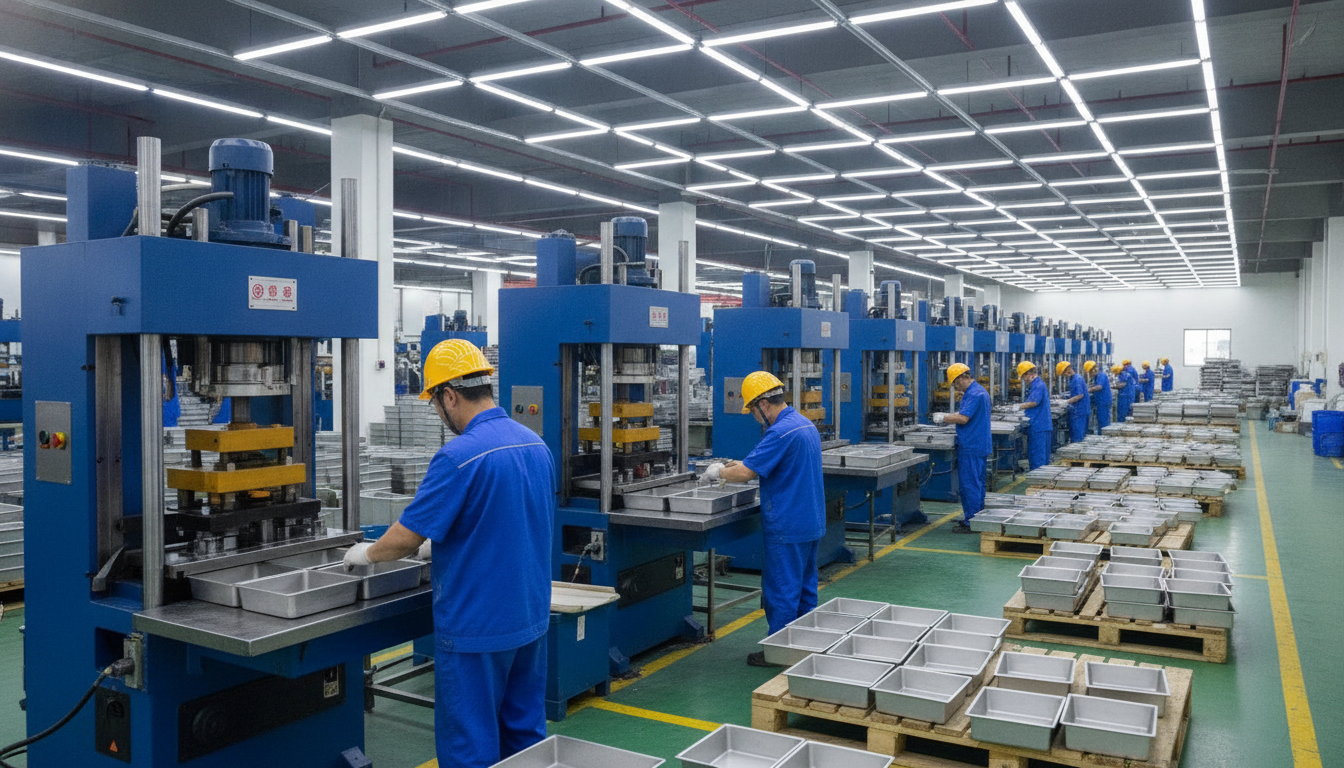
A reliable custom dimension rectangular baking pan manufacturer should offer low-MOQ tooling, transparent lead times, and food-grade certifications before you commit to bulk orders. Shansen Bakeware runs 7 in-house bakeware lines at 500,000 units/month capacity in Yongkang, Zhejiang, with MOQ from 1 piece per SKU and 7-10 day sampling for custom sizes in carbon steel, aluminum, and stainless steel.
📋 Table of Contents
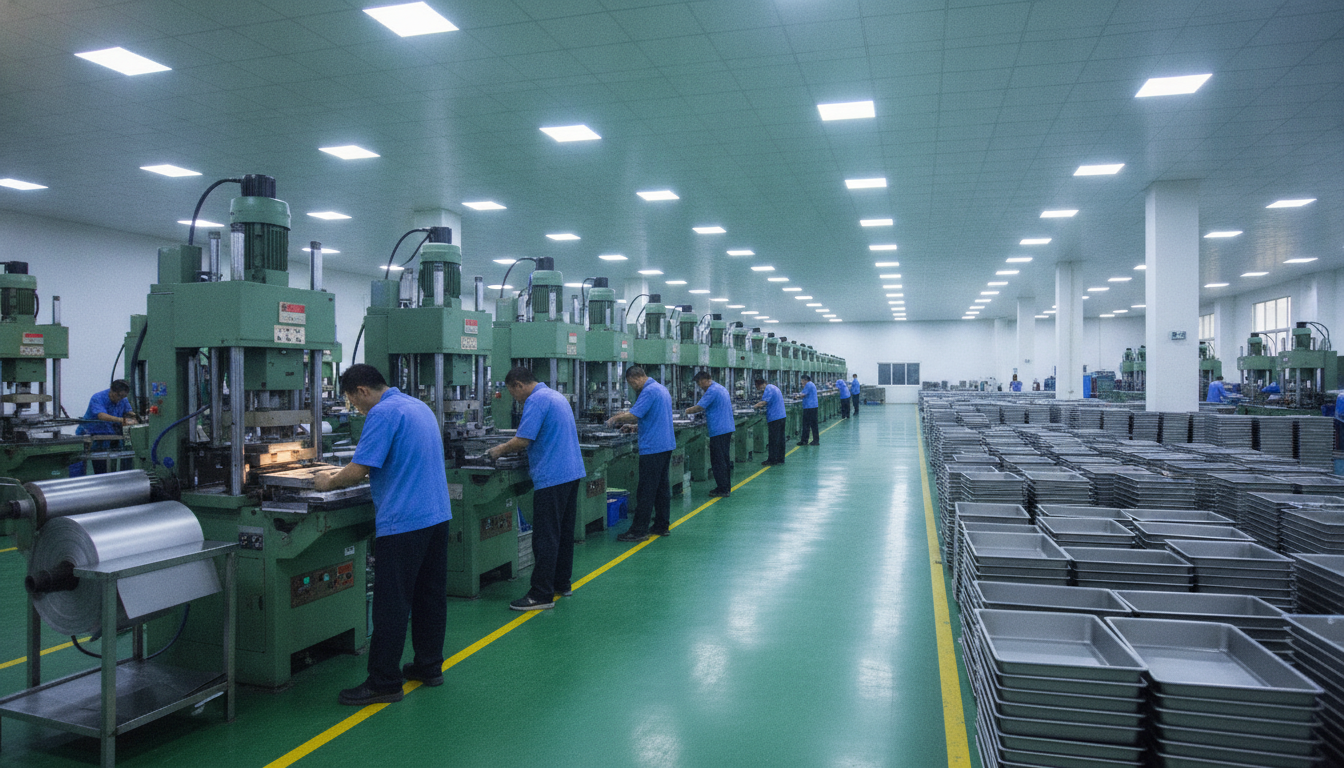
Standard rectangular baking pans come in a handful of sizes, but commercial bakeries, hotel kitchens, and institutional caterers often need pans that fit specific oven racks, proving cabinets, or display trays. A custom dimension rectangular baking pan manufacturer can produce pans to exact length, width, and depth specifications, ensuring tight fit and maximizing oven space utilization.
Many commercial deck ovens and convection ovens have non-standard rack dimensions. A pan that is 5 cm too wide wastes space and reduces batch size. Custom pans eliminate that gap. For example, a Lagos hotel bakery may need a 38 cm × 28 cm × 5 cm pan to fit a European-made deck oven, while a Nairobi catering supplier may require 42 cm × 32 cm × 6 cm for local rack systems.
Bread bakeries use proving cabinets with fixed shelf spacing. A custom-height pan ensures dough rises without touching the shelf above. Similarly, bakery display cases have precise tray slots; a custom pan slides in without wobbling or leaving gaps.
A single custom dimension can serve multiple applications. A 40 cm × 30 cm × 4 cm carbon steel pan works for sheet cakes, lasagna, and roasted vegetables, reducing the number of SKUs a distributor must stock. This is particularly valuable for African importers managing container space and working capital.
The material determines heat conductivity, durability, and food-contact safety. A custom dimension rectangular baking pan manufacturer should offer at least three substrate options and explain the trade-offs clearly.
Carbon steel pans heat quickly and evenly, making them ideal for bread and cakes. A 0.6 mm gauge offers good rigidity without excessive weight. Nonstick coatings (PTFE or ceramic) are common. Buyers often see generic “customizable sizes” claims without the engineering details needed to verify fit, gauge, coating durability, or packaging for export.
Aluminum is 30% lighter than carbon steel at the same gauge, reducing shipping costs. It is the material of choice for high-volume bakeries that bake hundreds of loaves daily. However, uncoated aluminum can react with acidic batters; a food-grade anodized or nonstick finish is essential.
Stainless steel pans withstand heavy use and frequent washing without warping. They are slower to heat, which suits savory applications like lasagna or roasted vegetables. For institutional buyers in Africa, stainless steel offers the longest service life, offsetting the higher upfront cost.
Many buyers get a “custom size available” promise but no clear minimum order quantity, tooling cost, or lead time until they inquire directly, which slows procurement decisions. A transparent custom dimension rectangular baking pan manufacturer publishes MOQ tiers and explains when tooling charges apply.
Shansen Bakeware accepts 1 piece per SKU for custom-dimension samples. This allows a Nairobi kitchenware importer to validate fit in their client’s oven before committing to 500 units. The sample includes the exact gauge, coating, and finish specified for production.
After sample approval, the first production run typically requires 30-100 pieces per SKU, depending on material and coating complexity. A simple uncoated aluminum pan may have a 30-piece MOQ, while a multi-layer nonstick carbon steel pan may require 100 pieces to justify coating-line setup.
Standard rectangular shapes (length-to-width ratio between 1.2:1 and 1.5:1) usually need no new tooling. The manufacturer should quote this upfront, not after sample approval.
Sample MOQ: 1 piece. Bulk MOQ: 30-100 pieces per SKU.
A clear sampling workflow reduces back-and-forth and speeds up validation. The manufacturer should outline each step and its duration.
The buyer provides exact dimensions (length, width, depth), material, gauge, coating type, and any handle or rim requirements. The manufacturer reviews the spec for manufacturability and flags any issues, such as a depth-to-width ratio that risks warping during baking.
Once the spec is confirmed, the factory produces the sample. For Shansen, this takes 7-10 days, including material cutting, forming, coating application, and SGS food-grade testing alignment. The sample ships via DHL or FedEx with tracking.
The buyer tests the sample in their target oven or bakery environment. Common tests include heat distribution (bake a batch of bread and check for hot spots), coating release (bake without greasing and verify clean release), and dimensional fit (slide the pan into the oven rack or proving cabinet). Feedback is incorporated into the production spec.
In practice: A Johannesburg bakeware distributor requested a 39 cm × 29 cm × 5.5 cm carbon steel pan for a hotel client’s European deck oven. Shansen produced a 1-piece sample in 8 days, the client validated fit and heat performance, and the distributor placed a 60-unit first order without tying up cash in untested inventory.
African importers need documentation that satisfies local health authorities and reassures end customers. A custom dimension rectangular baking pan manufacturer should provide SGS or equivalent third-party test reports for every material and coating.
SGS tests for heavy metals (lead, cadmium), migration of coating components into food simulants, and compliance with FDA 21 CFR 177.2600 (for silicone and rubber) or FDA 21 CFR 175.300 (for nonstick coatings). Shansen provides SGS reports for carbon steel, aluminum, and stainless steel substrates, as well as PTFE and ceramic nonstick finishes.
Many African markets are adopting stricter food-safety standards. A PFAS-free declaration confirms that the nonstick coating does not contain per- and polyfluoroalkyl substances, which are restricted in the EU and increasingly in African markets. A lead-free declaration (typically <90 ppm) is essential for Nigeria, Kenya, and South Africa.
MSDS documents detail the chemical composition of coatings and substrates. Customs authorities in Lagos, Mombasa, and Luanda may request these during clearance. The manufacturer should provide MSDS in English, French, or Portuguese as needed.
Shansen ships from Ningbo port with SGS-tested, FDA-aligned food-grade bakeware, ensuring compliance across African markets.
Custom dimensions affect packing efficiency. A manufacturer experienced in African exports optimizes carton size and stacking to maximize container utilization and minimize per-unit freight cost.
Rectangular pans nest well, but custom dimensions may not fit standard carton sizes. The manufacturer should design a carton that holds 12-24 pans, with dividers to prevent scratching during transit. Carton dimensions are then optimized for 20-foot or 40-foot container loading.
Lagos Apapa, Mombasa, and Luanda each have specific documentation requirements. The manufacturer should provide a commercial invoice with HS code 7323.93.00 (table, kitchen, or other household articles of iron or steel), a packing list with net and gross weights, and a certificate of origin if the buyer qualifies for preferential tariffs under COMESA or ECOWAS agreements.
After production, pans are inspected, packed, and trucked to Ningbo port. Shansen’s factory in Yongkang is 180 km from Ningbo; transit takes 1 day. Container stuffing and customs clearance add 2-3 days. Total lead time from production completion to vessel departure is 3-4 days.
Distributors can explore wholesale bakeware sets that combine custom pans with complementary tools, optimizing container space and product mix.
Shansen Bakeware accepts 1 piece per SKU for custom-dimension samples, allowing buyers to validate oven fit and heat performance before committing to bulk orders. The first production run typically requires 30-100 pieces per SKU, depending on material and coating complexity.
Custom-dimension sampling takes 7-10 days at Shansen’s Yongkang factory, including material cutting, forming, nonstick coating application, and SGS food-grade testing alignment. The sample ships via DHL or FedEx with tracking. Buyers test the sample in their target oven or bakery environment, then provide feedback that is incorporated into the production specification before the bulk order begins.
Aluminum rectangular pans are the top choice for high-volume bakeries because they are 30% lighter than carbon steel at the same gauge, reducing shipping costs and operator fatigue. Aluminum heats rapidly and evenly, ideal for bread, sheet cakes, and cookies. A food-grade anodized or nonstick finish is essential to prevent reaction with acidic batters. Carbon steel offers slightly better heat retention for artisan bread, while stainless steel provides superior durability for institutional and savory applications.
Ready to validate custom dimensions with a 1-piece sample and transparent MOQ terms?
Request your custom pan sample →
Written by the Shansen Bakeware Export Team.
MOQ 1 set on stock configurations. Tell us what you need and we reply on WhatsApp.
Click the button below to open WhatsApp. If you're not logged in to WhatsApp Web yet, scan the QR code first — then come back here and copy the message into the chat.