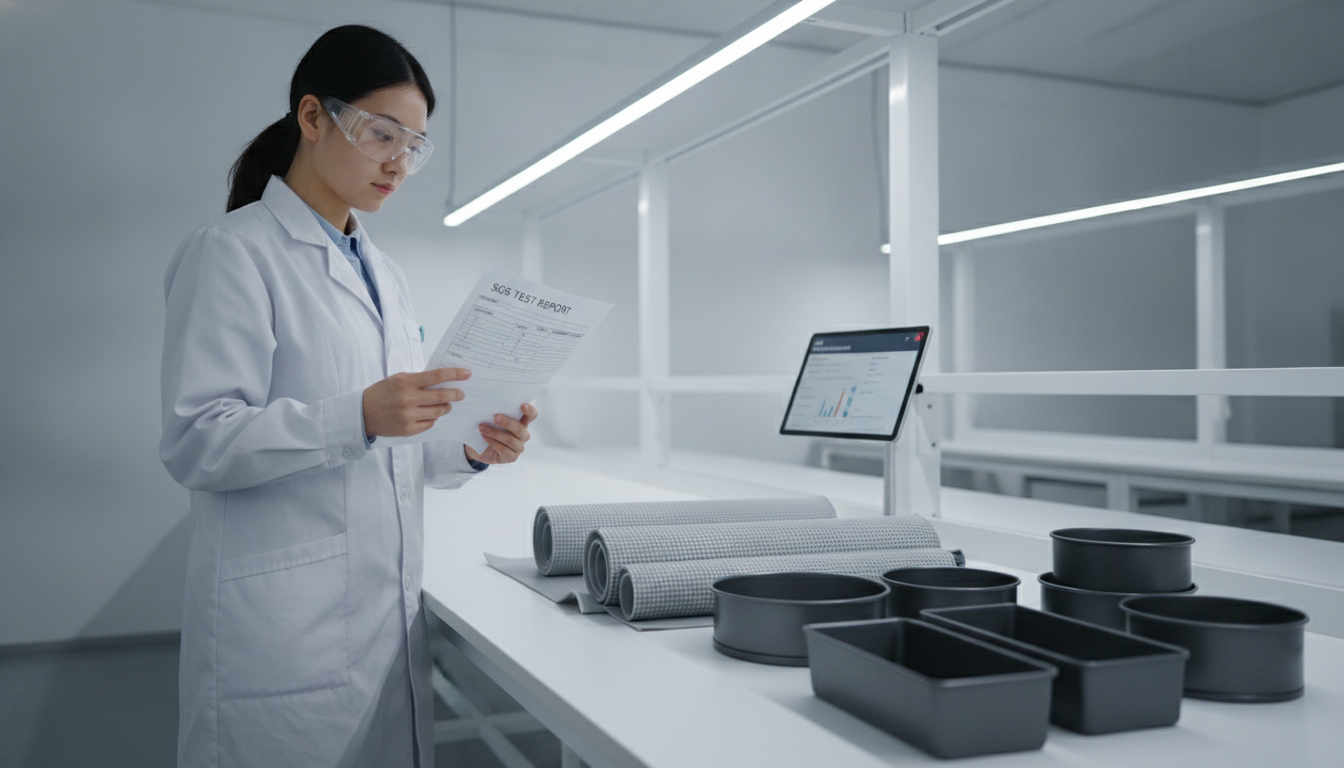
To verify bakeware factory food-grade certification before ordering, request the original test report with a traceable report number, confirm the issuing lab is accredited and listed in its own public database, and check that the certificate scope covers the exact product material, factory name, and site address you plan to order from.
📋 Table of Contents

Many suppliers display FDA or SGS logos on product pages, but a logo proves nothing about the specific batch you plan to order. Professional buyers ask for the original test report in PDF format, issued by the testing laboratory, with a unique report number and the lab’s contact details printed on every page.
Buyers often say supplier claims like “food grade” or “FDA approved” are meaningless without a traceable test report number or a verifiable lab record, making it hard to know whether the batch is actually compliant. If the supplier hesitates to share the full report or offers only a logo image, that is a red flag.
A certificate image can be edited in minutes. A report number, by contrast, can be cross-checked in the lab’s online portal or by email. Importers shipping wholesale bakeware sets into Lagos Apapa or Mombasa face customs scrutiny; a logo will not satisfy port authorities, but a traceable test report will.
How to verify bakeware factory food-grade certification before ordering depends on confirming the testing lab itself is legitimate and accredited. Not every laboratory that prints an official-looking letterhead holds recognized accreditation, and some fraudulent suppliers invent lab names or recycle expired certificates.
Enter the report number exactly as printed on the certificate. The portal will return the product description, test date, factory name, and validity status. If the portal shows “not found” or the details do not match your supplier’s claim, stop the transaction and request clarification.
When a supplier provides a certificate from a smaller or regional lab without an online portal, email the lab’s official address (found on their corporate website, not the supplier’s forwarded email) with the report number and factory name. Ask for confirmation that the certificate is current and covers the product you intend to order.
A common pain point is that the certificate may be real but still useless if it covers the wrong product name, wrong factory site, or only a different material family. Verifying how to verify bakeware factory food-grade certification before ordering means reading the scope section of the test report line by line.
The certificate must list the legal entity name and physical factory address. If the supplier operates from Yiwu International Trade Market but the certificate shows a factory in Guangdong, ask whether the Yiwu entity is a trading office and whether the Guangdong site actually manufactures your order. Shansen Bakeware, for example, runs 7 in-house bakeware lines at a factory in Yongkang, Zhejiang, with a sourcing showroom at Yiwu International Trade Market; buyers ordering from Yiwu can verify that the certificate lists the Yongkang production site.
Different markets require different test standards. FDA 21 CFR 177.2600 applies to silicone articles intended for repeated use in contact with food in the United States. EN 1186 and Regulation (EC) 1935/2004 govern migration limits in the European Union. GB 4806 series standards apply to China domestic sales. If you plan to import into Nigeria or Kenya, confirm the certificate uses a standard recognized by your destination country’s regulatory authority.
Shansen capacity: 500,000 units per month across silicone, carbon steel, stainless steel, aluminum, cake-decorating tools, strainers & sifters, and multi-piece sets. MOQ: from 1 set / 1 piece per SKU. Shipping: Ningbo port to Lagos Apapa, Mombasa, and Francophone/Lusophone African ports.
Food-contact test reports do not remain valid indefinitely. Most laboratories and regulatory bodies expect retesting every 12 to 24 months, especially when the supplier changes raw-material batches, coating formulations, or production equipment.
Some certificates print an explicit expiry date; others state “valid for 12 months from issue.” Calculate the expiry date yourself and confirm the certificate remains current at the time you place your purchase order. If the certificate expires before your shipment arrives, request a renewed test report before finalizing payment terms.
Buyers importing low-MOQ bakeware for startups into African markets should request fresh testing if the supplier cannot provide a certificate less than 18 months old, if the product design has changed, or if the factory has relocated. The cost of a new SGS or Intertek test report ranges from $300 to $800 per material family, a small expense compared to a rejected container at port.
In practice: A Kenyan kitchenware importer requested fresh SGS testing for a 30-piece-per-SKU first order of silicone baking mats after the supplier’s certificate showed a two-year-old test date and a different factory address, preventing a customs hold at Mombasa port.
Buyers complain that uploaded PDFs can look official while hiding expired dates, missing scope details, or no way to confirm the issuing body’s status online. Recognizing fraud patterns helps you avoid suppliers who recycle certificates or fabricate test results.
Some fraudulent suppliers take a valid certificate number from one product line and paste it onto documents for unrelated items. Cross-check the report number in the lab’s portal; if the returned product description does not match what you plan to order, the certificate is invalid for your transaction.
Legitimate test reports print the lab’s official phone number, email address, and website footer on every page. If the certificate shows no contact details, or if the listed phone number goes to a personal mobile line instead of a corporate switchboard, treat the document as suspect.
Check that the lab’s accreditation logo on the certificate matches the current design published on the accreditation body’s website. Accreditation marks change periodically, and an outdated logo may indicate the lab’s accreditation lapsed or the certificate is a forgery.
Phrases like “general kitchenware” or “food-safe materials” without naming the specific product type, material composition, or test standard provide no compliance assurance. A valid certificate describes the tested item in detail: “silicone baking mat, 40 cm × 30 cm, tested per FDA 21 CFR 177.2600 for migration of volatile compounds.”
Professional buyers ordering food-grade SGS FDA certified bakeware for distribution across Nigeria, Kenya, or South Africa treat certificate verification as a non-negotiable step before signing a purchase order. The time invested in checking report numbers and lab portals prevents costly customs rejections and protects brand reputation.
Request the original test report PDF with a unique report number, then verify that number in the testing lab’s online portal or by emailing the lab directly. Cross-check that the product description, factory name, and site address on the certificate match your supplier’s details. If the lab confirms the report is current and covers the exact material you plan to order, the certificate is real.
A reputable supplier provides the full food-contact test report (SGS, Intertek, or equivalent), business registration certificate showing the legal entity name and address, and a recent factory audit report if available. For custom OEM private-label bakeware, request proof that the certificate covers the specific material family and product type you intend to order, not just a generic company claim.
FDA 21 CFR 177.2600 compliance is widely accepted for silicone bakeware exports to the United States, but other markets require additional standards. The European Union mandates EN 1186 migration testing and Regulation (EC) 1935/2004 compliance. China domestic sales require GB 4806 series standards. Confirm your destination country’s regulatory requirements and request test reports covering the applicable standards before placing your order.
Ready to verify your supplier’s food-grade credentials before placing your first bakeware order?
Request Test Reports and Factory Documentation →
Written by the Shansen Bakeware Export Team.
MOQ 1 set on stock configurations. Tell us what you need and we reply on WhatsApp.
Click the button below to open WhatsApp. If you're not logged in to WhatsApp Web yet, scan the QR code first — then come back here and copy the message into the chat.