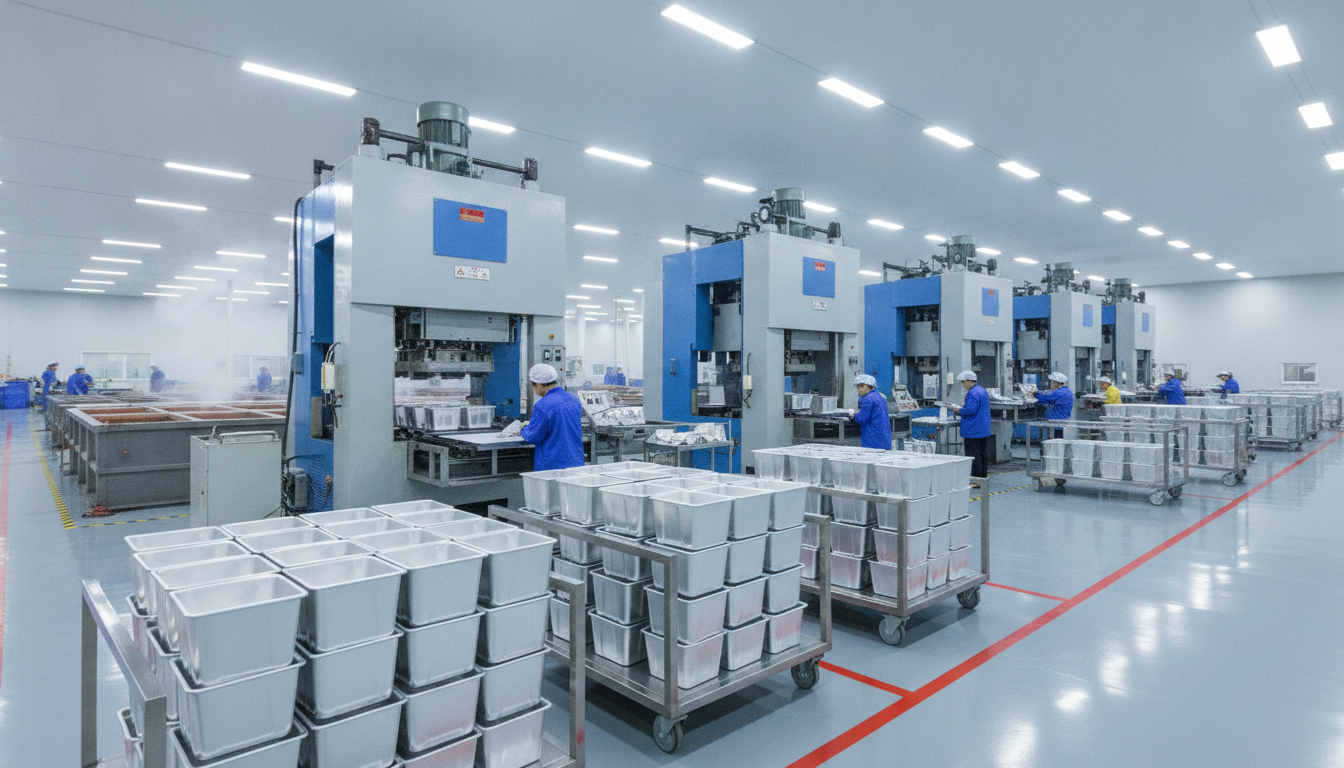
A food grade aluminized steel sheet pan factory china should provide SGS or FDA food-contact test reports, offer 1-piece sample MOQ to validate quality before bulk orders, and ship from a verified manufacturing base like Yongkang or Guangdong. Aluminized steel combines a carbon-steel core with an aluminum-silicon coating for even heat distribution and rust resistance, but only factories that test migration limits under FDA 21 CFR 175.300 or equivalent standards can legally claim food-grade status for export markets.
📋 Table of Contents
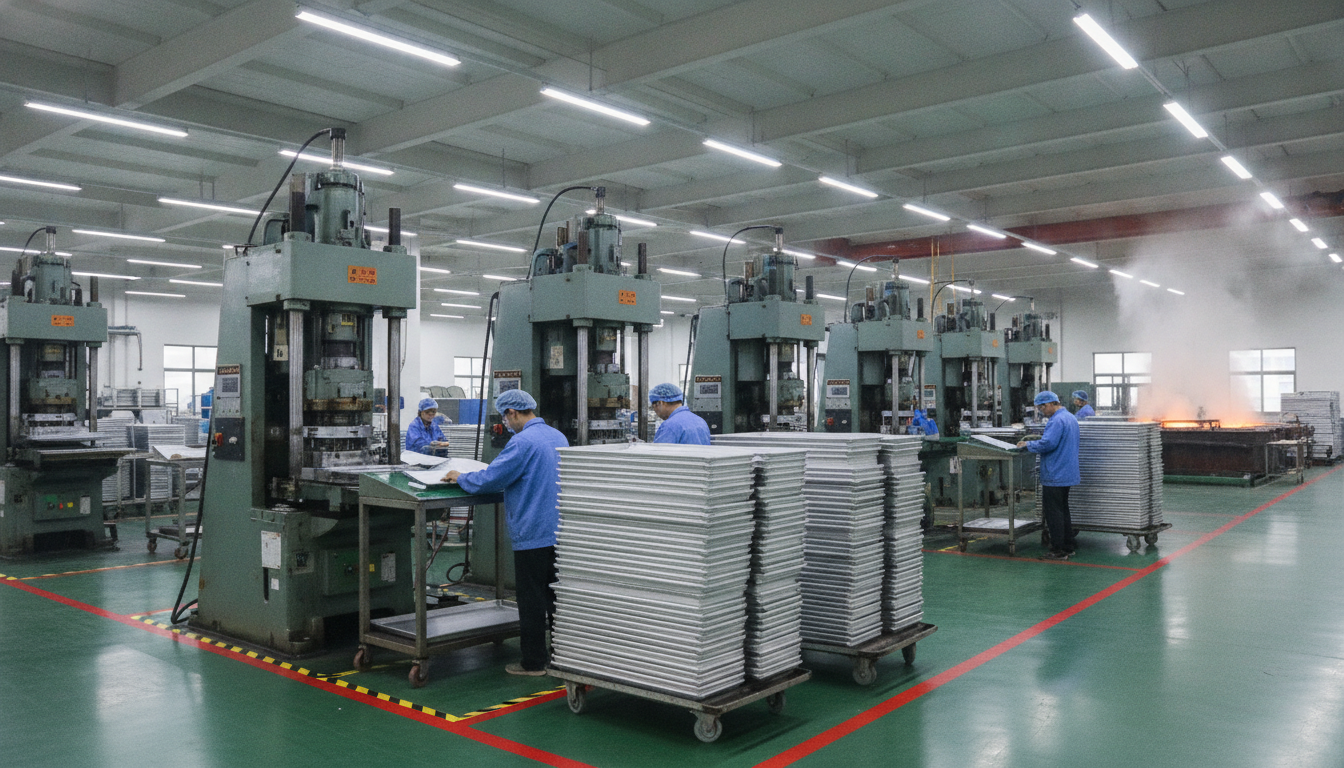
Aluminized steel is a carbon-steel substrate hot-dip coated with an aluminum-silicon alloy, creating a surface that resists oxidation while retaining the structural strength and thermal mass of steel. For commercial sheet pans, this combination delivers faster heat-up times than pure stainless steel and better rust resistance than uncoated carbon steel, particularly in high-humidity bakery environments common across coastal African cities.
The carbon-steel core provides rigidity and warp resistance under repeated thermal cycling. A typical 18-inch by 26-inch half-sheet pan uses 0.8 to 1.2 millimeter gauge steel, thick enough to prevent oil-canning when loaded with 4 kilograms of dough yet light enough for single-hand handling by bakery staff. The aluminum-silicon coating, applied at approximately 10 to 40 microns thickness, bonds metallurgically to the steel during the hot-dip process, so it will not flake or peel under normal baking temperatures up to 260 degrees Celsius.
Aluminum conducts heat roughly four times faster than stainless steel, so aluminized pans reach target oven temperature in 6 to 8 minutes compared to 12 to 15 minutes for equivalent stainless pans. This faster response reduces preheating energy costs and shortens batch cycle times in commercial operations. The steel core adds thermal mass that evens out hot spots, particularly important when baking on wire racks in convection ovens where air velocity varies across the oven cavity.
Buyers often ask whether aluminized pans will rust. The aluminum coating itself does not rust, but any scratches or edge cuts that expose the underlying carbon steel can develop surface oxidation if left wet. In our 10 years supporting bakery distributors across Lagos and Nairobi, we see rust complaints primarily from operations that soak pans overnight or stack them wet. Factories that apply a food-grade silicone or PTFE topcoat over the aluminized base add a second barrier, though this raises unit cost by 8 to 12 percent.
A factory claiming food-grade status must demonstrate that the finished pan releases no harmful substances when in contact with food under normal baking conditions. This requires migration testing, not just a material safety data sheet for the raw coating alloy.
Ask the factory for an SGS or equivalent third-party test report covering lead migration, cadmium migration, and total extractables in food simulants. FDA 21 CFR 175.300 specifies test conditions: the pan is filled with a food simulant (distilled water, 3 percent acetic acid, or 50 percent ethanol depending on intended use), held at baking temperature for a defined contact time, then the simulant is analyzed for migrated metals and organics. A compliant report will show lead below 0.1 parts per million and cadmium below 0.05 parts per million in the simulant.
The test report should include photographs of the actual pan tested, the factory name, and the production batch or date code. Generic reports listing only “aluminized steel bakeware” without batch traceability are a red flag; the factory may be recycling a competitor’s report or testing a different product line. Request that the factory send you a sample from the same production batch that was tested, and cross-check the pan’s physical markings against the report photos.
SGS is a testing laboratory, not a certification body. An “SGS-tested” claim means the factory paid SGS to run specific tests and received a report; it does not mean SGS continuously audits the factory or certifies every production run. Similarly, FDA does not “certify” factories or products. FDA 21 CFR 175.300 is a regulation that sets allowable limits; compliance is the manufacturer’s responsibility, proven through test data. Factories that claim “FDA certified” or “SGS certified” are using imprecise language, which may signal inexperience with export compliance or deliberate misrepresentation.
If the factory applies a non-stick coating over the aluminized base, ask whether the coating is PFAS-free. PFAS (per- and polyfluoroalkyl substances) are restricted in the European Union under REACH and increasingly scrutinized in African markets. A PFAS-free silicone or ceramic-based non-stick coating costs 10 to 15 percent more than traditional PTFE but eliminates regulatory risk. Similarly, verify that any colored enamel or powder-coat finish is lead-free and cadmium-free, particularly if the pans will be marketed for home baking where children may handle them.
Shansen sources SGS-tested, FDA-aligned bakeware from our Yongkang factory, where every production batch undergoes migration testing before shipment, and we provide copies of the test reports with each container to simplify customs clearance in Lagos, Mombasa, and Luanda.
Choosing the right base material depends on your target market’s price sensitivity, expected product lifespan, and operational dishwashing practices. The table below compares the three most common sheet-pan materials on attributes African distributors prioritize.
Distributors serving coastal cities (Lagos, Mombasa, Durban, Luanda) report that uncoated carbon-steel pans develop surface rust within 3 to 6 months even with diligent drying, because ambient humidity in warehouse and retail storage hovers above 70 percent year-round. Aluminized pans in the same environment show minimal oxidation over 12 to 18 months, reducing customer returns and warranty claims. The 15 to 25 percent factory-gate premium is recovered through lower reverse-logistics costs and stronger retailer confidence.
Stainless steel makes sense for buyers targeting hotel kitchens, hospital food-service operations, or premium home-baking retail, where pans go through commercial dishwashers daily and buyers expect 5-plus-year product life. Stainless pans tolerate caustic detergents and high-temperature rinse cycles that would degrade aluminized coatings over time. However, the slower heat-up increases energy costs in high-throughput bakeries, and the higher unit cost (often 40 to 60 percent above carbon steel at factory gate) limits adoption in price-sensitive wholesale channels.
Many aluminized sheet pans ship with a secondary non-stick coating applied over the aluminum layer. Common options include:
Buyers concerned about non-stick longevity should know that coatings degrade sooner than advertised. A silicone non-stick pan rated for 1,000 baking cycles may show reduced release performance after 400 to 600 cycles in a commercial bakery using metal spatulas and abrasive sponges. Bare aluminized pans paired with parchment paper eliminate this variable and simplify quality control across production batches.
In practice: A Nairobi bakery-supply distributor tested 50-piece batches of carbon steel, aluminized steel, and stainless steel half-sheet pans across 12 retail bakeries in humid coastal and dry highland locations. After 9 months, carbon-steel pans showed rust in 8 of 12 locations, aluminized pans showed rust in 1 of 12, and stainless pans showed zero rust. The distributor shifted 70 percent of future orders to aluminized steel, accepting the 18 percent cost increase to cut warranty replacements.
Visiting a food grade aluminized steel sheet pan factory china in person or conducting a video audit reveals production realities that product catalogs hide. Use this checklist to separate capable manufacturers from trading companies and shell operations.
Ask how many sheet pans the factory produces per month, and verify the number against visible press and coating lines. A factory claiming 500,000 units per month should operate at least 4 to 6 stamping presses running two shifts, plus dedicated hot-dip aluminizing tanks or a continuous coating line. If you see only 1 or 2 small presses and no coating equipment on-site, the factory is likely outsourcing coating to a third party, which adds lead time and quality-control handoffs. Our Yongkang facility runs 7 in-house bakeware lines at 500,000 units per month, with stamping, coating, and final inspection under one roof to minimize batch-to-batch variation.
Walk the production line and count how many inspection stations exist between raw material and finished goods. A QC process includes:
Request to see the factory’s most recent SGS or third-party migration test reports, and confirm that the reports cover the exact pan model and coating type you plan to order. Ask how often the factory retests, because a single report from 3 years ago does not prove current production meets the same standard. Reputable factories retest every 6 to 12 months or whenever they change coating suppliers. Also ask whether the factory maintains a food-safety management system (HACCP or equivalent); while not mandatory for bakeware, it signals a culture of traceability and contamination control.
A factory confident in its quality will ship samples within 7 to 10 days at minimal cost. If the factory requires 4 to 6 weeks for a sample or quotes a sample fee exceeding 3 times the bulk unit price, it may be sourcing the sample from another manufacturer or custom-making a one-off piece that does not reflect series production. Request samples from existing stock, not custom prototypes, to see what your bulk order will actually look like.
Many Alibaba and Made-in-China storefronts are operated by trading companies, not factories. Trading companies add 10 to 20 percent margin, lengthen communication chains, and complicate quality disputes because they do not control production. To verify factory status, ask for:
Shansen operates from a factory in Yongkang and maintains a sourcing showroom at Yiwu International Trade Market, giving buyers the option to inspect samples in Yiwu or visit the production floor in Yongkang 90 minutes away. This dual presence simplifies verification for buyers who want factory confirmation without the logistics of traveling to a remote industrial zone.
African distributors face unique cost pressures when sourcing from China: longer shipping times, higher per-container freight rates, and capital tied up in inventory before market validation. The right factory partnership addresses these constraints through flexible MOQ, fast sampling, and container-loading optimization.
For a startup wholesaler testing 5 to 10 SKU variants (different sizes, coatings, or rim styles), this balloons to $15,000 to $50,000 in untested inventory. Factories willing to accept 30 to 100 pieces per SKU for a first trial order reduce this risk by 90 percent, letting the buyer validate sell-through before committing to container-load volumes.
Expect to pay 2 to 4 times the bulk unit price for samples, plus international courier freight. A half-sheet aluminized pan that costs $2.50 in bulk may cost $6 to $8 as a sample, and DHL or FedEx shipping 5 samples to Lagos or Nairobi runs $40 to $70 for 3 to 5 day delivery. Total outlay for a 5-SKU sample pack is typically $70 to $110. Factories that waive sample fees or offer free samples often recoup the cost through inflated bulk pricing, so compare the all-in cost per unit at your target order volume, not just the sample price.
A standard 20-foot container holds 8,000 to 12,000 half-sheet pans (18 by 26 inches) depending on how efficiently the pans nest. Aluminized pans with rolled rims nest more compactly than pans with wire-reinforced edges, so specify rim style based on your container-utilization target. Factories experienced in African export will palletize and shrink-wrap in configurations that survive the 28 to 35 day ocean transit from Ningbo to Lagos Apapa or Mombasa, accounting for humidity, temperature swings, and rough handling during transshipment.
Ningbo port offers direct sailings to Lagos, Mombasa, Durban, and Luanda, with typical transit times of 28 to 32 days to West Africa and 26 to 30 days to East Africa. Freight rates fluctuate, but as of mid-2026 a 20-foot container from Ningbo to Lagos runs approximately $1,800 to $2,400, adding $0.15 to $0.30 per pan to your landed cost. Buyers in Francophone markets (Abidjan, Douala, Dakar) or Lusophone markets (Maputo, Luanda) should confirm that the factory has experience with the destination port’s documentation requirements, because customs clearance procedures vary significantly across African regions.
Most China factories require 30 percent deposit and 70 percent balance before shipment for first-time buyers. This protects the factory against order cancellations but leaves the buyer exposed if the goods fail inspection or never ship. Mitigate this risk by:
Shansen ships from Ningbo with container loading optimized for African distributors, and we provide pre-shipment inspection photos plus SGS test-report copies with every container to simplify your customs and quality-assurance workflows.
To compare quotes accurately, calculate total landed cost per unit, not just the factory FOB price. The formula for a container of aluminized sheet pans shipped to Lagos is:
Landed cost per unit = (FOB unit price × quantity) + ocean freight + destination port charges + customs duty + VAT + inland transport) ÷ quantity.
Always model the full landed cost before choosing a supplier based on FOB price alone.
In practice: A Johannesburg kitchenware importer compared three aluminized-pan suppliers, one quoting $2.20 FOB, one $2.50 FOB, and one $2.70 FOB. The $2.70 supplier accepted 100-piece MOQ per SKU and shipped samples in 7 days, letting the importer validate 8 SKUs with $2,160 outlay and place a mixed-SKU container order 3 weeks later. The higher unit price was offset by faster cash turn and zero unsold inventory risk.
For buyers launching a bakeware brand with limited capital, the ability to test multiple SKUs at low MOQ and fast sampling speed often outweighs a 10 to 15 percent FOB saving from a high-MOQ factory.
Aluminized steel is safe for food contact when the coating and substrate meet FDA 21 CFR 175.300 migration limits for metals and extractables. The aluminum-silicon alloy coating itself is inert and does not leach harmful substances under normal baking temperatures up to 260 degrees Celsius. However, any scratches that expose the underlying carbon steel can release trace iron, so buyers should request migration test reports from SGS or an equivalent third-party lab confirming that lead, cadmium, and total extractables remain below regulatory thresholds. Factories that apply a secondary food-grade silicone or ceramic coating over the aluminized base add an extra barrier, though this raises unit cost by 8 to 12 percent.
Request a video walkthrough showing raw steel coils, stamping presses, hot-dip aluminizing tanks or coating lines, and finished-goods warehouse with visible company signage. Cross-check the factory address on the business license against the video location and contact address; mismatches indicate a trading company. Ask to speak directly with the production manager or QC supervisor, not just the sales team, because trading companies cannot provide production-floor access. Also verify that the business license lists manufacturing or production in the scope of business, not only import-export or trading. Factories confident in their capabilities will arrange a live video call or in-person visit within 7 to 10 days; those that delay or deflect are often intermediaries.
Aluminized steel uses an aluminum-silicon alloy coating applied by hot-dip process, delivering even heat distribution and moderate corrosion resistance suitable for bakeware. Galvanized steel uses a zinc coating, which provides excellent rust protection but releases zinc fumes when heated above 200 degrees Celsius, making it unsafe for baking applications and prohibited under food-contact regulations in most markets. Aluminized coatings remain stable and inert at typical baking temperatures up to 260 degrees Celsius, whereas galvanized coatings can flake and contaminate food under thermal cycling. Buyers should never substitute galvanized steel for aluminized steel in sheet pans, even if the factory offers a lower price, because the zinc coating poses a food-safety hazard and will fail FDA or SGS migration testing.
Ready to source food-grade aluminized steel sheet pans with 1-piece sample MOQ, 7-day sampling, and SGS test reports included?
Request Your Sample Pack →
Written by the Shansen Bakeware Export Team.
MOQ 1 set on stock configurations. Tell us what you need and we reply on WhatsApp.
Click the button below to open WhatsApp. If you're not logged in to WhatsApp Web yet, scan the QR code first — then come back here and copy the message into the chat.