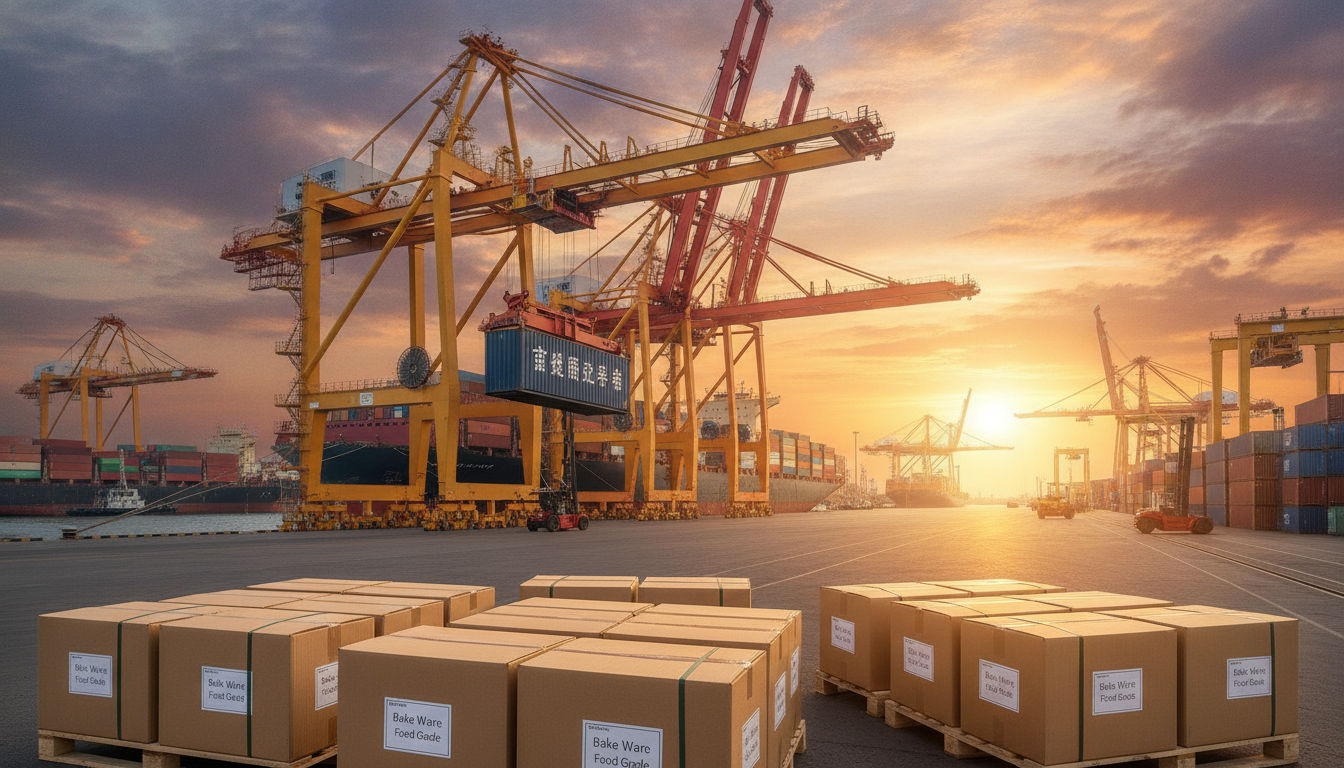
Importing bakeware to Ghana through Tema port often means navigating unclear landed costs, inconsistent food-safety documentation, and suppliers who quote FOB prices but leave duties, local handling, and inland delivery as surprises. A DDP Accra Tema port baking pan supplier that provides transparent all-in pricing, SGS-tested coating performance, and container loading optimized for West African distributors solves the three pain points bulk buyers raise most: hidden costs at clearance, coating durability that does not match the listing, and MOQs that tie up cash before market validation.
📋 Table of Contents
Shansen Bakeware operates a factory in Yongkang, Zhejiang, with a sourcing showroom at Yiwu International Trade Market. We run 7 in-house bakeware lines at 500,000 units per month capacity, shipping from Ningbo to Lagos Apapa, Mombasa, and West African ports including Tema. Our wholesale bakeware sets start at 1 piece per SKU for sampling and 30 pieces per SKU for bulk orders, with SGS-tested food-grade coating and container-loading plans optimized for African distributors.

DDP (Delivered Duty Paid) is an Incoterm where the supplier assumes all costs and risks until the goods reach the buyer’s warehouse in Accra. This includes ocean freight from Ningbo to Tema, Ghana import duties, port clearance fees, and inland trucking.
A transparent DDP Accra Tema port baking pan supplier quote breaks down five line items: factory ex-works price, Ningbo-to-Tema ocean freight, Ghana customs duty (typically 10-20% CIF for kitchenware under HS code 7323), Tema port terminal handling, and Accra inland delivery. Buyers avoid the common complaint that shipping quotes exclude duties and local handling, which can add 25-35% to the FOB price.
Under DDP terms, the supplier retains responsibility for damage, loss, or customs rejection until the container is unloaded at the buyer’s Accra warehouse. This contrasts with FOB Ningbo, where the buyer assumes risk once goods cross the ship’s rail in China. For first-time importers, DDP reduces the complexity of coordinating freight forwarders, customs brokers, and inland hauliers across two continents.
Tema is Ghana’s largest seaport and handles the majority of containerized imports destined for Accra and the Greater Accra Region. Proximity to the capital (25 kilometers) keeps inland trucking costs low and reduces the risk of bent corners or scratched coatings during long-haul transit.
Tema’s Meridian Port Services terminal operates 24/7 with gantry cranes that handle up to 1.5 million TEUs per year. Average container dwell time is 7-10 days, shorter than many West African ports. Faster clearance means less demurrage and lower storage fees for bakeware shipments.
Ghana Customs requires a commercial invoice, packing list, bill of lading, and certificate of origin. For food-contact bakeware, buyers benefit from SGS test reports and FDA compliance letters that confirm coating safety. Suppliers who pre-clear documentation with Ghana Standards Authority reduce the risk of inspection delays that can extend dwell time to 14-21 days.
Tema advantage: 25 km to Accra, 7-10 day average dwell time, 24/7 terminal operations.
Bulk buyers frequently complain that low-cost bakeware listings arrive with inconsistent non-stick performance, making trays harder to clean and reducing repeat purchase confidence. SGS migration testing quantifies whether a coating releases heavy metals, PFAS, or other contaminants when exposed to baking temperatures.
FDA 21 CFR 177.2600 sets extraction limits for rubber and silicone articles intended for repeated food contact. A compliant non-stick coating must release less than 200 ppm total extractables when tested in n-heptane at 70°C for 30 minutes. Shansen’s carbon-steel and aluminum baking pans carry SGS reports that confirm zero lead, zero cadmium, and PFAS-free formulations, meeting both FDA and EU 10/2011 standards.
Commercial bakeries and catering-supply chains need pans that survive 500+ baking cycles without flaking or discoloration. Our factory runs a 1,000-cycle abrasion test with steel wool under 500-gram pressure, measuring coating adhesion and color retention. Pans that pass ship with a durability certificate, addressing the complaint that product performance does not match the listing.
Our food-grade SGS FDA certified bakeware line includes carbon steel, stainless steel, aluminum, and silicone SKUs, each with material-specific test reports that buyers can present to Ghana Standards Authority or retail-chain QA teams.
Import buyers often say that high MOQs tie up cash before they validate market demand. A DDP Accra Tema port baking pan supplier offering 1-piece sampling lets bakery-supply startups test coating performance, pan depth, and customer response without locking capital into a 500-piece order.
Step one: buyer selects 3-5 SKUs from our 7 product lines (silicone muffin molds, carbon-steel loaf pans, stainless-steel cooling racks, aluminum sheet pans, cake-decorating turntables, flour sifters, or multi-piece sets). Step two: we ship 1 piece of each SKU via DHL or FedEx, delivered to Accra in 7-10 days. Step three: buyer conducts in-market trials with bakery customers or retail-chain buyers. Step four: confirmed SKUs move to a 30-piece-per-SKU bulk order shipped by ocean container.
A 1-piece sample costs more per unit because air freight and handling are split across a single pan. A 30-piece LCL shipment reduces per-unit landed cost by 40-60% compared to air samples. A 40-foot container holding 10,000 units brings per-unit cost down another 20-30% versus LCL. Buyers who validate with samples, then scale to container orders, avoid the cash-flow trap of ordering 5,000 pieces of an untested SKU.
In practice: A Ghana bakery-supply distributor ordered 1-piece samples of 5 carbon-steel loaf-pan sizes, tested them with 3 commercial bakeries in Accra, then placed a 30-piece-per-SKU order for the 2 best-selling sizes without tying up capital in slow-moving inventory.
Our low MOQ bakeware for startups program supports first-time importers who need flexibility during market-entry phases.
Bulk buyers note weak packaging protection for metal bakeware, leading to bent corners, scratched coatings, or dented trays after international transit. Container loading optimized for the Ningbo-Tema route mitigates these risks through carton reinforcement, pallet stacking, and void-fill placement.
Each baking pan ships in a 5-layer corrugated carton with corner protectors and bubble-wrap inner sleeves. Cartons are sealed with water-activated tape that resists humidity during the 28-day ocean voyage. Carbon-steel and aluminum pans receive an additional polyethylene bag to prevent saltwater corrosion if the container encounters deck spray.
A 40-foot high-cube container holds 20 Euro pallets (1200 mm × 800 mm) stacked 2.3 meters high. Heavier SKUs (aluminum sheet pans, stainless-steel cooling racks) load on bottom pallets; lighter items (silicone muffin molds, cake-decorating tools) stack on top. This prevents crushing and keeps the container’s center of gravity low, reducing shift during truck transit from Tema to Accra.
Air pockets between pallets allow cartons to shift and collide during ocean swell. We insert inflatable dunnage bags (60 cm × 120 cm) in gaps wider than 10 cm, inflated to 0.2 bar pressure. This locks pallets in place and absorbs vibration, addressing the complaint that bakeware arrives with bent corners or scratched coatings.
Our factory’s container-loading crew photographs each pallet layer and sends a load plan to the buyer before sealing the container. This transparency lets buyers verify SKU mix, carton count, and void-fill placement, reducing disputes at Tema port unloading.
Distributors serving Nigeria, Kenya, and Francophone markets can apply the same packing protocols when shipping from Ningbo to Lagos Apapa or Mombasa. Our baking tools wholesale Nigeria page details similar container-optimization strategies for West African routes.
DDP (Delivered Duty Paid) means the supplier pays ocean freight from Ningbo to Tema, Ghana import duties, port clearance fees, and inland trucking to Accra. The buyer receives a single all-in price with no hidden costs at customs or during local delivery, reducing the risk of budget overruns that can add 25-35% to FOB quotes.
Look for a factory-direct manufacturer with SGS test reports for food-contact coatings, 1-piece sample MOQ for market validation, and transparent DDP pricing that includes Tema port clearance and Accra inland delivery. Request a container load plan and photographs of pallet stacking to verify packaging protection against transit damage.
Landed cost equals factory ex-works price plus ocean freight (USD 2,200-3,500 per 40-foot container Ningbo-Tema), Ghana import duty (10-20% of CIF value for kitchenware), Tema port clearance (USD 400-700), and Accra inland trucking (USD 150-300). A DDP quote bundles all five components into one price, eliminating surprises at customs.
Yes. A 40-foot high-cube container holds 8,000 to 12,000 baking pans depending on pan depth and material gauge. Bulk orders start at 30 pieces per SKU, with mixed-SKU loads allowed to meet diverse product-line needs. Container loading includes corner protectors, bubble-wrap sleeves, and inflatable dunnage to prevent bent corners and scratched coatings during the 28-day Ningbo-Tema voyage.
Verify that the supplier provides SGS migration test reports per FDA 21 CFR 177.2600, confirming zero lead, zero cadmium, and PFAS-free coatings. Request a 1,000-cycle abrasion test certificate and thermal-shock test results to ensure pans survive 500+ baking cycles without flaking. Suppliers who pre-clear documentation with Ghana Standards Authority reduce customs inspection delays at Tema port.
Ready to validate your bakeware line with 1-piece samples and transparent DDP pricing to Accra?
Request Your Sample Pack →
Written by the Shansen Bakeware Export Team.
MOQ 1 set on stock configurations. Tell us what you need and we reply on WhatsApp.
Click the button below to open WhatsApp. If you're not logged in to WhatsApp Web yet, scan the QR code first — then come back here and copy the message into the chat.