📋 Table of Contents
Importing bakeware from China to Lagos under DDP bakeware shipping to Lagos Nigeria terms transfers all logistics risk to the supplier, who handles ocean freight, Nigerian customs clearance, duties, and final delivery to your warehouse or retail location. For distributors launching a bakeware line or bakery-supply chains expanding inventory, DDP eliminates surprise fees and simplifies cash-flow planning.
This guide walks through transit times, cost structures, required documentation, and quality controls specific to bakeware shipments arriving at Apapa or Tin Can Island ports.
DDP (Delivered Duty Paid) is an Incoterm where the seller assumes maximum responsibility. The supplier arranges export from China, ocean or air freight, Nigerian customs clearance, payment of all import duties and taxes, and inland trucking to the buyer’s specified address in Lagos.
Under DDP bakeware shipping to Lagos Nigeria, the factory or trading company must secure an export license, book container space, file the Nigerian Single Goods Declaration, pay the 20 percent import duty and 7.5 percent VAT, and coordinate with a Lagos clearing agent. The buyer receives goods at the warehouse door with no additional invoices.
The importer provides a delivery address, assists with any local permits if the bakeware requires NAFDAC registration (processed-food contact items sometimes do), and inspects goods upon arrival. Payment terms are typically 30 percent deposit and 70 percent before shipment or against bill-of-lading copy, since the supplier carries the landed-cost risk.
New distributors benefit most. Calculating duties, managing customs brokers, and navigating port delays at Apapa can tie up working capital for 2 to 3 weeks. A supplier quoting DDP provides a single landed price, simplifying budgeting and eliminating the need to maintain a clearing-agent relationship for small-volume orders.
Choosing the right Incoterm affects cash flow, control, and risk exposure. Below is a comparison of common terms for bakeware imports.
Shansen Bakeware ships from Ningbo port and offers all four terms. Our wholesale bakeware sets are container-optimized with mixed-SKU packing lists, so a 20-foot shipment can include silicone muffin pans, carbon-steel baking sheets, stainless cake rings, and aluminum loaf pans in quantities that match retail demand curves.
Understanding the journey from factory to Lagos warehouse helps buyers plan inventory cycles and manage customer expectations.
Our Yongkang facility is 180 kilometers from Ningbo. Finished bakeware is palletized, shrink-wrapped, and trucked to the container yard within 2 days of production sign-off. Consolidated LCL shipments from the Yiwu sourcing showroom add 1 day for cross-dock handling.
Direct sailings on COSCO, MSC, or Maersk lines take 35 to 40 days. Transshipment routes via Lomé or Cotonou add 5 to 7 days but sometimes offer lower freight rates during low-season months (February, March, September). Vessel schedules are weekly, so booking flexibility is high.
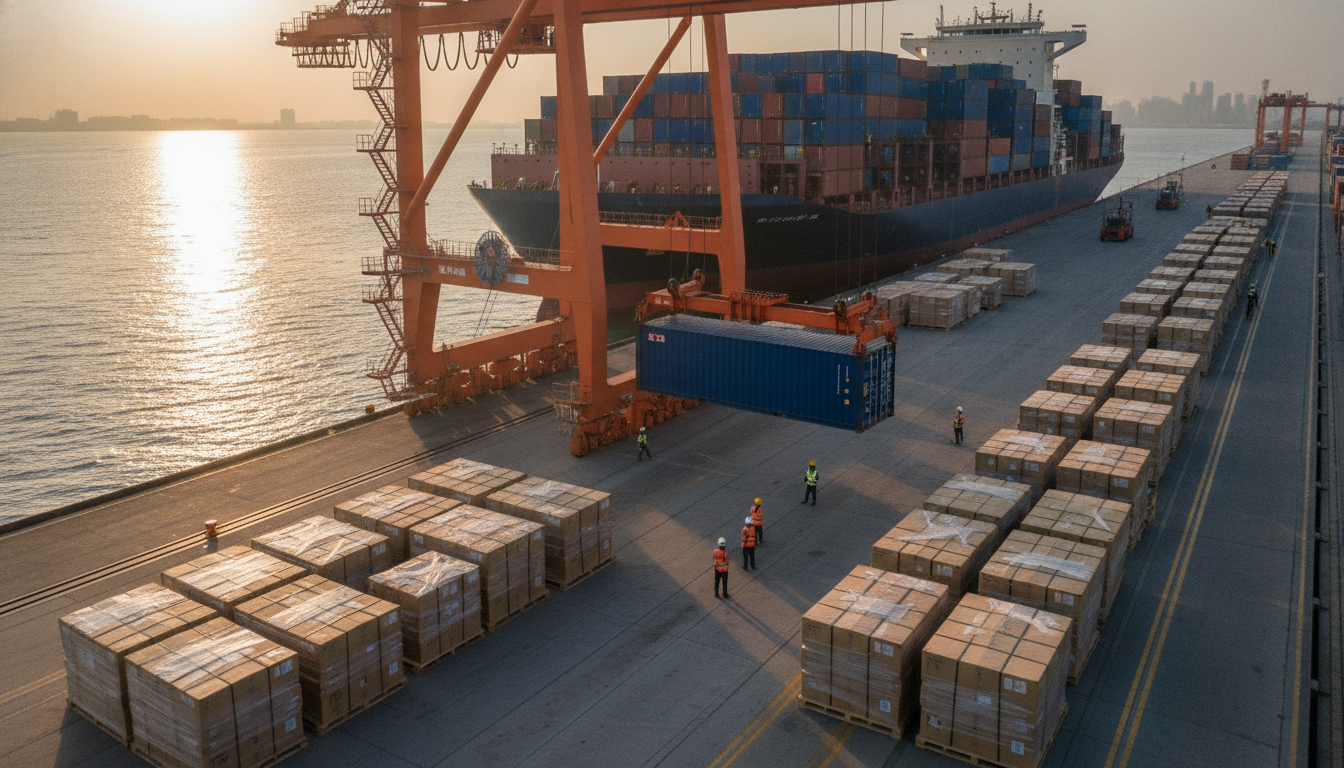
Apapa and Tin Can Island ports process bakeware under HS codes 7323.93 (stainless steel) and 3924.10 (silicone). Average dwell time is 5 to 7 days if documentation is complete. Our Lagos clearing agent pre-files the Single Goods Declaration 48 hours before vessel arrival, cutting clearance to 3 days for compliant shipments. Final-mile trucking to Ikeja, Lekki, or mainland warehouses takes 1 to 2 days depending on traffic and security-escort requirements for high-value containers.
For sample validation or urgent restocks, air freight from Hangzhou to Murtala Muhammed International takes 5 to 7 days door-to-door. Cost is approximately 4.5 times sea freight per kilogram, practical only for orders under 100 kilograms.
A transparent DDP quote should itemize every cost component. Below is a worked example for a 20-foot container of mixed bakeware.
For buyers planning multi-country distribution, our baking tools wholesale Nigeria program offers consolidated shipments to Lagos with onward LCL parcels to Accra, Abidjan, or Luanda, sharing container freight across markets.
Complete paperwork prevents demurrage and storage fees. Nigerian Customs requires specific certificates for food-contact items.
Must show HS codes (7323.93 for stainless bakeware, 3924.10 for silicone, 7615.10 for aluminum), unit prices, total FOB value, and Incoterm. Undervaluation triggers physical inspection and penalties, so declared values should match proforma and production records.
Carton-by-carton breakdown with gross weight, net weight, and cubic-meter dimensions. Nigeria Customs cross-checks container weight against the bill of lading; discrepancies over 5 percent flag the shipment for examination.
Ocean B/L issued by the carrier, showing consignee as the buyer (for DDP, sometimes the clearing agent is named as notify party). Telex release is common for DDP shipments to speed clearance without waiting for original documents.
Bakeware that touches food during baking requires proof of food-grade material compliance. Our factory provides SGS test reports confirming PFAS-free coatings, lead-free stainless steel, and FDA food-contact standards for silicone (21 CFR 177.2600 compliance). NAFDAC sometimes requests these during random inspections.
China-origin bakeware does not require a Form M (import license) under Nigeria’s current policy, but a Certificate of Origin issued by the China Council for the Promotion of International Trade (CCPIT) is mandatory for duty assessment. We include this in every DDP shipment.
Filed electronically by the clearing agent 5 days before vessel berthing. The PAAR generates a risk-assessment score; low-risk shipments (complete documentation, consistent importer history) clear in 2 to 3 days, while high-risk containers face physical examination adding 5 to 7 days.
In practice: A Lagos bakery-supply distributor imported 120 cartons of silicone baking mats and carbon-steel sheet pans under DDP terms, received SGS food-contact certificates in the shipment, and cleared Apapa in 3 days with zero storage fees
Bakeware is vulnerable to dents, scratches, and coating damage during the 35-day ocean voyage and port handling. Proper packaging is non-negotiable.
We use double-wall corrugated cartons (burst strength 32 ECT) with 5-layer construction. Each carton is corner-reinforced with cardboard angles and sealed with water-activated tape, not plastic strapping that loosens in humidity.
Carbon-steel and stainless bakeware is individually wrapped in PE foam sleeves, then nested with corrugated dividers separating each piece. Silicone bakeware is less fragile but still benefits from interleaving to prevent surface scuffing during vibration.
Cartons are stacked on heat-treated wooden pallets (ISPM-15 compliant) and shrink-wrapped in 6 layers. Inside the container, pallets are braced with dunnage airbags between rows to eliminate shifting. Our Ningbo loading team photographs each layer for insurance documentation.
Properly packed bakeware shipments to Lagos average under 2 percent damage rate. Importers report that non-stick coating scratches (cosmetic, not functional) account for most claims. We recommend buyers inspect containers at the port before accepting delivery; once the container leaves the terminal, carrier liability ends.
Marine insurance covers total loss and general average. For partial damage, the buyer must note discrepancies on the delivery receipt, photograph affected items within 24 hours, and file a claim with the insurer within 7 days. Our DDP terms include all-risk coverage, so claims are filed by us on the buyer’s behalf, simplifying the process.
Not all factories quoting DDP have the infrastructure to deliver. Vet suppliers on these operational capabilities.
Ask if the supplier has a dedicated clearing agent in Lagos or contracts ad-hoc. Dedicated agents with PAAR filing experience clear faster. Request the agent’s name and phone number; a supplier unwilling to share this detail may be outsourcing DDP logistics to a middleman, adding cost and risk.
DDP quotes should be in USD to avoid exchange-rate disputes. Payment is typically 30 percent deposit (triggers production) and 70 percent before shipment. Avoid suppliers demanding 100 percent upfront; legitimate factories accept letters of credit or trade-assurance terms for first orders.
A factory running 7 bakeware lines at 500,000 units per month (like our Yongkang facility) can absorb a 3,000-unit mixed-SKU order without delaying other clients. Smaller workshops may promise DDP but lack the volume to negotiate competitive freight rates, inflating the landed price.
Reputable suppliers allow third-party inspection before shipment. We coordinate SGS or Bureau Veritas pre-shipment checks at our factory, with reports sent to the buyer 48 hours before container loading. Suppliers who refuse inspection access often ship substandard goods, betting that DDP terms discourage buyers from rejecting a container already in transit.
First-time importers need low MOQ to validate demand before committing to full containers. Our low MOQ bakeware for startups program starts at 30 pieces per SKU, so a buyer can test 5 SKUs (silicone muffin pan, carbon-steel baking sheet, stainless cake ring, aluminum loaf pan, multi-piece measuring set) with a 150-unit total order, fitting in a shared LCL shipment.
Request copies of SGS test reports and FDA compliance letters before placing an order. Factories that provide these upfront are confident in their material sourcing. Our food-grade SGS FDA certified bakeware line includes PFAS-free non-stick coatings and lead-free stainless steel, with test reports updated annually and available for download.
DDP responsibility ends at delivery, but quality issues may surface during retail distribution. Clarify warranty terms: we replace defective units (manufacturing defects, not user damage) within 90 days of container receipt, shipping replacements via air at our cost if the defect rate exceeds 1 percent of the order.
In practice: A Lekki kitchenware retailer ordered 200 units across 4 bakeware SKUs under DDP terms, received goods in 42 days, and discovered 3 dented cake pans; the supplier air-shipped replacements within 10 days under the 90-day warranty
DDP (Delivered Duty Paid) means the supplier pays all costs to deliver goods to the buyer’s address in Nigeria, including ocean freight, insurance, import duties, VAT, customs clearance, and inland trucking. The buyer receives a single invoice with no additional charges upon arrival.
A 20-foot container of bakeware shipped DDP from Ningbo to Lagos typically costs 13,000 to 19,000 USD landed, depending on product FOB value, seasonal freight rates, and SKU mix. This includes ocean freight (1,800 to 2,400 USD), duties (20 percent of CIF), VAT (7.5 percent), and inland delivery.
Sea freight from Ningbo to Lagos Apapa takes 35 to 45 days, with an additional 5 to 10 days for customs clearance and final-mile delivery to the buyer’s warehouse. Air freight reduces total transit to 5 to 7 days but costs approximately 4.5 times more per kilogram.
Required documents include a commercial invoice with HS codes, packing list, bill of lading, SGS or FDA food-contact certificate for bakeware, Certificate of Origin from CCPIT, and a Pre-Arrival Assessment Report filed by the clearing agent 5 days before vessel arrival.
DDP is best for first-time importers and small distributors who want a single landed price with no customs-clearance responsibility. Experienced buyers with established clearing-agent relationships often prefer CIF or DAP to control duty-payment timing and reduce supplier markup on inland logistics.
Written by the Shansen Bakeware Export Team.
Ready to simplify your bakeware imports with transparent DDP pricing and factory-direct quality?
Request a DDP Quote Today →
MOQ 1 set on stock configurations. Tell us what you need and we reply on WhatsApp.
Click the button below to open WhatsApp. If you're not logged in to WhatsApp Web yet, scan the QR code first — then come back here and copy the message into the chat.