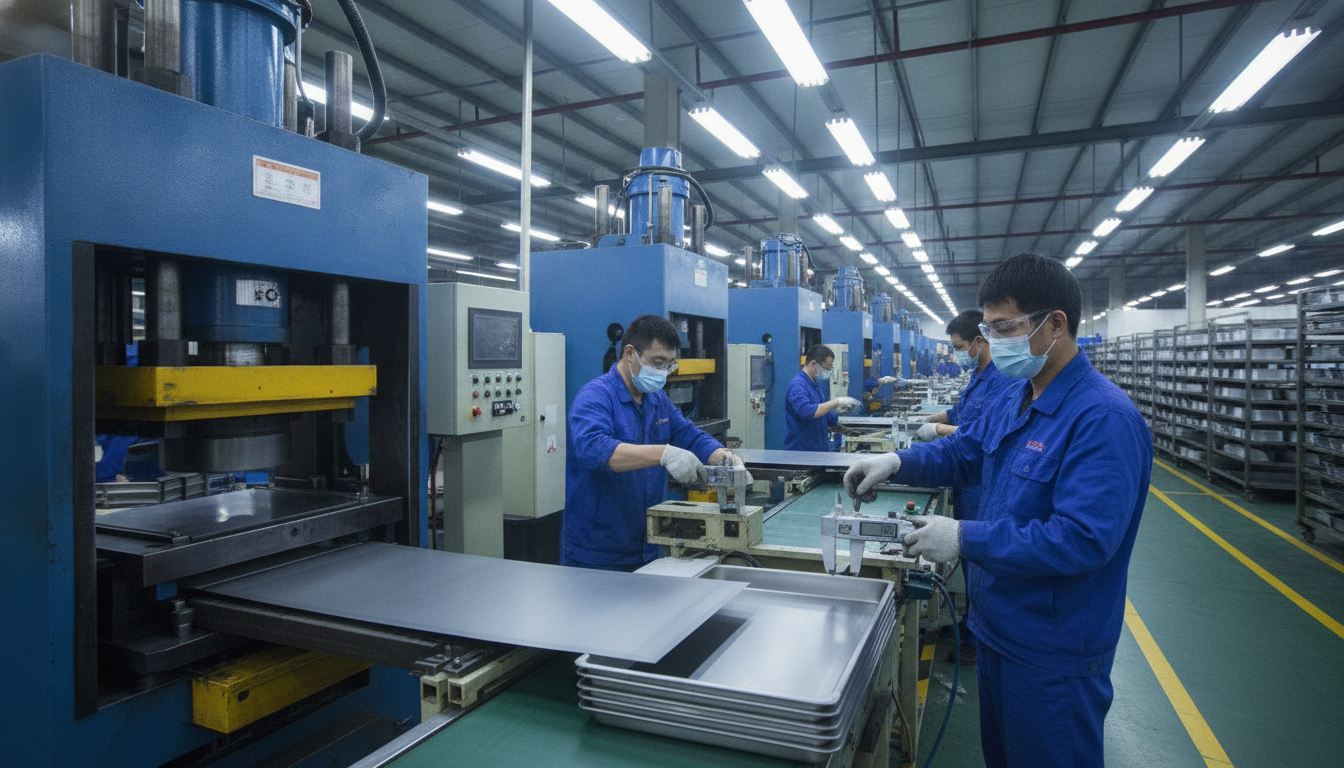
Buyers across West Africa frequently report that baking sheets deform in high-heat ovens, twisting or popping loudly mid-bake. A warp resistant carbon steel sheet pan africa sourcing strategy addresses this by specifying minimum gauge thickness, reinforced rim construction, and material composition that withstand repeated 230°C cycles without bending. Importers in Lagos, Accra, and Abidjan need pans that survive humid coastal warehousing and heavy commercial bakery use, not consumer-grade thin-gauge alternatives marketed as heavy-duty.
📋 Table of Contents
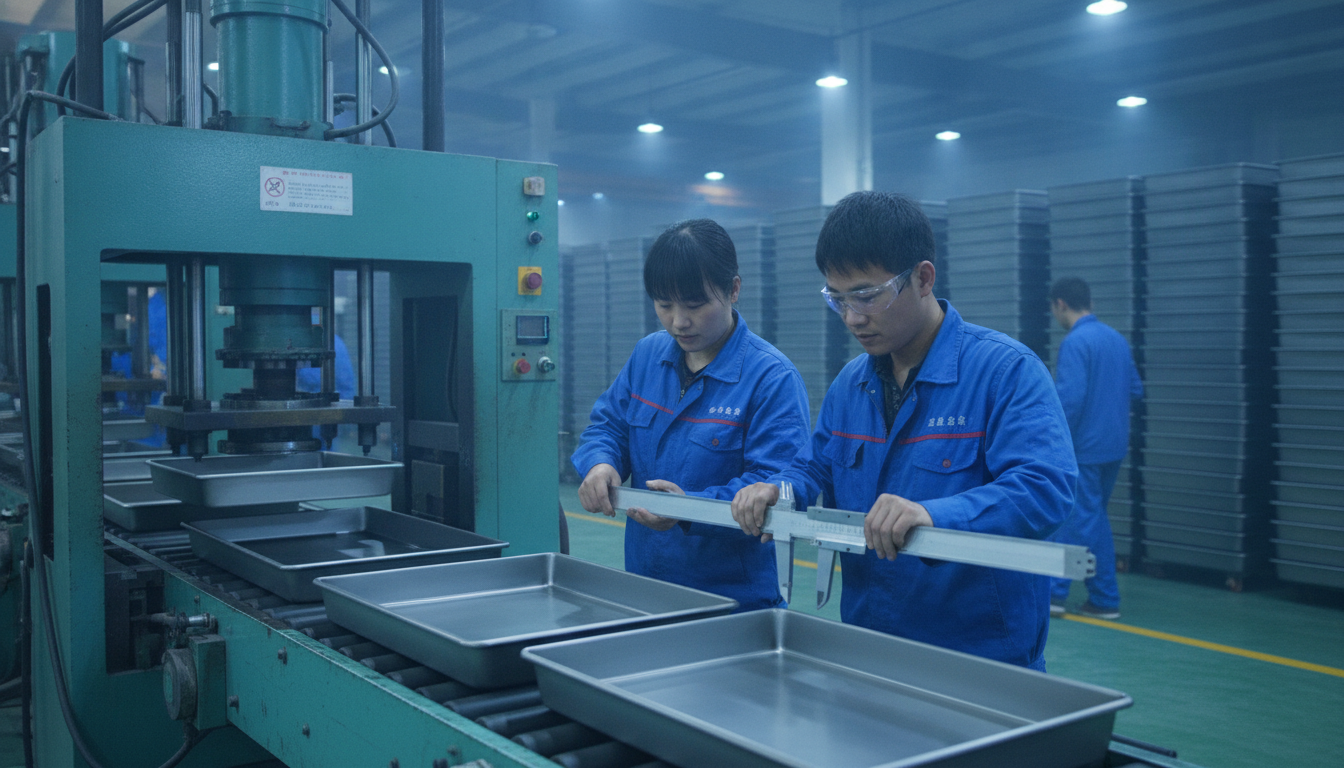
Thermal expansion causes metal to grow when heated. Thin carbon steel expands unevenly if the pan heats faster at the center than the edges, creating internal stress. When stress exceeds the metal’s yield strength, the pan bends or twists to relieve tension. Buyers report loud popping sounds as the metal buckles, then the pan cools into a permanent warp.
Placing a cold pan directly into a preheated 220°C oven creates a temperature gradient of 200°C or more within seconds. The bottom surface expands rapidly while the rim stays cooler, forcing the pan to flex. Repeated cycles weaken the metal structure, and warping becomes permanent after 10-20 heat cycles in consumer-grade pans.
A 24-gauge (0.6 mm) pan flexes easily under its own weight when loaded with dough. The same pan in a 230°C oven has minimal resistance to thermal stress. Thicker gauge steel has greater cross-sectional mass, which slows heat transfer and reduces the temperature gradient between top and bottom surfaces during heating.
Flat-edge pans have no perimeter reinforcement. Heat expands the center faster than the edges, and the rim cannot counteract the upward or downward bow. Wire-edge or rolled-rim designs add a structural bead that resists bending, distributing thermal expansion more evenly and maintaining flatness under load.
Gauge is the standard measure of sheet-metal thickness. Lower gauge numbers indicate thicker metal. For wholesale bakeware sets destined for commercial use in West Africa, 18-gauge is the entry point for warp resistance, and 16-gauge is the preferred specification for high-volume bakeries.
An 18-gauge pan weighs approximately 850 grams for a half-sheet size (46 cm × 33 cm). This thickness provides enough rigidity for daily baking at 200-230°C without permanent deformation. Small bakeries in Accra or Abidjan running 20-30 bake cycles per week find 18-gauge pans deliver 12-18 months of service before replacement.
A 16-gauge half-sheet pan weighs roughly 1,100 grams. The additional 250 grams of steel mass slows heat transfer, reducing thermal shock. Hotel kitchens and bakery chains in Lagos running 50+ cycles per week report 24-36 months of service life, making the higher upfront cost economically viable over the pan’s lifecycle.
Importers sometimes source 22-gauge or 24-gauge pans to hit lower retail price points. These pans warp within the first month of commercial use, generating customer returns and damaging brand reputation. The cost of handling returns and replacing defective stock often exceeds the savings from the lower factory price.
Rim reinforcement is the second critical factor after gauge thickness. A wire-edge or rolled-rim design adds a structural bead around the perimeter, creating a frame that resists bending when the pan heats unevenly. Flat-edge pans lack this reinforcement and rely solely on material thickness to prevent warping.
Wire-edge pans have a steel wire rolled into the rim during stamping. The wire acts as a tension member, holding the perimeter flat even when the center expands. This design adds 30-50 grams to the pan weight and increases factory cost by approximately 8-12%, but the warp-resistance improvement is substantial.
Rolled-rim pans fold the edge of the sheet metal back onto itself, creating a double-thickness bead. This method is less expensive than wire-edge but still provides meaningful reinforcement. The rolled edge also eliminates sharp metal edges that can cut hands during handling, a safety consideration for bakery staff.
Flat-edge pans are stamped from a single sheet with no perimeter reinforcement. They are the lowest-cost option and acceptable for single-use or very light home baking. In commercial environments, flat-edge pans warp quickly unless the gauge is 16 or thicker, which negates the cost advantage.
Specification example: A 16-gauge carbon steel half-sheet pan with wire-edge reinforcement, measuring 46 cm × 33 cm × 2.5 cm depth, weighs 1,150 grams and resists warping through 500+ bake cycles at 230°C.
West African importers face environmental challenges that European or North American buyers do not encounter. High humidity in coastal cities, long warehouse storage periods, and variable oven maintenance in commercial kitchens all stress carbon steel pans beyond standard specifications.
Lagos, Mombasa, and Abidjan experience year-round relative humidity above 70%. Carbon steel rusts quickly in these conditions unless protected. Factory-applied food-grade mineral oil or silicone coating provides 30-60 days of rust protection during warehousing and distribution. Buyers should specify this coating when ordering, as unprotected pans develop surface rust within 10-14 days of arrival at port.
Many bakery ovens in West Africa lack precise temperature control. A thermostat set to 200°C may deliver actual temperatures ranging from 180°C to 240°C during a single bake cycle. This variability increases thermal stress on pans. Thicker gauge steel and reinforced rims tolerate these swings better than thin-gauge alternatives.
A 16-gauge warp resistant carbon steel sheet pan africa specification costs 40-60% more than a 22-gauge thin pan at factory. Over 24 months of daily commercial use, the 16-gauge pan avoids 2-3 replacement purchases, lowering total cost per bake cycle by 30-40%. Importers serving hotel and bakery-chain accounts find this cost structure easier to justify than retail buyers focused solely on shelf price.
Sourcing custom OEM private label bakeware from China requires understanding minimum order quantities, sampling timelines, and container logistics. Shansen Bakeware operates from a factory in Yongkang, Zhejiang, with a sourcing showroom at Yiwu International Trade Market, shipping from Ningbo port to Lagos Apapa, Mombasa, and Francophone/Lusophone African ports.
Sampling starts at 1 piece per SKU, allowing buyers to validate gauge thickness, rim construction, and coating quality before committing to production. First commercial orders require 30 pieces per SKU, which fills approximately 0.15 cubic meters of container space for half-sheet pans. A 20-foot container holds 1,800-2,000 half-sheet pans when stacked efficiently.
Sample production takes 7-10 days after specification confirmation. Bulk production for 500-1,000 units runs 18-22 days, including stamping, rim reinforcement, coating application, and QC inspection. SGS food-grade testing adds 5-7 days if third-party certification is required for customs or retail-chain compliance.
Importers in Lagos and Mombasa often combine carbon steel sheet pans with food-grade SGS FDA certified bakeware in other materials to maximize container utilization. A typical mixed shipment includes 40% carbon steel pans, 30% silicone molds, 20% aluminum cake pans, and 10% stainless steel tools. This mix balances weight and volume, avoiding container overweight penalties at African ports.
Nigeria NAFDAC and Kenya KEBS require food-contact certification for imported bakeware. SGS test reports confirming FDA food-grade compliance and absence of lead, cadmium, and PFAS satisfy most African customs authorities. Shansen Bakeware provides these reports at no additional cost for orders above 500 pieces per SKU. Smaller orders can request SGS testing for a flat fee of $300-$400 per material type.
In practice: A Lagos kitchenware importer validated 16-gauge wire-edge sheet pans with 5-piece samples, then placed a 150-unit first order mixed with silicone molds, filling 0.4 of a 20-foot container and avoiding MOQ cash-flow pressure
Ningbo to Lagos Apapa takes 28-32 days by sea. Ningbo to Mombasa takes 26-30 days. Importers should budget 10-14 days for customs clearance at Lagos and 7-10 days at Mombasa. Inland trucking from Apapa to Ikeja or from Mombasa to Nairobi adds 2-3 days. Total lead time from factory gate to distributor warehouse averages 45-55 days for West African buyers.
Baking sheets with 16-gauge or 18-gauge carbon steel and wire-edge or rolled-rim reinforcement resist warping in commercial ovens up to 230°C. Thicker gauge steel slows heat transfer, reducing the temperature gradient between center and edges that causes thermal stress. Reinforced rims add structural rigidity that flat-edge pans lack, distributing expansion forces more evenly across the perimeter.
Thin-gauge carbon steel under 1.0 mm warps when subjected to rapid temperature changes or uneven heating. Thermal expansion causes the center of the pan to grow faster than the edges, creating internal stress that bends the metal. Pans thicker than 1.2 mm (18-gauge) with reinforced rims resist this stress and maintain flatness through repeated heating cycles.
Preventing warping requires three steps: specify 18-gauge or thicker carbon steel, choose wire-edge or rolled-rim construction, and avoid placing cold pans into preheated ovens. Gradual heating reduces thermal shock by allowing the entire pan to reach temperature at a similar rate, minimizing the stress gradient between center and edges. Thicker gauge and reinforced rims provide structural resistance to the expansion forces that remain.
Aluminized steel has an aluminum-silicon coating that reflects heat and slows browning, making it suitable for delicate pastries. Carbon steel conducts heat more directly, producing faster browning and crisping. For warp resistance, both materials perform similarly at equivalent gauge thickness and rim construction. Carbon steel is typically 15-25% less expensive at factory and easier to source in Africa-optimized MOQ quantities.
For small bakeries and cafés, 18-gauge (1.2 mm) carbon steel provides good warp resistance at a moderate price point. High-volume hotel kitchens and bakery chains benefit from 16-gauge (1.5 mm) steel, which delivers 500+ bake cycles without permanent deformation. Thinner gauges under 1.0 mm warp quickly in commercial environments and should be avoided for daily use.
Written by the Shansen Bakeware Export Team.
Ready to source warp resistant carbon steel sheet pan africa inventory for your distribution network?
Request 1-piece samples and MOQ details →
MOQ 1 set on stock configurations. Tell us what you need and we reply on WhatsApp.
Click the button below to open WhatsApp. If you're not logged in to WhatsApp Web yet, scan the QR code first — then come back here and copy the message into the chat.