
Ceramic bakeware refers to metal baking pans and dishes coated with a ceramic-based nonstick finish, distinct from traditional PTFE coatings. Shansen Bakeware’s carbon-steel line carries SGS-verified FDA 21 CFR 175.300 test reports on the nonstick coating, with MOQ from 1 pc for sampling and 500 pcs per SKU for OEM production runs, shipping from Ningbo port to Lagos, Mombasa, and West African destinations.
📋 Table of Contents
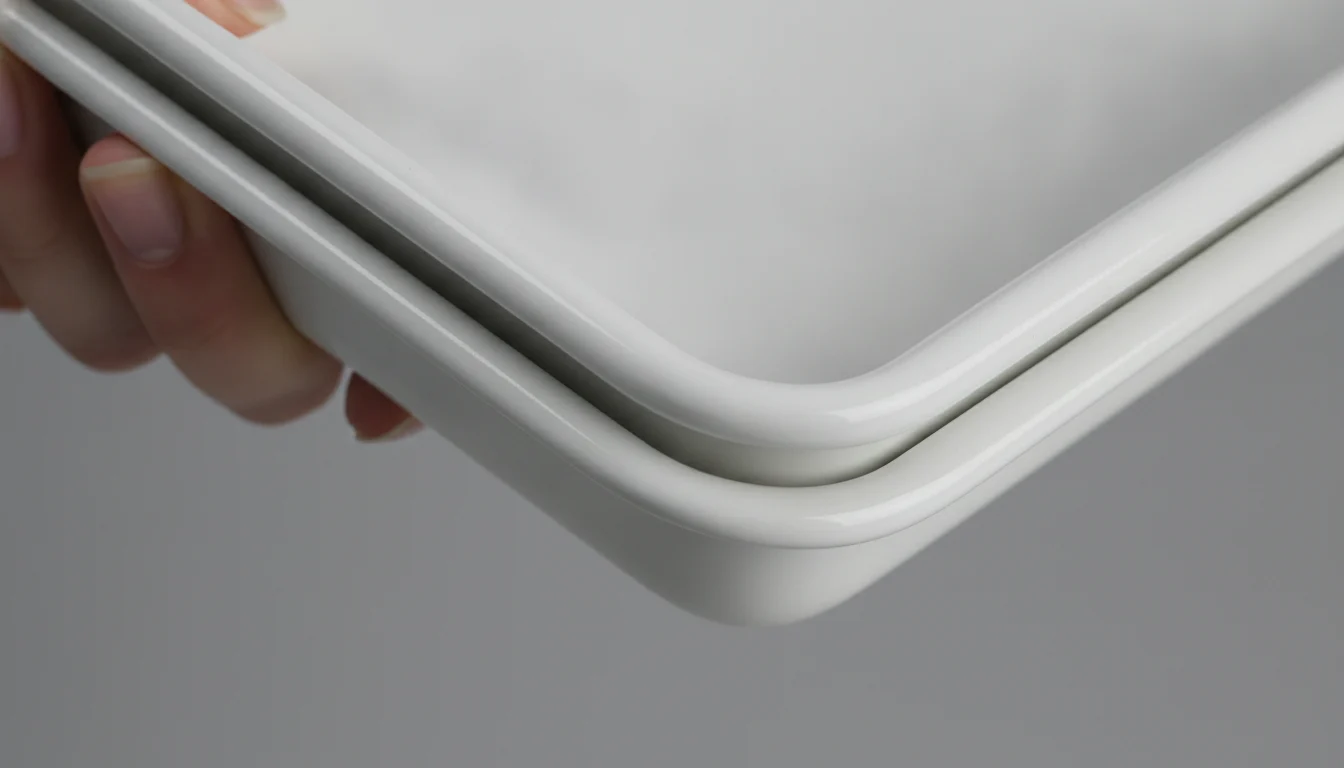
Ceramic bakeware in the B2B context describes metal baking pans coated with a ceramic-based nonstick layer, not solid ceramic or stoneware dishes. The substrate is typically carbon steel or aluminum, spray-coated with a sol-gel ceramic finish that polymerizes under high heat. This construction delivers nonstick performance without PTFE or PFOA, appealing to health-conscious retail segments across Nigeria, Kenya, and South Africa.
Carbon-steel bases offer superior heat retention and even browning, while aluminum substrates heat faster but may warp under extreme oven temperatures. Our Yongkang factory runs both substrate options across the 7 in-house bakeware lines, with the carbon-steel line carrying SGS-verified FDA 21 CFR 175.300 test reports dated 2020, 2021, and 2023. Aluminum lines do not carry the same certification scope; buyers sourcing for food-safety-regulated markets should confirm substrate and coating pairing before ordering.
PTFE coatings release food at lower temperatures but degrade above 260°C, while ceramic finishes tolerate up to 230°C without off-gassing. Distributors targeting bakery-supply chains in Lagos or Johannesburg often prefer ceramic positioning for retail shelves, even though PTFE remains the workhorse in commercial kitchens. The trade-off is lifespan: PTFE coatings typically last longer under daily professional use, while ceramic finishes appeal to home bakers willing to hand-wash and store carefully.
Buyers report that ceramic-coated bakeware can chip or scratch over time, especially with regular use or rough handling. According to Taste of Home’s review of Caraway bakeware, longevity depends heavily on careful cleaning and storage. Importers stocking retail chains in Nairobi or Durban need to brief end-users on proper care, or face returns and negative reviews that erode brand equity.
Rust can form at rolled edges where water gets trapped, and some pans warp under extreme oven temperatures, as noted in CookCraftAndCreate’s ceramic bakeware review. Carbon-steel pans with double-rolled rims and full-surface coating coverage (including the underside) reduce these failure modes. When requesting samples, check that the coating extends over the rim fold; exposed metal at the edge is the most common entry point for moisture and oxidation.
Some buyers say ceramic-coated pieces are not truly dishwasher-friendly and need hand washing to preserve the finish, which adds extra maintenance. Retail packaging that promises dishwasher-safe convenience without clarifying that hand-washing extends lifespan sets up disappointed customers. Distributors should either source pans tested for 100+ dishwasher cycles (request the test report) or print care instructions that recommend hand-washing for longevity.
Nigeria, Kenya, and South Africa each recognize SGS and FDA test reports as proof of food-contact safety, though enforcement varies by port and by importer category. A Lagos-based distributor supplying hotel chains will face stricter scrutiny than a small wholesaler in Kano, but the same SGS-verified FDA 21 CFR 175.300 report satisfies both if the coating formulation matches the tested batch.
The 2020 SGS report on Shansen’s carbon-steel line tests the nonstick coating against FDA 21 CFR 175.300, confirming PFAS-free and lead-free status. This certification applies to the carbon-steel substrate with ceramic spray coating; it does not extend to aluminum lines or to any silicone bakeware in the product range. Buyers must request the specific test report matching the substrate and coating they intend to order. Reports are issued per production batch and provided on request, not published publicly.
Côte d’Ivoire, Senegal, and Cameroon follow French food-contact norms that accept FDA and SGS documentation, though some ports require French-language summaries. Angola and Mozambique recognize Portuguese translations of the same reports. Our export team coordinates translation and legalization when the order quantity justifies the administrative cost, typically for container loads rather than sample shipments. Confirm document requirements during quotation to avoid clearance delays at Abidjan or Luanda.
Certification scope: SGS/FDA 21 CFR 175.300 applies to carbon-steel line only. Reports: dated 2020, 2021, 2023, issued per batch on request. Coverage: PFAS-free, Pb-free nonstick coating.
Minimum-order-quantity structures differ by product line. Bakeware sets are available from 1 set for market testing, while the metal and carbon-steel line requires 1 pc for sampling and 500 pcs per SKU for an OEM production run. Importers validating demand in Nairobi or Port Harcourt can order a single set, test retail response, then scale to a 500-unit run with custom packaging once the SKU proves viable.
Sample production for the carbon-steel line is confirmed at quotation from artwork approval. Sample cost is deducted from the first OEM order when that order meets the 500-pc-per-SKU threshold. Buyers who order samples of three SKUs and later consolidate into a single 1,500-pc order covering all three receive the full sample refund; those who order samples but never reach production MOQ forfeit the sample fee.
Custom options include substrate gauge, coating color (white, cream, grey, black), handle style, and private-label packaging. Our OEM and private-label service supports full-color sleeve boxes, hang tags, and laser-etched logos on stainless-steel handles. Tooling cost for a new pan shape starts at a figure confirmed at quotation; modifying an existing mold (handle angle, rim width) costs less and ships faster. Lead time for a new-mold OEM run is confirmed at quotation from mold approval; repeat orders on approved molds ship in a timeline confirmed at quotation.
Ordering 1 set of a 6-piece bakeware collection allows photography of the items, testing in a local bakery, and gauging retail interest before placing a 500-unit OEM order with private-label packaging.
Shansen ships from Ningbo port with container loading optimized for African distributors. A 20-foot container holds approximately 8,000 to 12,000 pieces depending on pan size and nesting efficiency; a 40-foot high-cube container doubles that range. Ceramic-coated pans nest less efficiently than bare metal due to the coating thickness, so final piece count is confirmed after carton dimensions are locked.
Direct sailings from Ningbo to Lagos Apapa run on a schedule confirmed at quotation, with transit time confirmed at quotation. Mombasa routing adds a timeline confirmed at quotation due to the Suez Canal leg. Importers in Nairobi trucking inland from Mombasa should budget an additional timeline confirmed at quotation for customs clearance and road transit. Our export team coordinates with freight forwarders who handle both ports daily, ensuring that Bill of Lading details match the importer’s bank and customs-clearance requirements.
Abidjan, Dakar, and Tema receive transshipment containers via Lomé or direct calls depending on carrier and season. Luanda and Maputo sailings are less frequent; consolidating orders to meet container minimums reduces per-unit freight cost. Humid storage conditions at these ports make carton moisture protection critical: we use PE-lined inner boxes and shrink-wrap pallets when the buyer requests it, adding a cost confirmed at quotation per container. Distributors in Angola and Mozambique should inspect cartons immediately upon arrival, as port dwell time often exceeds two weeks and condensation can compromise packaging.
Ceramic-coated pans are less prone to breakage than glass or stoneware, but rough handling at transshipment hubs can dent rims and chip coatings. Five-layer corrugated cartons with corner protectors reduce damage rates; our standard export carton is bursting-strength tested to 200 kgf/cm². Distributors who experienced high damage rates on previous shipments should request carton samples before finalizing the order, and consider upgrading to seven-layer cartons for long-haul or multi-transshipment routes.
The SGS-verified FDA 21 CFR 175.300 certification applies only to the carbon-steel line with ceramic spray coating. Aluminum substrate pans do not carry the same test reports on file. Buyers sourcing for food-safety-regulated markets should request a separate test report for aluminum lines or select the carbon-steel substrate to ensure compliance documentation is already available.
Yes, container loads can combine multiple substrate lines as long as each SKU meets its respective MOQ. A 40-foot high-cube container typically holds two to three SKU groups at 500 pcs each, plus bakeware sets at lower unit counts. Our export team confirms final piece count and carton configuration once SKU mix and packaging are locked, ensuring efficient nesting and weight distribution.
Ceramic coatings do not have a fixed shelf life in storage, but nonstick performance degrades with use rather than time. Proper care extends usable life: hand-washing, avoiding metal utensils, and storing with pan protectors keep the coating intact longer. Buyers should educate retail customers that ceramic bakeware is not indestructible and that rough handling accelerates wear, unlike marketing claims that imply permanent nonstick performance.
Ready to source food-grade ceramic bakeware with verified test reports and African-port logistics?
Request samples and MOQ details →
Written by the Shansen Bakeware Export Team.
MOQ 1 set on stock configurations. Tell us what you need and we reply on WhatsApp.
Click the button below to open WhatsApp. If you're not logged in to WhatsApp Web yet, scan the QR code first — then come back here and copy the message into the chat.