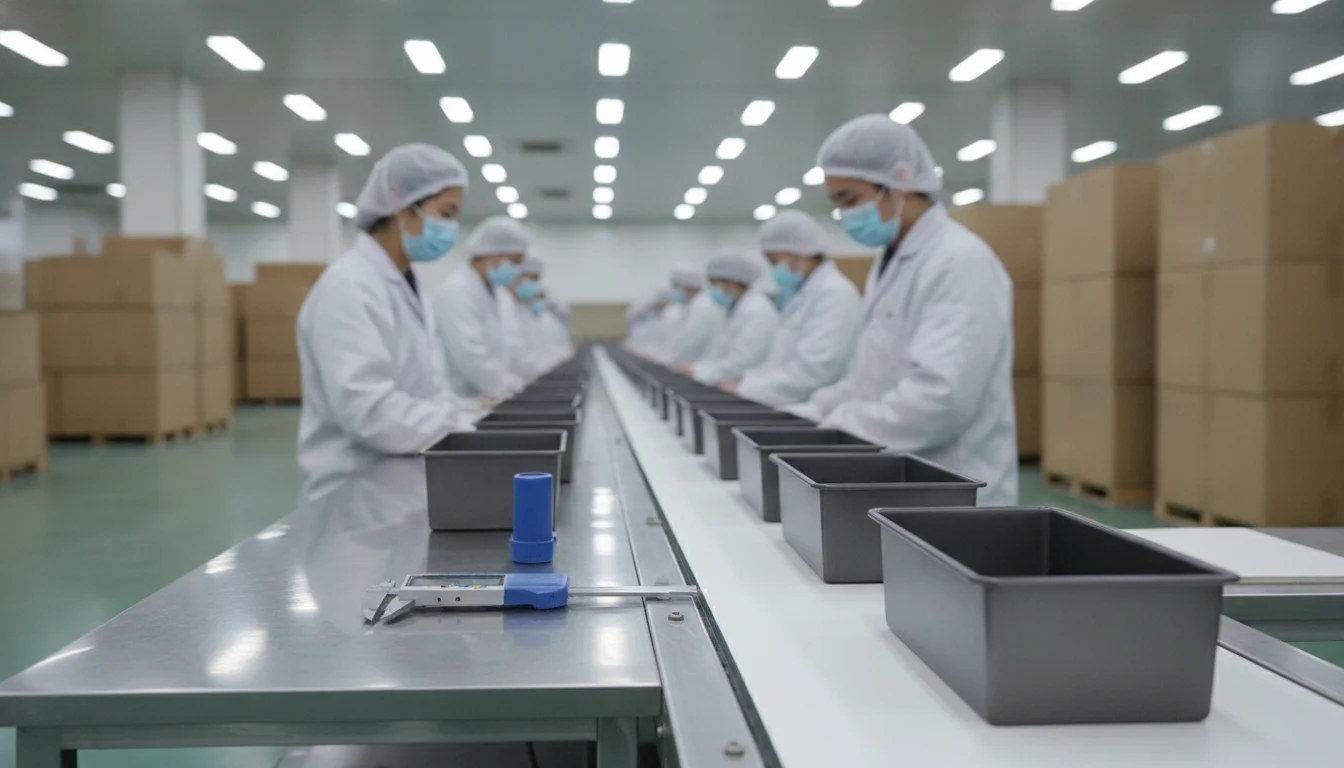
A bread tin is a rectangular or oblong metal bakeware pan designed for baking loaf-shaped bread, banana bread, pound cakes, and similar products. Wholesale buyers source bread tins in carbon steel with nonstick coating, aluminum (anodized or plain), or stainless steel, typically in standard 1 lb (8.5×4.5 in) or 2 lb (9×5 in) capacities. Our Yongkang factory produces all three material lines at 500,000 units/month capacity, with MOQ of 1 pc for sampling and 500 pcs per SKU for OEM production runs on the metal line.
📋 Table of Contents
Material selection determines heat conductivity, release performance, rust resistance, and price point. Carbon steel, aluminum, and stainless steel each serve distinct buyer segments and recipe types. Distributors stocking for home bakers prioritize nonstick release and affordability; commercial bakery buyers prioritize durability and wash-cycle tolerance.
Carbon steel conducts heat efficiently and evenly, producing consistent crust color and crumb structure. A PFAS-free nonstick coating allows loaves to release cleanly without greasing, reducing labor in high-volume bakeries. Our carbon-steel bread tin line carries SGS test reports dated 2020, 2021, and 2023; the 2020 report covers FDA 21 CFR 175.300 food-contact requirements for the nonstick coating. Gauge typically ranges from 0.4 to 0.6 mm; thicker gauges resist warping under repeated thermal cycling. Buyers report that thinner pans warp after a few dozen uses, particularly when moved directly from a hot oven to a cold counter.
Aluminum is lighter than carbon steel, rust-proof, and heats quickly. Anodized aluminum forms a hard, non-reactive surface that resists scratching and does not leach metallic flavor into acidic batters like banana bread or sourdough. Plain aluminum costs less but may discolor over time and requires a nonstick spray or parchment liner for release. Weight savings matter for distributors paying air-freight rates or targeting home bakers who prefer easy handling. Aluminum bread tins are common in disposable formats for bake sales and gift packaging, though buyers complain that disposable pans are often smaller than advertised and too flimsy for reuse.
Stainless steel offers the longest lifespan and withstands industrial dishwashers without coating degradation. It does not conduct heat as efficiently as carbon steel or aluminum, so loaves may bake unevenly unless the pan has a thick base (1.0 mm or more). Stainless requires greasing or parchment lining because it has no nonstick surface. Professional bakeries and institutional kitchens choose stainless for its durability and ease of sanitization, accepting the extra release-prep step.
Bread tin dimensions are typically expressed as length × width × height (or depth) in inches or centimeters, with capacity described in pounds of dough or liters. The two most common retail sizes are 1 lb and 2 lb loaf pans. Stocking the right mix depends on your target customer: home bakers prefer smaller tins for quick breads and pound cakes, while small commercial bakeries and catering operations need larger capacities for sandwich loaves.
This size suits recipes calling for 2 to 3 cups of flour, producing a compact loaf ideal for banana bread, zucchini bread, and small pound cakes. Home bakers in Nigeria, Kenya, and South Africa frequently request this dimension because it fits standard home ovens and serves a typical household. Distributors targeting retail chains and kitchenware shops should prioritize this size in wholesale bakeware sets that bundle a loaf pan with a round cake tin and a baking tray.
The 2 lb pan accommodates recipes with 3 to 4 cups of flour, yielding a taller loaf suitable for sandwich slicing. Bakeries producing for retail sale or catering prefer this capacity because it maximizes output per baking cycle. The slightly deeper walls require even heat distribution to prevent a doughy center; carbon steel with a 0.5 mm gauge or thicker performs better than thin aluminum in this size.
Some markets request mini loaf pans (5.75×3×2 in) for individual servings or gift packaging, and extra-large pans (10×5×3 in) for artisan sourdough. Demand for these sizes is lower, so buyers often start with a small test batch. Our low-MOQ bakeware line allows distributors to sample specialty dimensions at 1 pc before committing to a 500-pc production run.
Sample: 1 pc (metal line). OEM run: 500 pcs per SKU. Sets: from 1 set.
Food-contact safety testing confirms that a nonstick coating does not migrate harmful substances into baked goods under normal use. Buyers in the US, UK, EU, and Middle East increasingly require PFAS-free certifications; African importers prioritize SGS or Intertek reports that demonstrate compliance with international standards. Verifying coating safety before placing a bulk order protects your brand reputation and reduces the risk of customs holds or retailer rejections.
This regulation specifies the types of fluoropolymer resins and additives permitted in food-contact coatings, along with maximum use temperatures and migration limits. Our carbon-steel bread tin line is covered by an SGS test report dated 2020 that confirms compliance with FDA 21 CFR 175.300. The report tests for lead (Pb), cadmium (Cd), and restricted fluoropolymers; results show non-detect levels for all restricted substances. Buyers targeting the US market or private-label brands with US distribution should request a copy of this report during the sampling phase.
SGS migration testing simulates cooking conditions by exposing the coated surface to food simulants (acidic, fatty, aqueous) at elevated temperatures, then measuring the concentration of migrated substances. A PFAS-free claim requires testing for per- and polyfluoroalkyl substances, a family of persistent chemicals restricted in California (Proposition 65) and several European markets. Our test reports dated 2021 and 2023 include PFAS screening; both returned non-detect results. Buyers should confirm that the test report covers the specific SKU and production batch they are ordering, because coating formulations can change between runs.
The SGS and FDA reports described above apply only to the carbon-steel nonstick line. Aluminum bread tins (anodized or plain) and stainless-steel pans require separate migration testing if marketed as food-grade. Anodized aluminum forms an inert oxide layer that does not typically leach, but buyers should still request a migration test for acidic foods like sourdough. Plain aluminum can release trace aluminum ions into acidic batters; testing confirms whether levels remain below regulatory limits. Stainless steel is generally considered food-safe without additional testing, but buyers targeting EU markets may need a declaration of conformity under Regulation (EC) 1935/2004.
Minimum order quantities and production timelines vary by material, customization level, and factory capacity. Understanding these parameters helps you plan cash flow, manage inventory risk, and set realistic launch dates for new SKUs or private-label lines.
For the metal and carbon-steel bread tin line, our factory accepts 1 pc sample orders so distributors and private-label buyers can test coating release, gauge thickness, and dimensional accuracy before committing to a bulk run. Sampling time is confirmed at quotation and depends on whether the requested size and coating are in stock or require a custom tooling setup. Stock sizes (1 lb and 2 lb) typically ship within one to two weeks; custom dimensions or proprietary coatings may add two to three weeks for tooling and trial runs.
Once sampling is complete, the production MOQ for metal and carbon-steel lines is 500 pcs per SKU. This threshold allows the factory to justify tooling setup, coating batch preparation, and quality-control inspection while keeping per-unit costs competitive for small and mid-size distributors. Buyers ordering multiple SKUs (for example, 1 lb and 2 lb sizes in the same coating) can split the 500-pc minimum across sizes, but each SKU must still meet a minimum of 200 pcs to ensure efficient production scheduling.
Our custom OEM private-label bakeware sets bundle a bread tin with complementary items like round cake pans, baking trays, and cooling racks. Set MOQ starts at 1 set for sampling, allowing buyers to evaluate packaging, item mix, and retail presentation before scaling up. Production runs for sets depend on the component with the highest MOQ; typically this is the metal or carbon-steel piece, so the effective set MOQ aligns with the 500-pc threshold described above.
Production lead time for a 500-pc to 5,000-pc order ranges from three to five weeks after sample approval and deposit payment, confirmed at quotation. Larger orders (10,000+ pcs) may extend to six to eight weeks depending on coating-line availability and tooling queue. We ship from Ningbo port, with container loading optimized for African distributors serving Lagos Apapa, Mombasa, and Francophone/Lusophone African ports. Transit time to Lagos is typically 30 to 35 days; to Mombasa, 25 to 30 days; to Luanda or Maputo, 35 to 40 days. Buyers should add customs clearance time (one to two weeks in most African ports) when planning retail launch dates.
In practice: Sampling each SKU at 1 pc before a 500-pc production run lets a distributor verify coating adhesion, dimensional tolerance, and stacking compatibility without tying up working capital in untested inventory
Buyers report recurring issues with bread tins sourced from factories that prioritize speed over quality control. Addressing these pain points during the specification and sampling phase reduces returns, negative reviews, and brand-reputation damage.
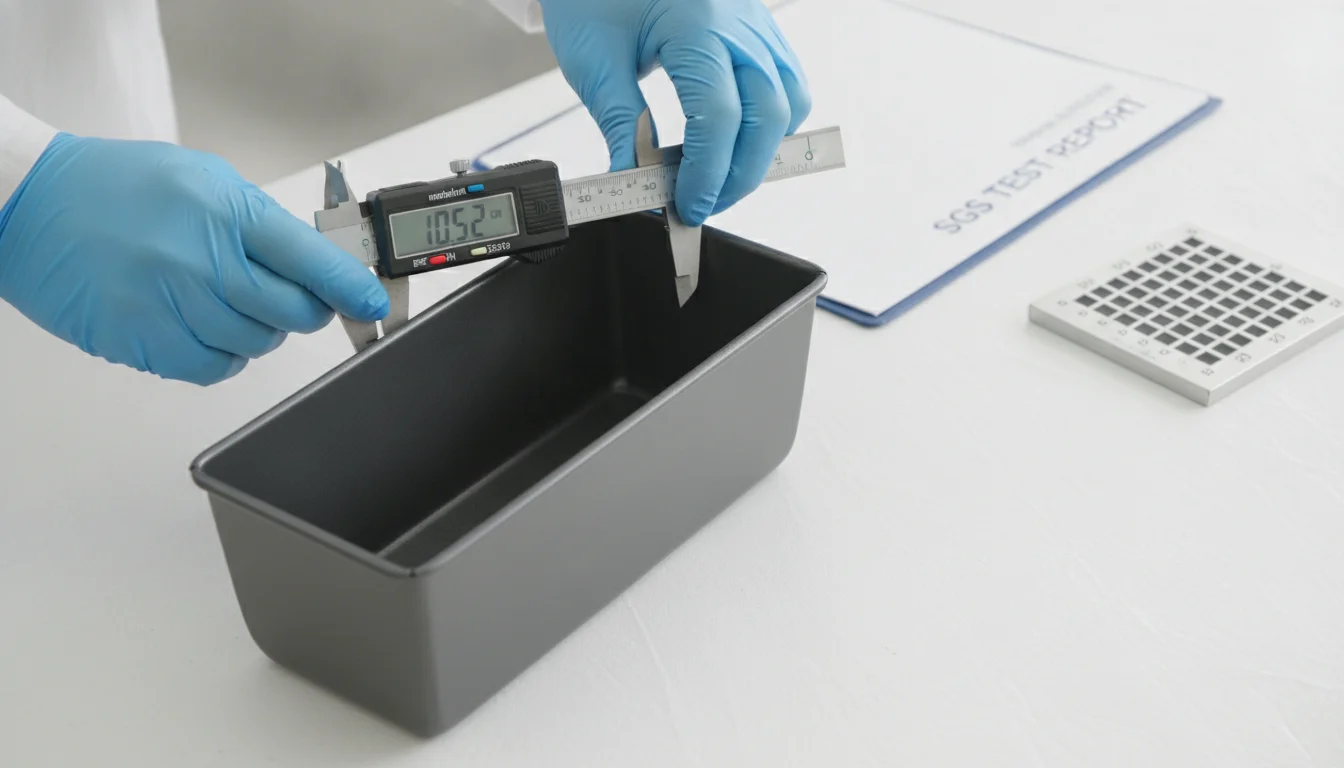
Distributors discover that some loaf tins measure smaller than advertised, making them unsuitable for standard recipes. A pan labeled as 9×5 in that actually measures 8.5×4.75 in will produce a taller, denser loaf that may not bake evenly. This problem arises when factories use worn tooling or skip post-forming dimensional checks. Request a tolerance specification (typically ±2 mm for length and width, ±1 mm for depth) and verify the sample against it with calipers before approving production. Our quality-control team measures every tenth pan during production and flags any unit that exceeds tolerance, ensuring consistency across the batch.
Buyers describe pans that dent or warp after a single use, particularly when moved from a hot oven to a sink or cooling rack. This occurs when the base-metal gauge is too thin (below 0.4 mm for carbon steel, below 0.5 mm for aluminum) or when the pan is formed without adequate corner reinforcement. Warped pans rock on flat surfaces and bake unevenly. Specify a minimum gauge in your purchase order and request a sample that has been through a simulated bake-cool cycle (heated to 200°C, then cooled to room temperature) to confirm warp resistance.
Users report that nonstick coatings peel, bubble, or discolor after limited use, exposing bare metal and causing loaves to stick. Coating failure usually stems from inadequate surface preparation (the base metal was not degreased or primed properly), insufficient curing time, or use of a low-quality resin. Our food-grade SGS/FDA-certified bakeware line follows a multi-stage coating process: degrease, phosphate conversion, primer application, topcoat spray, and oven cure at controlled temperature and dwell time. Request a coating-adhesion test report (cross-hatch or pull-off test) and confirm that the factory cures at the resin manufacturer’s recommended temperature, not a lower setting to save energy.
Rust appears on carbon-steel bread tins when the nonstick coating is scratched or when the pan is stored in a humid environment without adequate protection. While the coating is designed to shield the base metal, any chip or scratch creates a rust initiation site. Buyers should educate end users to hand-wash gently, dry immediately, and avoid metal utensils. For export to high-humidity markets (coastal Nigeria, Mombasa, Lagos), request an additional anti-corrosion oil coating applied over the nonstick surface before packaging; this temporary layer is wiped off before first use and prevents rust during transit and warehouse storage.
Buyers of disposable aluminum bread tins with lids report that lids do not stay attached or fit loosely, allowing moisture loss during transport or storage. This issue is common with stamped-aluminum disposable pans where the lid is a separate piece with no mechanical interlock. For disposable formats, specify a lid design with a rolled edge or crimp that engages the pan rim, or choose a two-piece set where the lid nests inside the pan lip. Our aluminum line offers both options; buyers targeting bake-sale or gift markets typically prefer the nested design for a cleaner presentation.
The terms are used interchangeably in most markets. “Bread tin” is more common in the UK, Australia, and Commonwealth countries, while “loaf pan” is standard in the US and Canada. Both refer to a rectangular metal bakeware pan designed for baking loaf-shaped bread, banana bread, pound cakes, and similar products. The functional specifications (material, gauge, nonstick coating, dimensions) are identical regardless of the name used.
Nonstick-coated carbon-steel or aluminum bread tins typically release cleanly without additional preparation, provided the coating is intact and the pan is not overheated. For uncoated aluminum or stainless-steel tins, grease the interior with butter, oil, or nonstick spray, then dust lightly with flour or line with parchment paper. Allow the baked loaf to cool in the pan for five to ten minutes before turning out; this lets steam condense and loosen the crust from the pan walls. Avoid cutting or scraping inside the pan with metal utensils, as this damages the nonstick coating and creates stick points.
Yes, bread tins work well for pound cakes, banana bread, zucchini bread, fruit cakes, and quick breads. The rectangular shape produces a loaf that slices neatly for serving or packaging. Some bakers use bread tins for layered cakes by baking two loaves and stacking them with frosting, though the tall narrow shape makes frosting more difficult than a round cake pan. Bread tins are not suitable for delicate sponge cakes or angel food cakes, which require a tube pan for proper rise and structure.
Written by the Shansen Bakeware Export Team.
Ready to source bread tins with verified food-contact safety and flexible MOQ?
Request Samples & SGS Reports →
MOQ 1 set on stock configurations. Tell us what you need and we reply on WhatsApp.
Click the button below to open WhatsApp. If you're not logged in to WhatsApp Web yet, scan the QR code first — then come back here and copy the message into the chat.