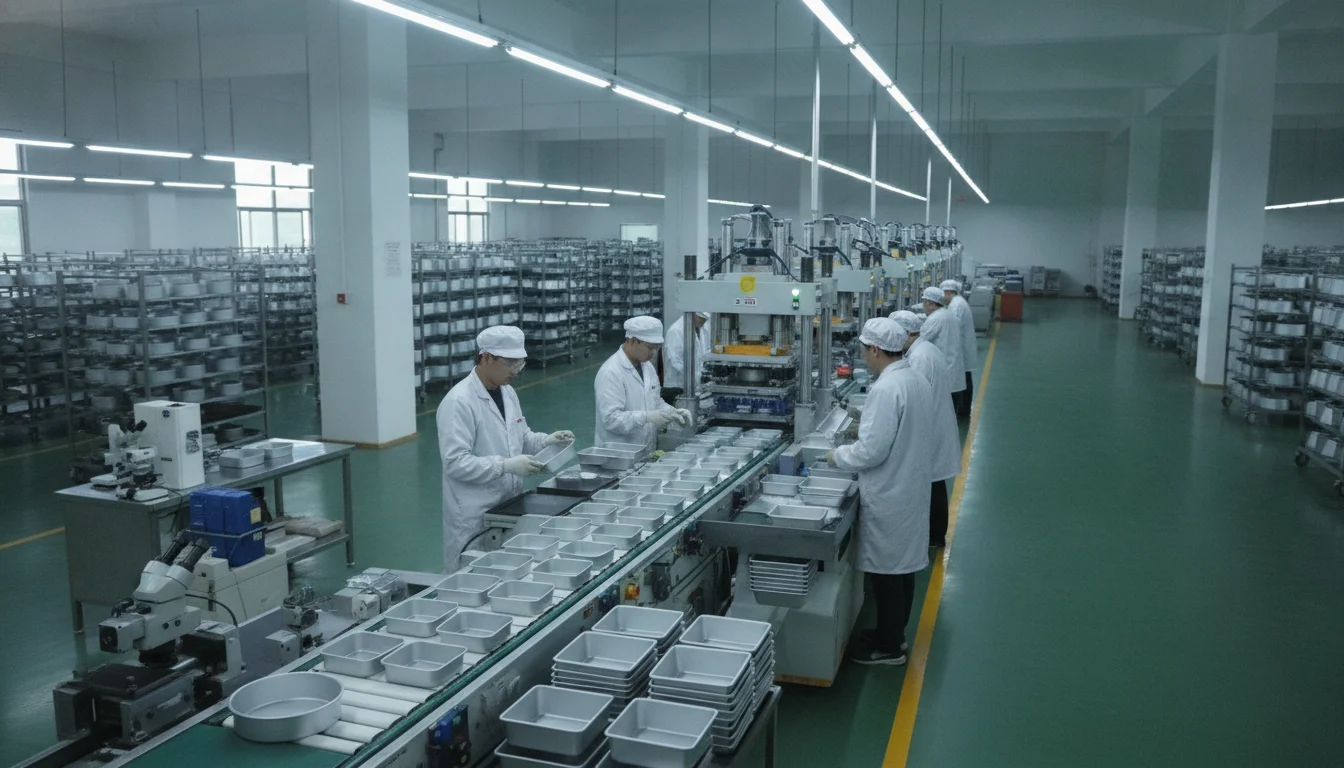
First-time buyers can negotiate minimum order quantity with bakeware factories by identifying whether the MOQ covers setup costs, material minimums, or packaging runs, then trading a smaller initial quantity for a setup fee, higher unit price, stock materials, or staged delivery. Shansen’s low-MOQ bakeware line offers 1 set sampling on multi-piece sets and 1 pc sampling on the metal line, with a 500 pc OEM production run per SKU.
📋 Table of Contents
Bakeware MOQ reflects the factory’s fixed costs spread across each production run. Understanding which cost dominates helps you negotiate the right trade-off without forcing the supplier into a loss.
Carbon-steel and aluminum bakeware require stamping dies, pressing molds, or rolling tooling. A custom cake pan shape may demand a new die that costs several hundred dollars and takes two weeks to machine. The factory amortizes that investment over the first production batch. Accepting an existing mold design eliminates setup cost and drops MOQ to material and coating minimums.
Steel coil, aluminum sheet, and food-grade silicone arrive in minimum mill quantities. A carbon-steel supplier may require a 2-ton coil purchase, which translates to several thousand pans depending on gauge and size. Ordering a standard gauge and finish the factory already stocks removes this constraint.
Non-stick coating lines operate in batches. Switching from one coating formulation to another requires cleaning, re-calibration, and test cycles. Factories set MOQ to justify the downtime. Choosing the factory’s most common coating formulation reduces changeover cost and lowers the order threshold.
Custom-printed sleeves, hang tags, and color boxes require printing-plate setup and minimum press runs. A four-color sleeve may carry a 5,000-piece printing minimum even when the product MOQ is lower. Using stock white boxes or generic sleeves with a sticker label cuts this cost entirely.
Ask the factory to break down the quoted MOQ by cost driver. A transparent supplier will specify whether the 500-piece minimum covers tooling amortization, material purchase, coating batch, packaging print run, or a combination.
Factories that refuse to itemize costs may be trading companies adding margin rather than manufacturers absorbing real setup expenses. A vertically integrated plant will explain each threshold because the production manager lives with those constraints daily.
Minimum order quantity negotiation for bakeware factory first-time buyers succeeds when you offer the supplier a different form of cost recovery. The factory needs to cover setup and material minimums; how you structure payment determines whether they accept a smaller initial quantity.
Propose a one-time tooling charge in exchange for a lower per-unit MOQ. A factory quoting 1,000 pieces at $3.00 each may accept 300 pieces at $3.50 plus a $200 setup fee. You pay the same total for tooling amortization but unlock a smaller test quantity. Document the setup fee and unit price separately in the quotation so future reorders drop to the base unit cost.
Offer to absorb setup cost through unit price rather than volume. A 500-piece run at $4.20 per pan may carry the same margin as 1,000 pieces at $3.80 when the factory spreads fixed costs differently. This works best when you plan to reorder at higher volume once the product proves itself in your market, bringing the blended cost down over time.
Choosing materials, finishes, and dimensions the factory already produces eliminates custom setup. Shansen’s carbon-steel line runs standard gauges and non-stick formulations that meet FDA 21 CFR 175.300 food-contact limits, allowing 500-piece OEM runs without tooling charges. Requesting a non-standard coating or custom embossing raises MOQ to justify the changeover.
Ordering three sizes in two colors creates six SKUs, each with its own MOQ. Consolidating to two sizes in one color halves the total order quantity while meeting per-SKU minimums. First-time buyers testing a new market gain more flexibility by validating one hero SKU at higher volume than spreading budget across multiple unproven variants.
Agree to a total volume delivered over two or three shipments rather than one large order. A factory may accept 400 pieces now and 600 pieces in 90 days if you sign a binding purchase order for the full 1,000-piece run. This spreads your cash outlay and inventory risk while giving the supplier production certainty.
In practice: Sampling 1 set from the multi-piece line and 1 pc from the metal line before committing to a 500-piece OEM run lets a distributor verify coating adhesion, dimensional tolerance, and food-grade compliance without tying capital to untested inventory
Mixed-model orders let first-time buyers meet factory minimums without overcommitting to a single SKU. The factory cares about total production volume and container utilization; whether that volume comes from one model or six often matters less than the setup complexity each introduces.
Combining multiple carbon-steel cake pans in different sizes within one order shares the same coating run and material batch. A 300-piece order might include 100 round pans, 100 square pans, and 100 loaf pans, all using the factory’s standard non-stick formulation. Each shape requires its own mold, so this approach works best when the factory already stocks the tooling.
Bakeware sets bundle multiple items under one SKU, spreading setup costs across the set rather than per piece. A 6-piece set containing two round pans, two square pans, one loaf pan, and one muffin tray may carry a 100-set MOQ, effectively giving you 600 individual pieces. Our wholesale bakeware sets start at 1 set for sampling, allowing first-time buyers to test bundled SKUs without the per-piece minimums that individual items require.
Factories running multiple product lines may allow you to combine silicone molds, carbon-steel pans, and stainless-steel bowls in one container to meet a total-order threshold. This works when the factory operates all lines in-house rather than outsourcing. Shansen’s 7 in-house bakeware lines cover silicone, carbon steel, stainless steel, aluminum, cake-decorating tools, strainers and sifters, and multi-piece sets at 500,000 units per month capacity, enabling mixed-category orders that share container space and reduce per-line MOQ pressure.
Shipping cost per unit drops significantly when you fill a container. A 20-foot container holds roughly 1,500 to 2,500 bakeware pieces depending on size and packaging. Combining models to reach container capacity spreads ocean freight across more units, lowering your landed cost even if the factory MOQ per SKU remains unchanged. Container loading optimized for African distributors shipping to Lagos Apapa, Mombasa, and Francophone or Lusophone African ports from Ningbo maximizes cube utilization and reduces breakage during transit.
Inflated MOQ claims signal a trading company rather than a manufacturer, or a factory testing whether you will accept a higher threshold without pushback. Verification protects first-time buyers from tying capital to unnecessarily large orders.
Ask for material cost, coating cost, labor cost, packaging cost, and setup amortization itemized separately. A manufacturer can produce this breakdown from their production costing system. A trading company will deflect or provide only a total unit price. The breakdown also reveals whether the MOQ covers genuine minimums or includes padded margin.
Request quotations from three factories for the same specification. MOQ variance of 50 to 100 percent across suppliers indicates flexible thresholds rather than hard production constraints. One factory quoting 1,000 pieces while two others quote 500 suggests the higher figure includes trading-company margin or risk buffer rather than true setup cost.
Inquire whether the factory maintains ready molds for common bakeware shapes. A manufacturer with in-house tooling will offer stock options at lower MOQ. A trading company sourcing from multiple workshops cannot guarantee tooling availability and will default to custom-order minimums even for standard shapes.
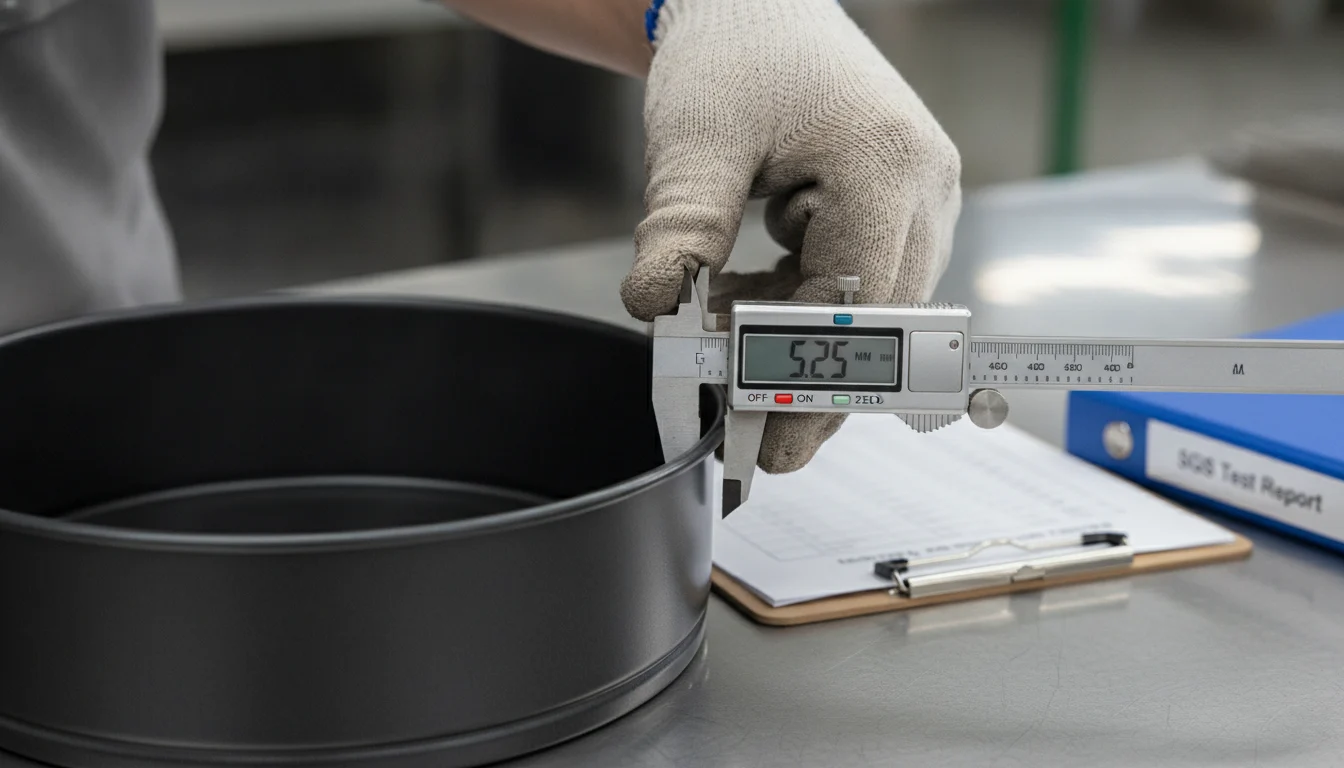
Request copies of recent food-contact test reports before committing to an order. Factories running food-grade SGS and FDA certified bakeware maintain test documentation dated within the past three years and issue reports per production batch. Trading companies reselling from multiple sources cannot provide batch-specific reports and may offer generic certificates that do not match your order specifications. Shansen’s SGS and FDA test reports cover the carbon-steel line’s non-stick coating against 21 CFR 175.300 food-contact limits, with reports issued per order on request.
A video walkthrough showing the production floor, coating line, and finished-goods warehouse confirms the supplier operates manufacturing equipment rather than brokering orders. Request footage of the specific bakeware line you plan to order, including mold storage, stamping or molding stations, and QC inspection. Factories confident in their capabilities provide this documentation readily; trading companies deflect or offer generic facility tours that do not match your product category.
A reasonable first-order MOQ depends on whether you accept stock tooling and materials. Carbon-steel and aluminum lines typically require 500 to 1,000 pieces per SKU when using standard molds and coatings, while silicone and multi-piece sets may start as low as 100 to 300 units. Requesting custom shapes, proprietary coatings, or printed packaging raises minimums to 1,500 pieces or more to justify setup costs. First-time buyers gain flexibility by sampling 1 set or 1 piece before committing to a production run, confirming fit and quality without tying capital to untested inventory.
Yes, MOQ is negotiable when you propose a trade-off the factory values. Offering to pay a setup fee, accept a higher unit price, choose stock specifications, reduce SKU variants, or commit to staged shipments gives the supplier cost recovery without forcing a large first order. Factories prioritize covering fixed costs and maintaining production efficiency; how you structure payment and specifications determines whether they accept a lower threshold. Always request a detailed cost breakdown to identify which expense drives the quoted MOQ, then address that constraint directly in your counteroffer.
Verify MOQ claims by requesting an itemized cost breakdown showing material, coating, labor, packaging, and setup costs separately. Compare quotations from three factories for identical specifications; variance exceeding 100 percent indicates flexible thresholds rather than hard production constraints. Ask whether the factory maintains stock tooling for common shapes, and request recent SGS or FDA test reports to confirm they manufacture in-house rather than broker orders. A video walkthrough of the production floor, coating line, and mold storage confirms the supplier operates the equipment needed to produce your order at the stated minimum.
Ready to negotiate MOQ terms that fit your budget and timeline?
Request a Quotation with Cost Breakdown →
Written by the Shansen Bakeware Export Team.
MOQ 1 set on stock configurations. Tell us what you need and we reply on WhatsApp.
Click the button below to open WhatsApp. If you're not logged in to WhatsApp Web yet, scan the QR code first — then come back here and copy the message into the chat.