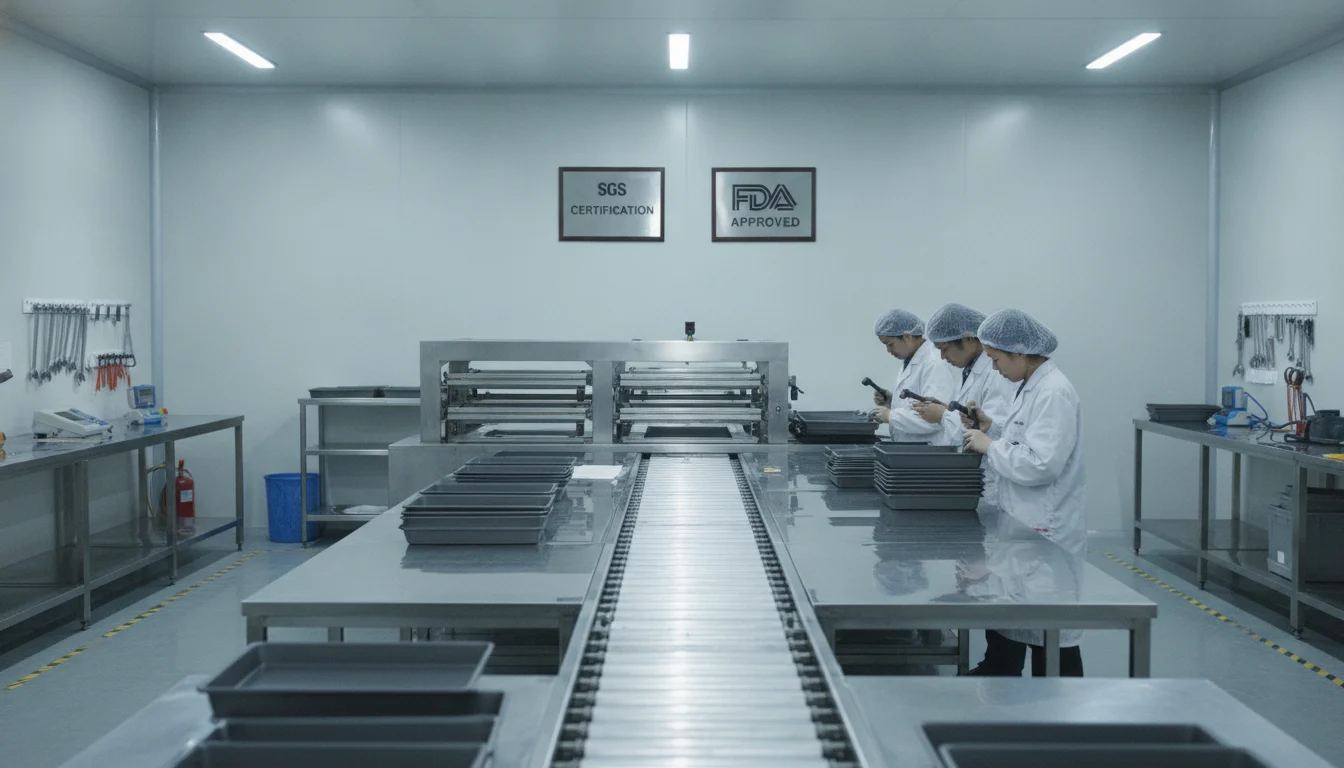
A non toxic bakeware set combines food-grade materials-carbon steel with FDA 21 CFR 175.300-compliant coatings, silicone, stainless steel, or aluminum-that release no PFAS, lead, or cadmium during baking. Shansen Bakeware’s Yongkang factory runs 7 in-house lines at 500,000 units per month, with SGS and FDA test reports on file dated 2020, 2021, and 2023; the 2020 report verifies the carbon-steel line’s non-stick coating against 21 CFR 175.300, confirming PFAS-free and Pb-free status.
📋 Table of Contents
A non toxic bakeware set excludes coatings and base materials that release regulated substances during oven use. Buyers frequently encounter broad claims such as “non-toxic” or “safe,” yet consumers remain concerned that vague language may conceal debated coatings or incomplete chemical disclosures. One product ranking favored a manufacturer specifically because it disclosed PTFE, PFOA, and PFOS exclusions more precisely, rather than relying on generic safety language.
In the United States, FDA regulation 21 CFR 175.300 sets migration limits for resinous and polymeric coatings in repeated food contact. The carbon-steel line at our Yongkang factory is tested against this standard; the 2020 SGS report verifies compliance, confirming that the non-stick coating releases no PFAS, lead, or cadmium within the regulation’s extraction conditions. Reports are issued per order and are not published publicly.
PFAS (per- and polyfluoroalkyl substances) is an umbrella term covering thousands of fluorinated compounds, including PFOA and PFOS. PTFE is a specific polymer within the PFAS family. The carbon-steel line carries SGS-verified PFAS-free and Pb-free badges since 2020. Silicone, stainless-steel, and aluminum lines do not use fluoropolymer coatings and therefore do not require PFAS testing, but they are not covered by the same SGS/FDA certification that applies to carbon steel.
Lead and cadmium leach from ceramic glazes and certain metal alloys when heated. The 2020 SGS report confirms Pb-free status on the carbon-steel line. Buyers sourcing ceramic-coated or enamel bakeware should request batch-level certificates of analysis for lead and cadmium, because those materials carry higher contamination risk than bare stainless steel or silicone.
Our Yongkang factory runs 7 in-house bakeware lines: silicone, carbon steel, stainless steel, aluminum, cake-decorating tools, strainers and sifters, and multi-piece sets. Each material offers distinct food-release, durability, and temperature-tolerance characteristics. Shoppers want reliable release without sacrificing safety, durability, or resistance to warping, which are recurring selling points in current product coverage.
The carbon-steel line uses a non-stick coating tested against FDA 21 CFR 175.300, which defines extraction limits for polymeric coatings in repeated food contact. The 2020 SGS report confirms PFAS-free and Pb-free status. Carbon steel offers excellent heat conductivity and even browning, making it suitable for sheet pans, cake tins, and loaf pans. The coating withstands temperatures up to the manufacturer’s stated oven limit, confirmed at quotation.
Food-grade silicone is a synthetic elastomer that does not require a separate non-stick coating. It is flexible, dishwasher-safe, and tolerates a wide temperature range. Silicone muffin cups, molds, and baking mats do not fall under the carbon-steel SGS/FDA certification; buyers should request silicone-specific test reports if food-contact compliance is required for their market.
Stainless steel and aluminum bakeware use no polymeric coatings, so PFAS and PFOA exclusions are not applicable. Stainless steel is inert and corrosion-resistant, ideal for cooling racks, mixing bowls, and strainers. Aluminum is lightweight and conducts heat rapidly; anodized aluminum forms a protective oxide layer that resists corrosion. Neither material is covered by the carbon-steel SGS/FDA certification.
Broad “non-toxic” language on a product page does not substitute for laboratory documentation. Buyers should request batch-level test reports and certificates of analysis before committing to a production run. Our team issues SGS and FDA test reports per order; the 2020 report covers the carbon-steel line, the 2021 and 2023 reports address additional production batches, and all are available on request.
Ask the factory for PDF copies of SGS, FDA, or equivalent third-party test reports. Verify that the report date is recent, that the tested SKU matches the product you intend to order, and that the report explicitly lists the regulated substances you care about (PFAS, PFOA, PTFE, lead, cadmium). A generic “food-safe” claim without a named standard or test method is not verifiable.
The carbon-steel line’s SGS/FDA certification does not extend to silicone, ceramic-coated, or aluminum lines. If you are sourcing a multi-material set, request separate test reports for each material type. Mixing certified and uncertified items in one shipment can create confusion during customs clearance in markets that enforce food-contact regulations.
SGS, Intertek, and Bureau Veritas are accredited third-party laboratories recognized by customs authorities in Nigeria, Kenya, South Africa, and most Francophone and Lusophone African countries. A test report from an unknown or in-house laboratory may not satisfy import inspectors. Confirm that the laboratory holds ISO/IEC 17025 accreditation for the specific test method cited in the report.
Minimum order quantities determine upfront cash outlay and inventory risk. Buyers frequently mention that fixed-size bundles create storage and value concerns for smaller households or test markets. Our MOQ structure separates sampling from production to let distributors validate demand before scaling.
Sample: 1 piece (metal and carbon-steel line). OEM production run: 500 pieces per SKU. Bakeware sets: from 1 set.
Multi-piece wholesale bakeware sets (for example, a 6-piece or 12-piece bundle) can be ordered from 1 set. This allows a distributor to evaluate the full SKU mix, packaging quality, and retail presentation before committing to a container load. Lead time and per-set pricing are confirmed at quotation.
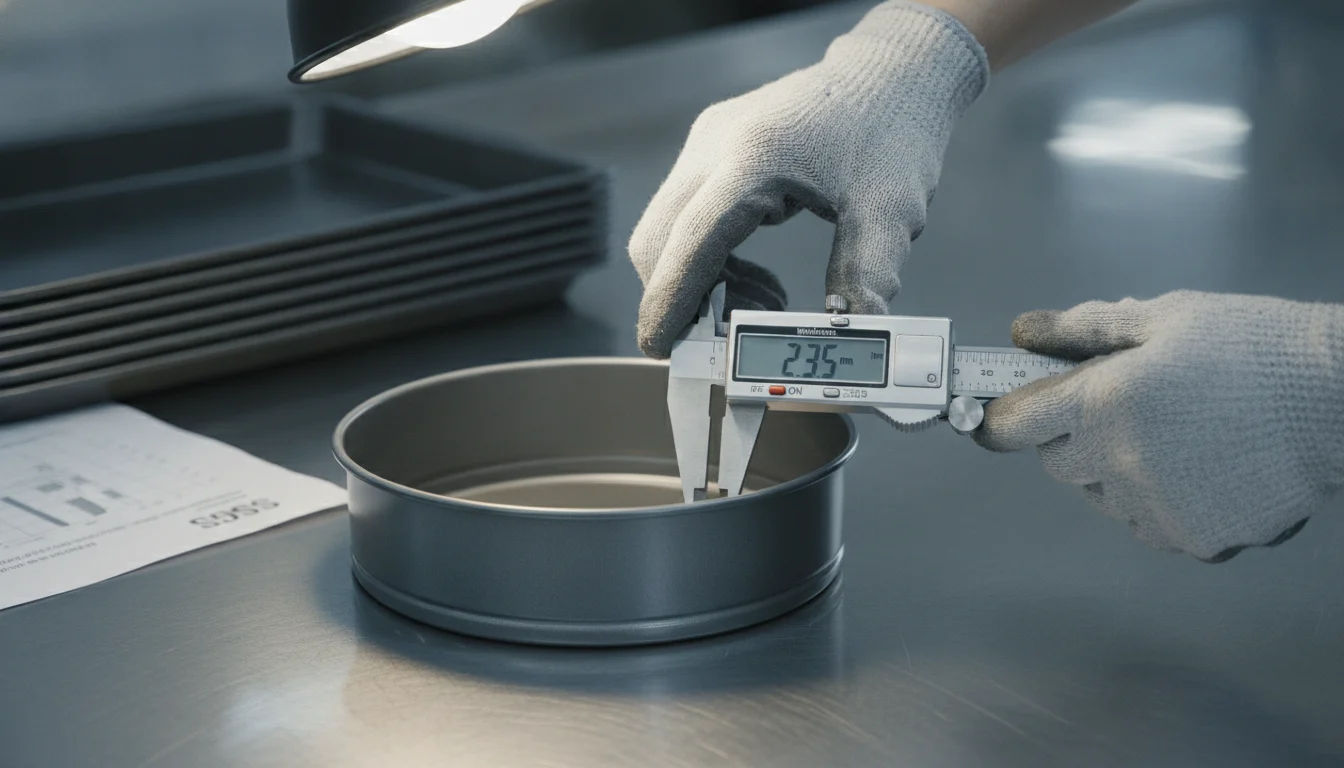
Individual carbon-steel, stainless-steel, and aluminum pieces require 1 piece for sampling and 500 pieces per SKU for an OEM production run. Sampling at 1 piece lets you check coating adhesion, gauge thickness, and dimensional accuracy against your local market’s expectations. The 500-piece threshold reflects the factory’s coating-line batch size and tooling setup cost.
Silicone molds, muffin cups, and cake-decorating tools follow the same 1-piece sample and 500-piece OEM structure as the metal line. Silicone tooling is mold-specific, so each SKU (for example, a 12-cup muffin tray versus a 6-cup tray) counts as a separate line item for MOQ purposes.
In practice: Sampling each SKU at 1 set or 1 piece before a full order lets a distributor check coating quality, fit, and packaging against local demand without tying up cash in untested inventory.
Container loading from Ningbo port is optimized for Lagos Apapa, Mombasa, and Francophone and Lusophone African ports (Abidjan, Dakar, Luanda, Maputo). Our team arranges stacking plans that maximize cubic utilization while keeping individual carton weight below the manual-handling limits common in African warehouses.
All shipments depart from Ningbo, Zhejiang. Transit days to Lagos Apapa, Mombasa, and West African ports are confirmed at quotation and depend on the carrier’s rotation schedule. Francophone and Lusophone markets may require additional documentation (certificate of origin, phytosanitary certificate, or pre-shipment inspection) that extends clearance time by several days.
Bakeware sets are packed in corrugated cartons sized to fit standard 20-foot and 40-foot containers. The team provides a container-loading plan showing carton count, gross weight, and cubic meters before booking, so you can calculate landed cost per unit and compare freight quotes. High-cube containers add 30 centimeters of height, which can increase carton count by 10 to 15 percent on lightweight SKUs.
Nigeria’s Standards Organisation of Nigeria (SON), Kenya’s Kenya Bureau of Standards (KEBS), and South Africa’s National Regulator for Compulsory Specifications (NRCS) all enforce food-contact safety rules. Our team issues a commercial invoice, packing list, bill of lading, and SGS/FDA test reports per order. Additional certificates (SONCAP for Nigeria, Pre-Export Verification of Conformity for Kenya) are arranged through the buyer’s clearing agent and are not included in the factory’s standard documentation package.
Stainless steel and food-grade silicone are the safest materials because they require no polymeric coatings and release no regulated substances during baking. Carbon steel with FDA 21 CFR 175.300-compliant non-stick coating is also safe when tested by an accredited laboratory; our 2020 SGS report confirms PFAS-free and Pb-free status on the carbon-steel line. Ceramic-coated and enamel bakeware carry higher contamination risk for lead and cadmium and should be accompanied by batch-level certificates of analysis.
Request a third-party test report from SGS, Intertek, or Bureau Veritas that explicitly lists lead and cadmium migration levels. The report should cite the test method (for example, FDA 21 CFR 175.300 or EN 1388-1) and show results below the regulatory limit for your destination market. Visual inspection cannot detect lead or cadmium; laboratory extraction testing is the only reliable verification method. Avoid suppliers who offer only a “food-safe” claim without a named standard or test report.
No. Silicone bakeware uses no polymeric coating, so FDA 21 CFR 175.300 (which governs resinous and polymeric coatings) does not apply. Food-grade silicone is instead tested under FDA 21 CFR 177.2600, which sets extraction limits for silicone rubber articles intended for repeated food contact. The carbon-steel line’s SGS/FDA certification does not cover silicone, stainless-steel, or aluminum lines; buyers should request separate test reports for each material type when sourcing a multi-material set.
Written by the Shansen Bakeware Export Team.
Ready to verify safety documentation and request samples for your market?
Request Test Reports & Samples →
MOQ 1 set on stock configurations. Tell us what you need and we reply on WhatsApp.
Click the button below to open WhatsApp. If you're not logged in to WhatsApp Web yet, scan the QR code first — then come back here and copy the message into the chat.