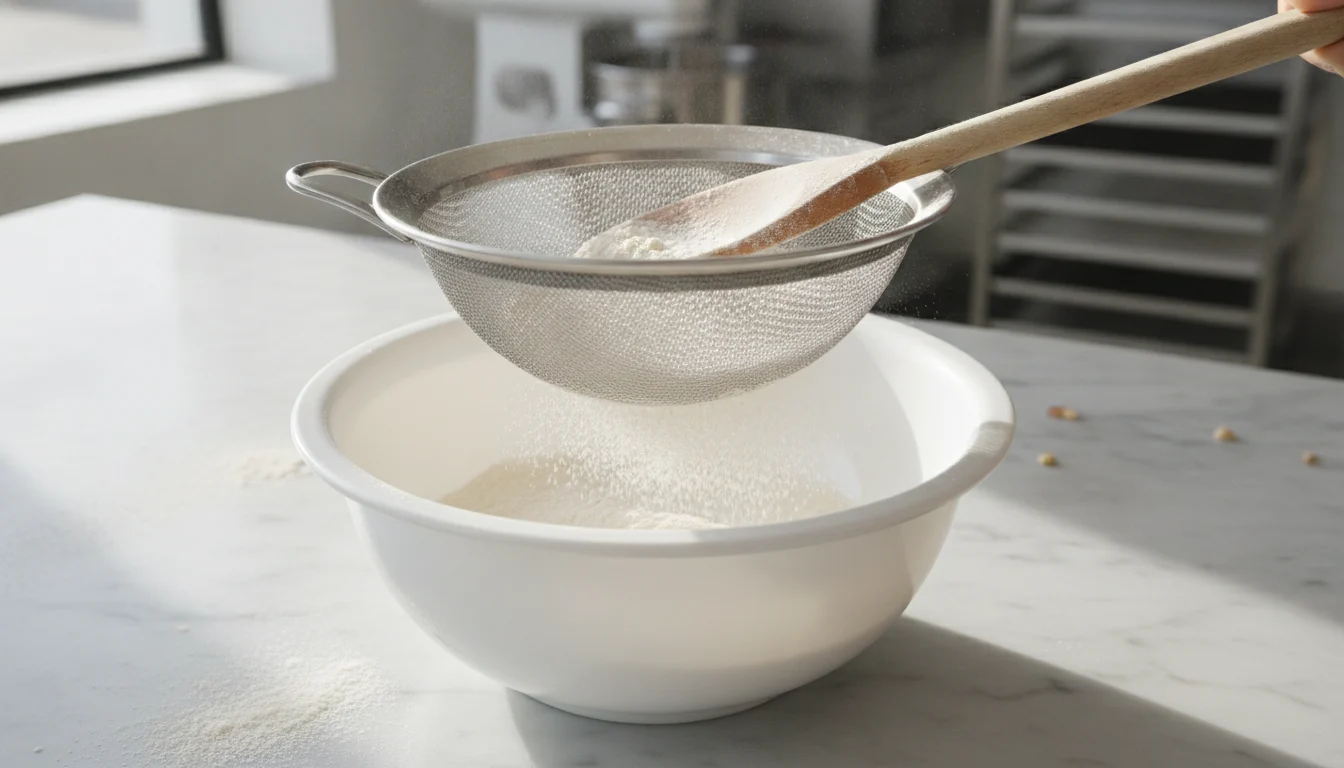
To sift flour without a sifter, use a fine-mesh strainer or sieve held over a bowl, then tap the side or stir the flour through with a spoon. A balloon whisk also aerates flour effectively when stirred vigorously for 20-30 seconds. Both methods break up clumps and incorporate air, matching the function of a dedicated sifter at zero additional cost.
📋 Table of Contents
Sifting removes clumps formed during storage and transport, ensuring even distribution of flour in batters and doughs. Clumped flour creates pockets of dry powder that do not hydrate uniformly, leading to dense spots in cakes and uneven crumb structure in breads. Aeration during sifting also increases flour volume slightly, which affects measurement accuracy when recipes call for sifted flour by volume rather than weight.
Flour stored in coastal or tropical regions absorbs ambient moisture, causing particles to stick together. A bag of all-purpose flour left unsealed for three days in Lagos or Mombasa can develop visible clumps that a spoon cannot break apart. Sifting before use eliminates these aggregates and restores the flour to a free-flowing state, critical for achieving target hydration ratios in professional baking.
Recipes written in cups rather than grams assume sifted flour unless stated otherwise. Unsifted flour packs more densely, adding 15-20% more mass per cup and throwing off ingredient ratios. Sifting before measuring standardizes volume, reducing batch-to-batch variation in texture and rise. Weight-based recipes bypass this issue, but many home and small-bakery formulas still rely on volume, making sifting a quality-control step.
A fine-mesh strainer or sieve serves as a direct sifter replacement for small to medium batches. Hold the strainer over a mixing bowl, add one to two cups of flour, then tap the side with your hand or stir the flour through with a spoon. The mesh breaks up clumps as flour passes through, and the falling motion aerates the flour similarly to a rotary sifter. This method suits home bakers and small-batch operations that process two to four kilograms of flour per day.
Strainers with 40-60 mesh count (openings around 0.25-0.40 mm) balance throughput and clump removal. Finer mesh clogs quickly with dense or slightly damp flour, forcing you to scrape and tap repeatedly. Coarser mesh lets small clumps pass through, defeating the purpose. Stainless-steel strainers resist rust in humid kitchens and maintain mesh tension longer than painted or coated alternatives, an advantage for distributors supplying coastal African markets where humidity accelerates corrosion.
Fine-mesh substitutes can clog quickly when the flour is packed too full, making the process slow and messy. Working in one-cup increments keeps the mesh clear and maintains consistent aeration. Attempting to sift four cups at once overloads the strainer, compressing flour against the mesh and creating a bottleneck. For recipes requiring five or more cups of sifted flour, divide into multiple passes or consider a dedicated sifter to avoid workflow slowdown.
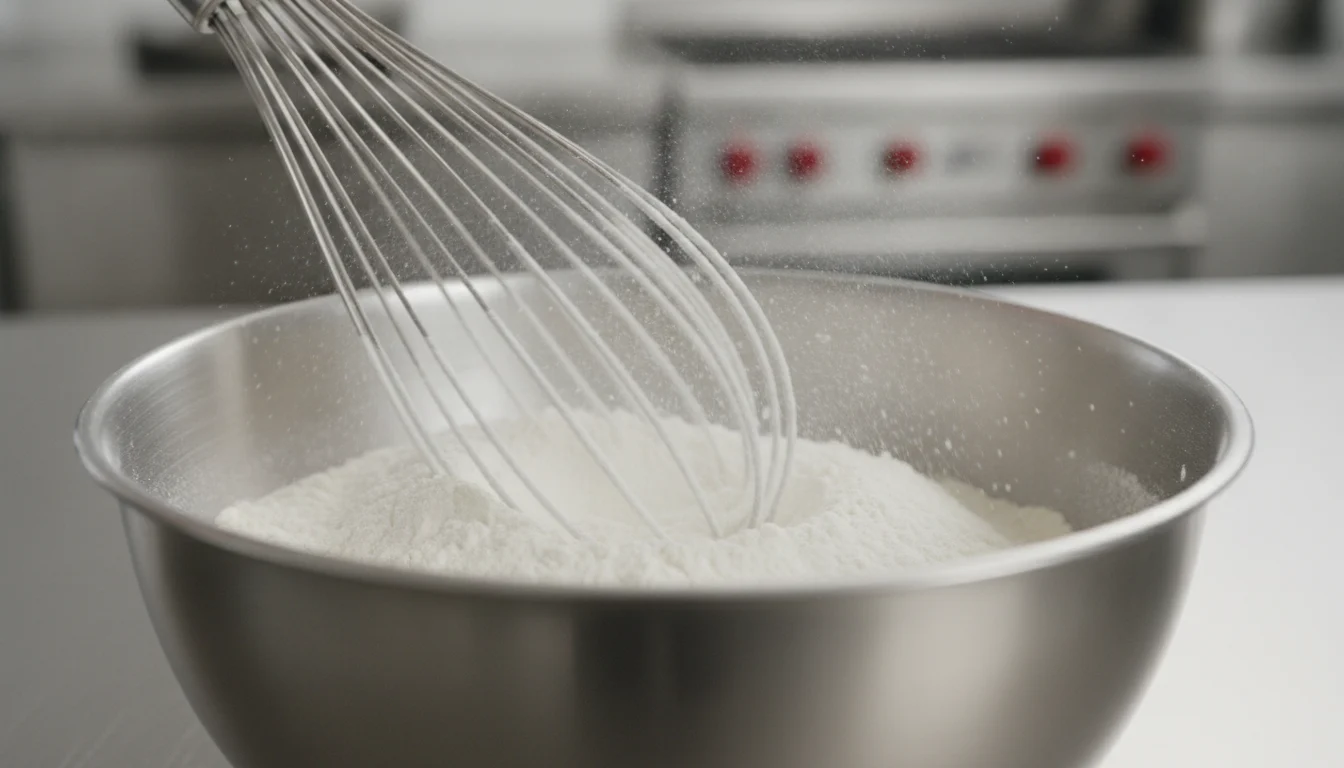
A balloon whisk offers the fastest no-tool option for aerating flour. Place flour in a wide bowl, insert the whisk, and stir vigorously in circular and figure-eight motions for 20-30 seconds. The wires cut through clumps and fold air into the flour, producing a lighter texture without the need for a sieve. This method works well when recipes call for sifting dry ingredients together, such as flour with baking powder or cocoa, as the whisk blends and aerates in one step.
Whisking disperses small to medium clumps but struggles with hardened aggregates formed by prolonged moisture exposure. If flour contains pebble-sized lumps, pre-break them with a fork or spoon before whisking. The whisk then finishes the job, ensuring no dry pockets remain. For pre-sifted or well-stored flour with minimal clumping, whisking alone suffices and saves time compared to strainer methods.
Use a whisk with at least eight wires for maximum aeration. Fewer wires reduce surface contact and leave more flour undisturbed. Maintain a brisk pace, lifting the whisk slightly to fold air from the top of the bowl downward. Thirty seconds of active whisking incorporates roughly the same air volume as two passes through a hand-crank sifter. Check for remaining clumps by running a finger through the flour; if you feel grit or lumps, whisk for another ten seconds.
A standard dinner fork can break up flour clumps when no whisk or strainer is available. Drag the tines through the flour in multiple directions, pressing lightly to crush aggregates. This method aerates less than whisking but suffices for quick fixes when texture is less critical, such as dusting a work surface or mixing a simple roux. For larger volumes, a lidded container shaken vigorously for 15-20 seconds tumbles flour and incorporates air, though it creates less uniform aeration than sifting or whisking.
Hold the fork at a shallow angle and use a raking motion, similar to tilling soil. Work through the entire flour mass, then repeat in perpendicular directions to catch clumps missed on the first pass. This approach is labor-intensive for more than one cup but requires no equipment beyond what most kitchens already have. It is a practical fallback when strainers and whisks are in use elsewhere during multi-recipe prep.
Transfer flour to a large jar or food-storage container with a tight-fitting lid. Seal and shake vigorously for 15-20 seconds, tumbling the flour to break up clumps and trap air. Open the lid slowly to avoid a flour cloud, then transfer to your mixing bowl. This method suits dry, free-flowing flour but struggles with damp or compacted flour, which tends to re-clump during shaking. It is best reserved for flour stored in low-humidity environments or for quick aeration of pre-sifted flour that has settled during transport.
Improvised methods meet occasional needs but become inefficient at scale. Bakeries processing ten or more kilograms of flour daily, or distributors assembling wholesale bakeware sets for retail clients, benefit from dedicated sifters that handle larger batches with less manual effort. Stainless-steel rotary sifters and crank-handle models process three to five cups per cycle, reducing prep time and freeing staff for other tasks.
Manual sifting takes more effort and time than many home bakers expect, especially when the flour is clumpy or dense. If you sift flour more than three times per week, or work with recipes requiring five or more cups of sifted flour per batch, a dedicated tool pays for itself in labor savings within a month. Small bakeries and catering operations that bake daily should prioritize a hand-crank or battery-powered sifter to maintain consistent output without bottlenecking prep workflows.
Stainless-steel sifters resist rust and maintain mesh tension longer than aluminum or plastic models, critical for operations in humid climates. Our Yongkang factory produces stainless-steel and aluminum sifters as part of the strainers-and-sifters line, with mesh sizes matched to common flour grades used in African retail channels. Squeeze-handle sifters without an agitator can clog on denser dry ingredients, so they are not reliable for every flour type; rotary models with internal agitators handle whole-wheat and specialty flours more consistently. Budget or compact sifters can feel underpowered for larger jobs, especially when bakers want to sift several cups at once; capacity matters as much as mesh quality when selecting a tool for high-volume use.
Home bakers who sift flour once or twice per month, or operations that primarily use weight-based recipes and sift only for specialty items like cake flour or cocoa, can continue with strainer or whisk methods indefinitely. The labor cost of improvised sifting remains low when volume is minimal, and avoiding a dedicated tool frees up storage space in compact kitchens. Distributors sourcing for this segment should stock fine-mesh strainers alongside sifters, as many buyers prefer multi-function tools that serve as both sieve and sifter.
In practice: Working in one-cup increments through a fine-mesh strainer keeps mesh clear and maintains consistent aeration, avoiding the clogging that occurs when three or more cups are sifted at once
Distributors assembling low-MOQ bakeware kits for startup bakeries should include at least one multi-function strainer in each set, as new operators often lack dedicated sifters and rely on improvised methods during early production runs. Pairing a stainless-steel strainer with silicone spatulas and measuring cups covers the most common prep tasks without inflating the kit price. Buyers can upgrade to rotary sifters once volume justifies the investment, but the strainer remains useful for tasks beyond sifting, such as rinsing berries or draining pasta.
A whisk aerates flour effectively and disperses small clumps, making it suitable for most home baking recipes that call for sifted flour. It struggles with hardened aggregates formed by prolonged moisture exposure, which require pre-breaking with a fork or spoon before whisking. For recipes demanding ultra-fine texture, such as angel food cake or French macarons, a fine-mesh sieve or dedicated sifter produces more consistent results by catching every particle and ensuring uniform aeration across the entire batch.
A mesh count between 40 and 60 (openings around 0.25-0.40 mm) balances throughput and clump removal for all-purpose and cake flour. Finer mesh clogs quickly with dense or slightly damp flour, requiring frequent scraping and tapping to maintain flow. Coarser mesh lets small clumps pass through, reducing the effectiveness of sifting. Stainless-steel construction resists rust and maintains mesh tension longer than painted or coated alternatives, an important consideration for kitchens in humid climates where corrosion accelerates tool degradation.
Hold the strainer or sieve close to the surface of the receiving bowl, reducing the distance flour falls and minimizing airborne particles. Tap the side gently rather than shaking vigorously, which throws flour into the air. When using a shaker container, open the lid slowly after shaking stops, allowing settled flour to rest before transferring. Work in a well-ventilated area and avoid positioning your face directly above the bowl, as even controlled sifting releases fine particles that can irritate airways during extended prep sessions.
Need strainers, sifters, or complete bakeware sets for your operation?
Request samples and MOQ details →
Written by the Shansen Bakeware Export Team.
MOQ 1 set on stock configurations. Tell us what you need and we reply on WhatsApp.
Click the button below to open WhatsApp. If you're not logged in to WhatsApp Web yet, scan the QR code first — then come back here and copy the message into the chat.