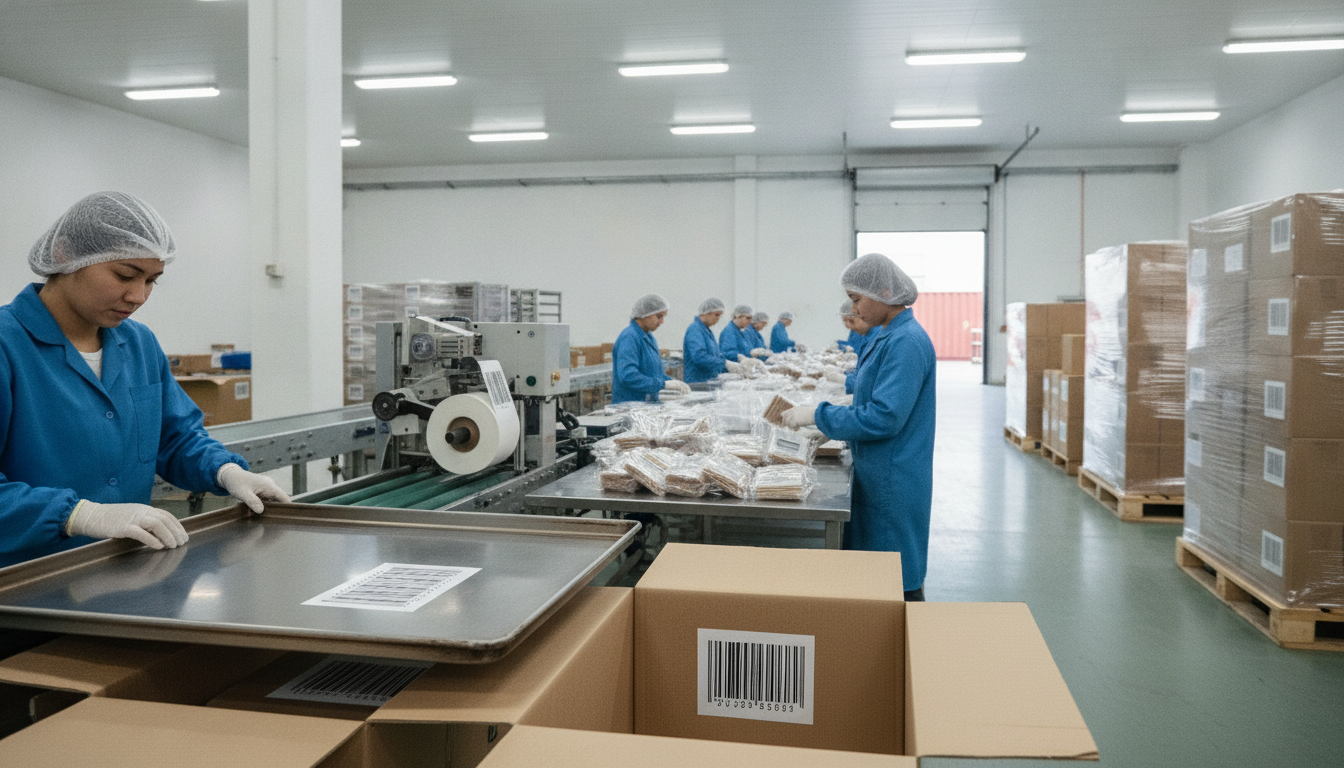
A private label cookie sheet packaging barcode service provides EAN-13 or UPC-A label printing, GS1 barcode registration, carton marking, and scannable-label production tailored to bakeware packaging surfaces. The service includes barcode data setup, label-size specification, adhesive selection for metal or cardboard substrates, and roll or sheet format delivery. Shansen Bakeware coordinates this end-to-end for cookie-sheet orders shipped to Lagos Apapa, Mombasa, and West African ports, ensuring retail-ready packaging from our Ningbo container-loading dock.
📋 Table of Contents

A complete private label cookie sheet packaging barcode service starts with barcode-data generation and ends with scannable labels applied to finished packaging. The workflow includes GS1 barcode registration, label artwork design, print-quality verification, and delivery in roll or sheet format. Cookie sheets ship in corrugated cartons or plastic sleeves, and each packaging type requires a different label substrate and adhesive strength to survive warehouse handling and retail shelf stocking.
The service provider generates EAN-13 or UPC-A barcode numbers from the buyer’s GS1 company prefix, assigns unique SKU identifiers, and encodes product attributes such as size, material, and coating type. Buyers supply a product master list with SKU names, dimensions, and pack quantities. The provider returns a barcode spreadsheet linking each SKU to its assigned 13-digit EAN-13 number. This spreadsheet feeds into label-artwork templates and inventory-management systems.
Label artwork combines the barcode graphic, product name, SKU code, batch number, and optional branding elements. Artwork must meet minimum bar-width and quiet-zone specifications to pass retail-scanner verification. The service includes layout proofs showing label placement on carton flaps, product sleeves, or hang-tag cards. Buyers approve artwork before print production begins.
Labels are printed using thermal transfer, flexographic, or digital methods depending on order quantity and substrate. Each print batch undergoes barcode-scanner verification to confirm that every label achieves a minimum grade of C or better on the ANSI grading scale. Low-grade barcodes fail point-of-sale scanners and cause receiving delays at distribution centers.
Labels arrive on rolls for automated applicators or as die-cut sheets for manual application. Roll labels specify core diameter, roll width, and label count per roll. Sheet labels specify sheet size, label matrix layout, and peel-off backing. Buyers coordinate label delivery with cookie-sheet production schedules to ensure packaging materials arrive before carton packing begins.
Shansen Bakeware coordinates barcode-service workflows for wholesale bakeware sets shipped from Ningbo to African ports. Our Yongkang factory produces 500,000 units per month across 7 in-house bakeware lines, and we synchronize label delivery with container-loading schedules to avoid packaging delays.
EAN-13 barcodes require a GS1 company prefix issued by the national GS1 organization in the country where the brand is registered. Distributors selling cookie sheets in Nigeria, Kenya, and South Africa face a choice: register separate GS1 prefixes in each country or obtain a global GS1 license that covers all three markets. Each option carries different costs and administrative requirements.
GS1 Nigeria, GS1 Kenya, and GS1 South Africa each issue company prefixes valid only within their national borders. A distributor registered in Lagos obtains a Nigerian prefix and encodes it into EAN-13 barcodes for products sold in Nigerian retail chains. If the same distributor later expands into Nairobi supermarkets, they must register a separate Kenyan prefix and reprint all labels with the new barcode. This approach minimizes upfront cost but creates label-inventory complexity when selling across multiple countries.
A global GS1 license allows a single company prefix to be recognized in all GS1 member countries. The license is issued by the brand owner’s home-country GS1 organization and costs more than a single-country prefix. Distributors planning to sell in three or more African markets find that global licenses reduce label-reprint costs and simplify SKU management. The same EAN-13 barcode works in Lagos, Mombasa, and Johannesburg retail chains.
Each GS1 prefix encodes the issuing country and company identifier. Nigerian prefixes start with 615, Kenyan with 616, and South African with 600-601. Retail buyers scan these prefixes to verify product origin and supplier identity. Distributors using a global license choose the prefix country based on where their brand is legally registered, not where the factory is located. A Lagos-based distributor manufacturing in China uses a 615 Nigerian prefix if the brand is registered in Nigeria.
In practice: A Nairobi kitchenware distributor registered a Kenyan GS1 prefix and printed 10,000 labels for carbon-steel cookie sheets, then won a contract with a Lagos retail chain and had to reprint all labels with a Nigerian prefix, doubling label costs.
Shansen Bakeware advises buyers on GS1 strategy during the custom OEM private label bakeware planning phase. We coordinate label artwork with GS1 prefix allocation to avoid reprint costs when distributors expand into new African markets.
Cookie sheets ship in corrugated cartons, plastic sleeves, or shrink-wrapped bundles, and each packaging type imposes different label requirements. Labels must adhere to the substrate, survive warehouse temperature swings, and remain scannable after handling by forklift operators and shelf stockers. Buyers specify label size, adhesive type, and substrate material based on the packaging surface and application method.
EAN-13 barcodes require a minimum width of 29.83 mm at 100% magnification. Labels smaller than this fail scanner verification. Cookie-sheet cartons typically use 50 mm × 30 mm labels to provide space for the barcode, SKU text, and batch number. Larger cartons accommodate 75 mm × 50 mm labels that include branding graphics and product images. Label height must allow for quiet zones-blank margins above and below the barcode-of at least 2.5 mm to prevent scan errors.
Permanent acrylic adhesive works for corrugated-carton labels that remain on the box through retail sale. Removable adhesive suits plastic sleeves where the buyer wants the label to peel off cleanly without leaving residue. Freezer-grade adhesive is required for cookie sheets stored in cold warehouses, as standard adhesive fails below 5°C and causes labels to detach. Buyers specify the warehouse temperature range when ordering labels.
Paper labels cost less but tear easily and absorb moisture in humid climates. Polypropylene film labels resist water and oil, making them suitable for plastic sleeves and shrink-wrapped bundles. Polyester labels withstand abrasion and extreme temperatures, ideal for metal tins or heavy-duty cartons that undergo rough handling. Buyers match substrate to the packaging environment and expected shelf life.
Thermal-transfer printing produces durable barcodes that resist fading under warehouse lighting. Inkjet printing costs less but smudges when wet. Flexographic printing suits high-volume orders above 50,000 labels and delivers consistent bar-width control. Buyers request print samples scanned at multiple angles to confirm readability before approving production.
Importers report that labels with incorrect adhesive or substrate fail during transit from Ningbo to Lagos Apapa, causing retail rejection when barcodes are unreadable. Shansen Bakeware tests label adhesion on actual cookie-sheet packaging materials before approving label production, reducing the risk of transit damage.
Buyers choose roll or sheet label formats based on whether labels will be applied manually or with automated equipment. Roll labels feed into label applicators that dispense and apply labels at high speed. Sheet labels suit manual workflows where workers peel labels from backing sheets and apply them by hand. Each format has different cost structures and workflow requirements.
Roll labels come wound on 76 mm or 40 mm cores, with label counts ranging from 500 to 5,000 per roll depending on label size. Automated label applicators pull labels from the roll, activate the adhesive, and press them onto cartons at rates up to 60 labels per minute. Roll labels cost less per unit than sheet labels at volumes above 10,000 pieces, but they require an applicator machine and trained operators. Buyers specify roll direction-labels dispensing from the top or bottom of the roll-to match their applicator’s feed mechanism.
Sheet labels are die-cut on A4 or letter-size backing sheets, with 6 to 24 labels per sheet depending on label size. Workers peel labels from the sheet and apply them to cartons by hand. Sheet labels suit low-volume production runs below 5,000 units and workflows where label placement varies by product. Sheet labels cost more per unit than roll labels but eliminate the need for applicator equipment. Buyers order sheets in quantities matching their weekly production volume to avoid label-inventory buildup.
Some distributors use roll labels for high-volume SKUs and sheet labels for slow-moving or seasonal products. A Lagos-based kitchenware importer applies roll labels to standard 13-inch carbon-steel cookie sheets that ship in 500-unit cartons, and sheet labels to specialty silicone baking mats that ship in 50-unit batches. This hybrid approach balances cost efficiency with workflow flexibility.
Buyers often struggle when suppliers do not clearly specify whether labels should come on sheets or rolls, causing incompatibility with application workflows. Shansen Bakeware asks buyers to describe their label-application process during the low MOQ bakeware for startups consultation, then recommends roll or sheet format based on production volume and equipment availability.
Retail buyers reject cookie-sheet shipments when barcode labels fail point-of-sale scanner verification. Scannable quality depends on bar-width accuracy, print contrast, quiet-zone margins, and substrate smoothness. A private label cookie sheet packaging barcode service includes scanner-grade verification before labels ship, reducing the risk of retail rejection.
Barcode scanners measure label quality on the ANSI grading scale, with grades from A (best) to F (fail). Retail chains require labels to achieve a minimum grade of C to pass receiving inspection. Grade C labels have minor print defects but remain readable at standard scan distances. Labels grading D or F fail scanner verification and trigger shipment holds. The barcode service provider scans a sample from each print batch and reports the ANSI grade before releasing labels for shipment.
Quiet zones are blank margins surrounding the barcode that prevent adjacent graphics or text from interfering with scanner reads. EAN-13 barcodes require a 2.5 mm quiet zone on the left and right edges. Labels printed too close to the edge of the backing sheet or positioned near carton seams violate quiet-zone rules and fail scanning. Artwork templates must enforce quiet-zone margins during the design phase.
Barcode scanners rely on high contrast between black bars and white spaces to decode the number. Low-contrast printing-caused by faded ink, dirty print heads, or low-quality substrates-reduces scan accuracy. Bar edges must be sharp with no feathering or ink bleed. Thermal-transfer printing delivers sharper edges than inkjet, making it the preferred method for labels that must pass strict retail standards.
Labels applied to rough or textured surfaces create air pockets that distort bar widths and reduce scan accuracy. Corrugated-carton labels require smooth-faced substrates that bridge surface irregularities. Adhesive must hold labels flat without bubbling or peeling, as curled labels cast shadows that interfere with scanner reads. Buyers request adhesive-bond tests on actual packaging materials before approving label production.
Scanner verification: ANSI grade C minimum. Quiet zones: 2.5 mm left and right. Print method: Thermal transfer for retail-grade sharpness.
Buyers report that barcode labels are not scannable when artwork, size, or print quality is not tightly controlled, which creates receiving and retail rejection problems. Shansen Bakeware coordinates with label suppliers who provide ANSI-grade verification reports and adhesive-bond test results for food-grade SGS FDA certified bakeware packaging, ensuring labels meet retail-chain acceptance standards before container loading at Ningbo port.
EAN-13 is the standard barcode for retail products sold in Africa, Europe, and most global markets. UPC-A is used primarily in the United States and Canada. Distributors selling cookie sheets in Nigerian, Kenyan, or South African retail chains should use EAN-13 barcodes with a GS1 company prefix registered in the destination country or a global GS1 license covering all three markets.
EAN-13 is required for products sold in African, European, and Asian retail chains. UPC-A is accepted in North American markets. If you plan to sell cookie sheets in Lagos, Mombasa, or Johannesburg supermarkets, use EAN-13 barcodes. If your distribution includes U.S. or Canadian buyers, request dual EAN-13 and UPC-A labels or choose EAN-13, which most North American scanners also recognize.
Yes. Roll labels feed into automated applicators for high-volume production, while sheet labels suit manual application workflows. Roll labels cost less per unit at volumes above 10,000 pieces but require applicator equipment. Sheet labels eliminate equipment costs and work well for low-volume or seasonal products. Buyers specify roll or sheet format based on production volume and label-application method.
Buyers provide a product master list with SKU names, dimensions, pack quantities, and GS1 company prefix. The label service generates EAN-13 numbers, designs artwork with barcode graphics, product names, SKU codes, and batch numbers, then delivers layout proofs for approval. Additional requirements include label size, adhesive type, substrate material, and delivery format (roll or sheet).
Labels must achieve ANSI grade C or better, with sharp bar edges, high print contrast, and 2.5 mm quiet zones on each side. Use thermal-transfer printing for retail-grade sharpness, match adhesive to the packaging surface, and avoid placing labels near carton seams or textured areas. Request ANSI-grade verification reports from the label supplier before approving production to reduce the risk of retail rejection.
Ready to coordinate barcode-service workflows for your private-label cookie sheets shipped to African ports?
Request label specs and GS1 setup guidance →
Written by the Shansen Bakeware Export Team.
MOQ 1 set on stock configurations. Tell us what you need and we reply on WhatsApp.
Click the button below to open WhatsApp. If you're not logged in to WhatsApp Web yet, scan the QR code first — then come back here and copy the message into the chat.