📋 Table of Contents
Restaurant chains and catering-supply distributors sourcing industrial pizza pan perforated factory direct face three recurring obstacles: thin gauge metal that warps after repeated 500°F cycles, inconsistent hole spacing that delivers uneven crust browning, and hidden MOQ thresholds that surface only after a week of email exchanges. A Lagos-based bakery-supply importer recently shared that two container loads of 14-inch perforated pans arrived with 2 mm holes instead of the specified 3 mm, forcing a complete reorder and delaying three restaurant openings by six weeks.
This guide walks through material gauge requirements, perforation-pattern standards, and the factory-direct procurement process for commercial pizza pans. You will see which specifications prevent warping, how hole diameter affects bake time, and what questions to ask before requesting samples.
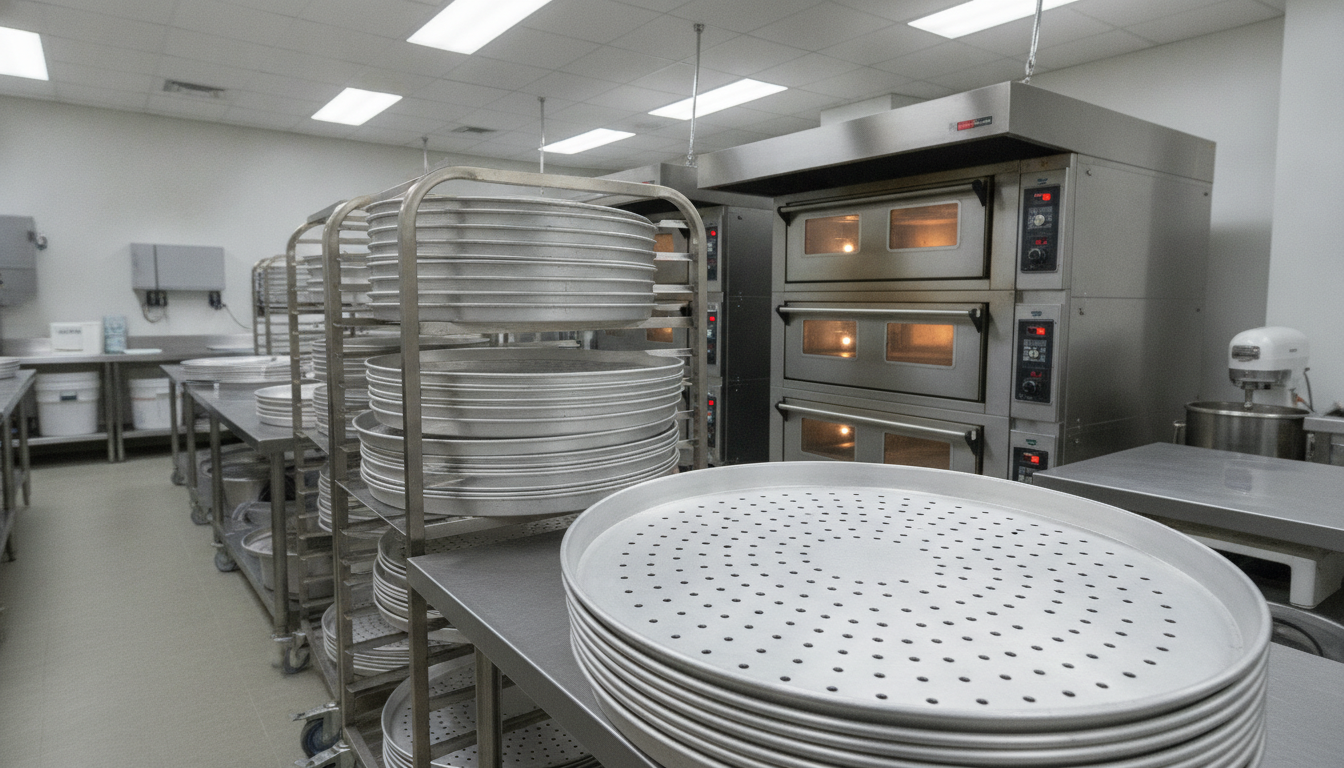
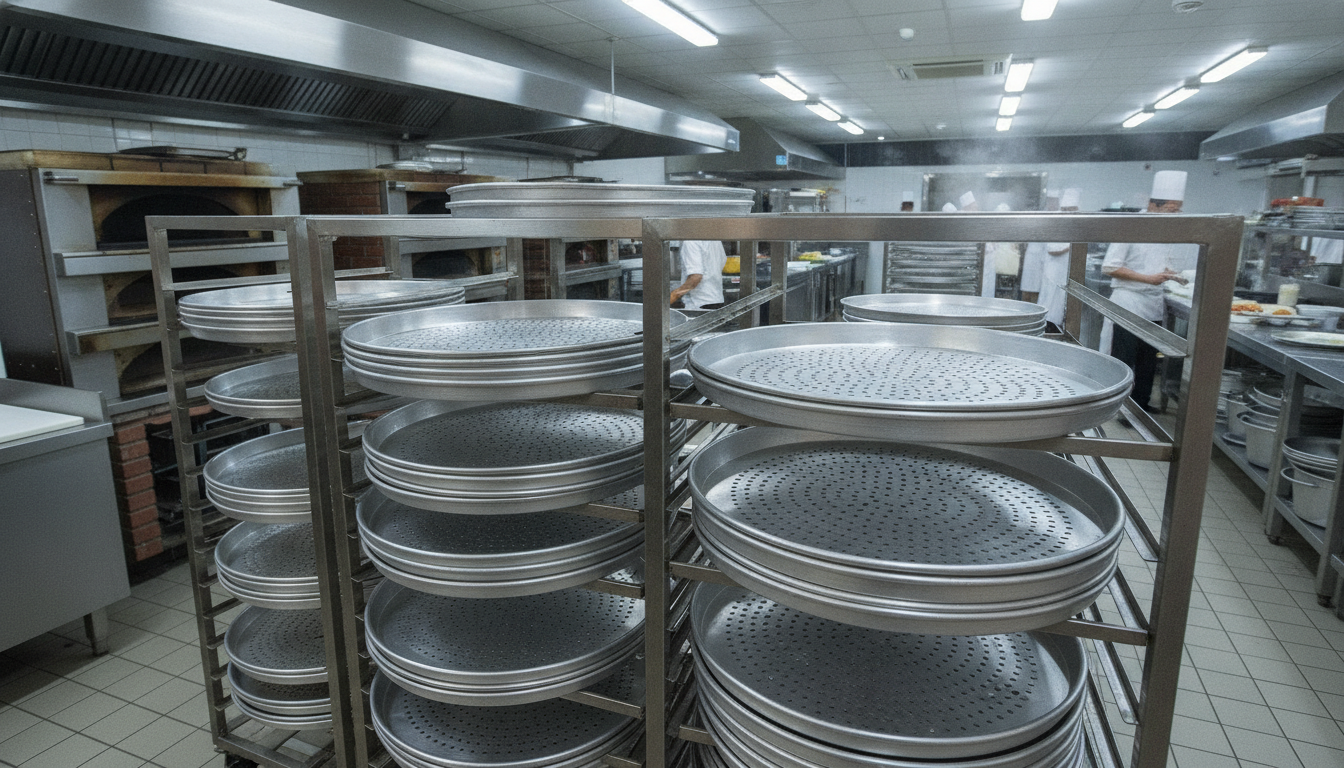
Perforated pizza pans solve the steam-trap problem that solid pans create. When dough bakes, it releases moisture. Solid pans trap that steam between the dough and the metal surface, producing a soft, pale crust. Perforation allows steam to escape through the holes, creating direct hot-air contact with the dough bottom and delivering the crisp, golden crust that customers expect from Neapolitan and New York-style pizzas.
Commercial deck ovens and conveyor systems operate at 475-550°F. Perforated pans reduce bake time by 12-18 percent compared to solid pans because hot air circulates through the holes and heats the dough from below. A Nairobi restaurant chain running a Lincoln Impinger conveyor oven measured bake time dropping from 7.5 minutes to 6.2 minutes after switching to 3 mm perforated aluminum pans, increasing hourly throughput from 48 pizzas to 58 pizzas per oven.
Perforation creates a crunchier bottom crust without overbaking the toppings. Restaurant buyers report that customer complaints about soggy or undercooked crusts drop significantly when perforated pans replace solid pans. The texture difference is most noticeable in high-moisture toppings like fresh mozzarella, tomatoes, and mushrooms, where excess liquid would otherwise pool on a solid pan surface.
Material choice determines heat conductivity, weight, durability, and cost. Commercial kitchens prioritize different attributes depending on oven type, volume, and budget.
Aluminum perforated pizza pans weigh 30-40 percent less than carbon steel equivalents, reducing operator fatigue during high-volume shifts. Aluminum conducts heat 2.4 times faster than steel, delivering faster bottom-crust browning. The trade-off is lower structural rigidity; aluminum pans require 1.0 mm minimum gauge to prevent warping under repeated thermal stress. Restaurant chains running conveyor ovens prefer aluminum because the lighter weight reduces wear on conveyor belts and motors.
Shansen Bakeware produces aluminum perforated pizza pans in 12-inch, 14-inch, and 16-inch diameters at 1.0 mm and 1.2 mm gauge options. The wholesale bakeware sets line includes mixed-size assortments for distributors supplying independent pizzerias with varied oven capacities.
Carbon steel perforated pans cost 20-25 percent less than aluminum per unit and tolerate rougher handling in high-turnover kitchens. Carbon steel requires 0.8 mm minimum gauge for commercial use; thinner gauges buckle after 50-60 bake cycles at 500°F. The heavier weight (approximately 340 grams for a 14-inch pan versus 240 grams for aluminum) makes carbon steel less suitable for conveyor systems but acceptable for deck ovens where pans remain stationary.
Carbon steel develops a natural seasoning layer over time, similar to cast iron, which some pizzeria operators value for flavor development. The material oxidizes without proper care, so buyers must specify a food-grade coating or accept the maintenance requirement of regular oiling.
Stainless steel perforated pizza pans cost 40-50 percent more than carbon steel but eliminate rust and coating-degradation concerns. Stainless steel is the preferred choice for commissary kitchens and multi-unit chains with centralized washing facilities using harsh detergents and high-temperature dishwashers. The material’s lower thermal conductivity (approximately 16 W/m·K versus 205 W/m·K for aluminum) means slightly longer bake times, which some operators offset by preheating pans.
Stainless steel perforated pans are common in European and Middle Eastern markets where health inspections emphasize corrosion-free surfaces. African distributors serving hotel chains and upscale restaurant groups increasingly request stainless options for the same reason.
Hole diameter, spacing pattern, and total open area determine airflow volume and baking performance. Importers often overlook these specifications until the first production batch arrives and crust quality does not match expectations.
Commercial perforated pizza pans use hole diameters between 2.5 mm and 4 mm. Smaller holes (2.5 mm) provide structural strength but reduce airflow by 30-35 percent compared to 4 mm holes. Larger holes (4 mm and above) risk dough seepage during proofing, especially with high-hydration doughs above 65 percent water content.
Recommended spec: 3 mm hole diameter for general-purpose use. Hole spacing: 12-15 mm center-to-center. Open area: 18-22 percent of total pan surface.
A Johannesburg catering-supply distributor tested three perforation patterns with a local pizzeria client: 2.5 mm holes at 10 mm spacing, 3 mm holes at 12 mm spacing, and 4 mm holes at 15 mm spacing. The 3 mm pattern delivered the best balance of crust crispness and dough stability, while the 4 mm pattern caused dough to sag through holes during the 20-minute proof stage.
Uniform grid patterns distribute holes evenly across the entire pan surface, creating consistent airflow. Radial patterns concentrate holes toward the pan center and reduce density near the rim, which some operators prefer for thicker-crust styles where edge browning should be gentler. Most commercial buyers specify uniform patterns because they simplify inventory management and work across multiple pizza styles.
Total open area is the percentage of the pan surface occupied by holes. Commercial perforated pizza pans typically range from 15 percent to 25 percent open area. Higher open area increases airflow and crust crispness but reduces structural support for heavy toppings. A 14-inch pan with 20 percent open area contains approximately 180-200 holes at 3 mm diameter.
Restaurant chains running high-volume operations should request open-area specifications in writing and verify them on the first sample. Buyers frequently discover that factory listings showing “perforated” pans do not specify hole count or open area, leading to performance mismatches.
Sourcing industrial pizza pan perforated factory direct eliminates the 35-45 percent markup that trading companies and regional wholesalers add. Factory-direct procurement also provides access to customization options that middlemen cannot offer.
Traditional bakeware factories require 500-1,000 piece minimums per SKU, forcing distributors to commit capital before validating demand.
In practice: A Mombasa kitchenware importer validated 12-inch, 14-inch, and 16-inch aluminum perforated pans with 1-piece samples, then placed a 90-unit mixed order (30 per size) to supply three independent pizzerias, avoiding the $4,200 inventory lock of a 500-piece single-SKU order
The low-MOQ bakeware for startups program supports African distributors entering the restaurant-supply segment without tying up working capital in slow-moving inventory.
Factory-direct sourcing enables custom diameter, rim height, and handle design. A Lagos-based distributor supplying a regional pizza chain requested 13.5-inch perforated pans to fit the chain’s existing oven racks, a size unavailable through catalog wholesalers. The factory produced a 50-piece trial run at standard pricing because the diameter change required only a die adjustment, not a full tooling investment.
Private-label branding is available at 100-piece minimums per SKU. Distributors serving branded restaurant chains or launching their own kitchenware lines can add logos, SKU codes, and care instructions via laser etching or stamped embossing. The custom OEM private label bakeware service includes design file review and pre-production samples within 10-12 days.
Factory-direct orders ship in 18-22 days for standard SKUs and 25-30 days for custom specifications, compared to 35-50 days when ordering through trading companies that batch multiple clients’ orders. Reorder lead times drop to 12-15 days once the factory has the buyer’s specifications and payment terms on file.
Shansen Bakeware maintains 500,000 units per month production capacity across seven bakeware lines, ensuring that restock orders for high-turnover distributors ship without delay. The Yongkang factory and Yiwu sourcing showroom allow buyers to inspect production samples in person before committing to container loads.
Importers who skip specification verification during sampling face costly rework or unsellable inventory. The checklist below prevents the most common procurement failures.
African ports increasingly require food-contact certification at customs clearance. Buyers should request the following documents before production:
The food-grade SGS FDA certified bakeware page provides downloadable compliance documentation for standard SKUs, reducing the documentation burden on first-time importers.
Factory-direct pricing should include a clear breakdown of unit cost, tooling fees (if custom), sampling cost, and shipping terms. Buyers report that some factories quote attractive per-unit prices but add undisclosed charges later:
Restaurant chains and distributors should establish a spare-stock strategy before the first shipment depletes. Perforated pizza pans are consumable items; heavy-use pizzerias replace pans every 6-9 months as perforation edges dull and surfaces discolor. Distributors who wait until stock runs out face 4-6 week replenishment gaps that drive clients to competitors.
Shansen Bakeware maintains a 12-15 day reorder lead time for repeat buyers with established specifications on file. The baking tools wholesale Nigeria program includes consignment inventory options for distributors serving Lagos, Abuja, and Port Harcourt markets, reducing the need for large upfront stock commitments.
A perforated pizza pan allows hot air to circulate through holes in the pan bottom, creating direct contact with the dough and producing a crisp, golden crust. The perforation eliminates the steam-trap effect of solid pans, which causes soft, pale crusts. Commercial pizzerias use perforated pans to reduce bake time by 12-18 percent and improve crust texture, especially for Neapolitan and New York-style pizzas with thin, crispy bottoms.
Aluminum is best for high-volume conveyor ovens because it weighs 30-40 percent less than steel and conducts heat 2.4 times faster, reducing bake time and operator fatigue. Carbon steel offers better durability and costs 20-25 percent less per unit, making it suitable for deck ovens and budget-conscious buyers. Stainless steel is the premium choice for commissary kitchens and hotel chains that prioritize corrosion resistance and dishwasher compatibility, though it costs 40-50 percent more than carbon steel.
The best size matches your oven rack dimensions and pizza diameter. Standard commercial sizes are 12-inch, 14-inch, and 16-inch. A 14-inch pan fits most deck ovens and conveyor systems and accommodates 12-inch pizzas with a 1-inch rim for handling. Restaurant chains should measure oven rack width and depth before ordering; a pan that does not fit standard racks creates workflow bottlenecks. Custom diameters like 13.5-inch are available factory-direct for non-standard oven configurations.
Perforated pans are better for crispy-crust styles like Neapolitan, New York, and thin-crust pizzas because the holes allow steam to escape and hot air to contact the dough directly. Solid pans are better for deep-dish and pan pizzas where a softer, bread-like crust is desired. Perforated pans reduce bake time by 12-18 percent and improve crust texture, but they require proper hole diameter (3 mm recommended) and spacing (12 mm center-to-center) to deliver consistent results.
Yes, buying industrial pizza pan perforated factory direct eliminates the 35-45 percent markup that trading companies and wholesalers add. Factory-direct sourcing provides access to 1-piece sampling, 30-piece production minimums, custom sizing, and private-label branding. Shansen Bakeware ships from Ningbo port to Lagos, Mombasa, and Francophone African ports with 18-22 day lead times for standard SKUs and 25-30 days for custom specifications, supporting restaurant chains and distributors who need flexible MOQs and fast replenishment.
Ready to source perforated pizza pans with 1-piece sampling and 30-piece production minimums?
Request samples and pricing →
Written by the Shansen Bakeware Export Team.
MOQ 1 set on stock configurations. Tell us what you need and we reply on WhatsApp.
Click the button below to open WhatsApp. If you're not logged in to WhatsApp Web yet, scan the QR code first — then come back here and copy the message into the chat.