
📋 Table of Contents
When you’re negotiating MOQ bakeware manufacturer first order terms, the single biggest mistake is treating minimum order quantity as a fixed factory rule. MOQ is a negotiable variable shaped by material choice, customization depth, and your reorder credibility. African importers face unique cash-flow constraints and port-clearance timelines that make trial-order flexibility critical, yet most generic sourcing guides ignore continent-specific logistics and compliance realities.
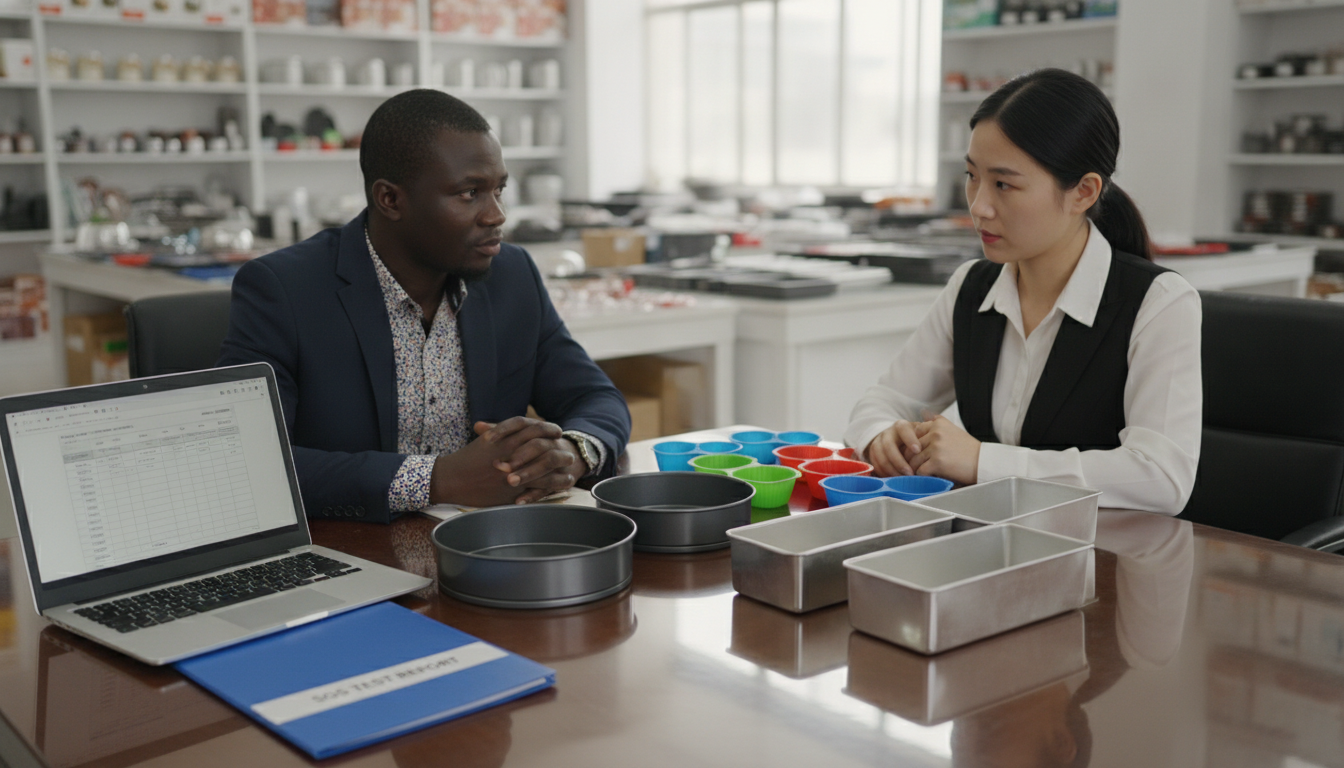
Negotiating MOQ bakeware manufacturer first order terms determines whether you lock up working capital in untested inventory or validate product-market fit before scaling. For buyers shipping to Lagos Apapa, Mombasa, or Luanda, port dwell time averages 10-21 days, and clearing fees scale with container volume. A bloated first order ties up cash twice: once in production payment, again in demurrage and storage.
Naira, Kenyan shilling, and kwanza exchange rates fluctuate daily. A 10,000-piece first order paid 50 percent upfront in US dollars exposes you to currency risk for 45-60 days between deposit and container arrival. Smaller trial orders reduce exposure and let you test retail pricing before committing to bulk.
Bakeware preferences vary across African markets. Silicone muffin pans popular in Nairobi bakeries may sit unsold in Abidjan, where aluminum round pans dominate. A 50-piece trial order per SKU lets you test three designs in-market for under $800 landed cost, versus $4,000-$6,000 for a full container of untested stock.
NAFDAC in Nigeria, KEBS in Kenya, and ARSO standards across East Africa each have specific food-contact labeling rules. A first order gives you one production cycle to confirm that SGS test reports, material declarations, and bilingual French/Portuguese labeling (for Francophone and Lusophone markets) clear customs without holds.
Factories calculate MOQ from four cost buckets: tooling, material waste, labor setup, and packaging. Each lever below attacks one bucket.
Offer to pay 15-25 percent above the bulk per-piece price in exchange for a 30-50 unit first batch. The factory recovers setup labor through margin instead of volume.
Custom silicone colors require dedicated mixer batches (minimum 50 kg raw compound). Switching to factory-stock gray, red, or blue silicone eliminates that waste and can drop MOQ from 1,000 pieces to 100-200 pieces. Similarly, replacing printed cartons with plain poly bags saves packaging setup and reduces first-order minimums by half.
Many buyers conflate sample cost with production MOQ. This two-step approach prevents you from ordering 500 pieces of a pan that warps on your customer’s induction cooktop.
Factories prioritize buyers who will reorder. Share a 6-month sales projection, distributor agreements, or retailer purchase orders. A manufacturer is more likely to accept a 50-piece trial if you can demonstrate a credible path to 500-piece monthly reorders. We’ve waived setup fees for buyers who provided signed distributor letters from Nairobi or Lagos chains.
Instead of ordering 20 pieces each of 10 different designs (200 total), order 50 pieces each of 4 designs. Fewer SKUs mean fewer mold changes, less material waste, and lower per-unit setup cost. The factory saves labor; you reduce MOQ per design while hitting the same total-piece threshold.
Bakeware MOQ varies by material because tooling investment and production-line setup differ. Silicone requires compression molds; carbon steel and stainless steel use stamping dies; aluminum uses casting or spinning. Matching your first-order material to your budget and market-test goals prevents overpaying for unnecessary tooling.
Compression molds for silicone muffin pans, loaf pans, or baking mats cost $800-$2,500 per cavity design. Factories amortize tooling across production runs, pushing MOQ to 500-1,000 pieces per SKU. If you need silicone for non-stick release properties, negotiate stock-color and stock-shape options first. A 12-cavity muffin pan in gray silicone may have existing tooling, dropping MOQ to 200-300 pieces.
Stamping dies for round cake pans, loaf pans, or baking sheets are reusable across thousands of cycles. Setup cost is lower, and material waste is minimal. Carbon steel and stainless steel first orders can start at 30-50 pieces per design. Buyers report that carbon steel pans warp on induction cooktops that heat extremely fast, and that carbon steel can rust within weeks if pre-seasoning is skipped. Request pre-seasoning or food-grade coating (not just raw steel) to avoid these failures in humid African climates.
Aluminum round pans and pizza trays are spun or stamped from sheet stock. Tooling cost sits between silicone and carbon steel. Typical first-order MOQ is 100-200 pieces per size. Aluminum conducts heat evenly, reducing hot spots that burn cake edges. For West African markets where aluminum is preferred for traditional baking, this material offers the best balance of MOQ flexibility and performance.
A 5-piece or 10-piece low-MOQ bakeware set bundles multiple SKUs (round pans, loaf pan, muffin tin, baking sheet) into one packaged unit. Because each component may come from different production lines, set MOQ is typically 50-100 sets (not pieces). This approach lets you test a product range without committing to 500 pieces of a single pan type.
Sample MOQ: 1 piece per SKU. Trial production MOQ: 30-50 pieces carbon/stainless steel, 100-200 aluminum, 200-500 silicone. Sampling time: 7-10 days from payment.
Clearing bakeware through Nigerian, Kenyan, or Angolan customs requires food-grade test reports and material declarations. Requesting these documents before placing your first order prevents costly holds and re-export penalties.
SGS labs test bakeware for heavy-metal migration (lead, cadmium) and food-contact safety under FDA 21 CFR 177.2600 (for silicone) and similar standards. Testing takes 7-10 business days and costs $300-$600 per material type. Request test reports during the sampling phase so you can include them in your customs documentation. Non-stick coatings are routinely over-claimed; SGS migration tests confirm that PFAS-free and Pb-free claims are genuine.
NAFDAC in Nigeria and KEBS in Kenya require bilingual labeling (English plus French or Portuguese for Francophone/Lusophone markets) and material composition statements. Confirm with your custom OEM bakeware manufacturer that carton artwork includes material type, country of origin, importer name, and any required warning icons before print plates are made. Changing artwork post-production adds 10-15 days and $200-$400 in re-plating fees.
Bakeware falls under HS codes 7323 (iron/steel) and 3924 (plastic/silicone). Duty rates vary: Nigeria applies 20-35 percent on kitchenware imports, Kenya 25 percent, South Africa 15-20 percent. Confirm the HS code and calculate landed cost (FOB + freight + duty + clearing) before locking your first-order quantity. A 500-piece order that looks profitable at FOB $0.60 per piece may lose money at landed cost $1.10 after duty and port fees.
Lagos Apapa requires a PAAR (Pre-Arrival Assessment Report) and SONCAP certification for certain product categories. Mombasa requires an IDF (Import Declaration Form) submitted 48 hours before vessel arrival. Luanda and Maputo require certificate of origin and commercial invoice notarization. Confirm documentation requirements with your freight forwarder before production starts so you can include preparation time in your lead-time calculation.
Cold outreach to a bakeware factory via email or WhatsApp should communicate three things: your target market, your trial-order intent, and your reorder potential. The script below is optimized for non-relationship first contact with Chinese manufacturers shipping to Africa.
Subject: MOQ inquiry: carbon steel bakeware trial order to Lagos/Mombasa [your company name]
Hello [factory contact name or “Sales Team”],
We are [your company name], a kitchenware importer based in [city, country]. We supply bakery-supply chains and retail distributors across [Nigeria/Kenya/Southern Africa].
We are interested in sourcing carbon steel round cake pans and loaf pans for a trial order to validate product-market fit before scaling to monthly container orders. Our target specifications:
Please provide:
If trial sales meet our 3-month forecast (500-1,000 pieces per month), we will transition to regular container orders. We have existing distributor agreements with [bakery-supply chain or retail group, if applicable].
Thank you, and we look forward to your quotation.
Best regards,
[Your name]
[Your title]
[Company name]
[Phone/WhatsApp]
[Email]
Hi [contact name], I sent an MOQ inquiry for carbon steel bakeware trial order yesterday. Could you confirm receipt and share indicative pricing for 30-50 pieces per size? We’re ready to request samples this week if terms fit our budget. Thanks!
Offer to pay 15-25 percent above the bulk per-piece price in exchange for a smaller first batch, typically 30-50 pieces per SKU. Strip customization by using stock colors, materials, and plain packaging to eliminate tooling and setup waste. Share a credible 3-6 month reorder forecast or distributor agreements to show volume potential. Separate paid sampling (1-3 pieces) from production MOQ so you validate quality before committing to larger quantities.
For carbon steel and stainless steel bakeware, 30-50 pieces per design is reasonable. Aluminum bakeware typically starts at 100-200 pieces per size. Silicone bakeware requires higher tooling investment, pushing first orders to 200-500 pieces unless you use existing stock molds. Multi-piece bakeware sets usually have a 50-100 set minimum. Always request 1-3 paid samples first to validate coating quality, warp resistance, and food-grade compliance before placing a production order.
Yes, if the premium is 15-25 percent and the reduced MOQ lets you validate product-market fit without tying up excessive working capital. A 40-piece trial order at $0.95 per carbon steel pan (versus $0.65 bulk) costs $38 total versus $325 for a 500-piece minimum. The $38 premium is negligible compared to the risk of ordering 500 pieces of a pan that warps, rusts, or fails to sell in your target market. Once sales are validated, transition to bulk pricing on reorders.
Use the term “trial order” explicitly in your subject line and opening paragraph. Specify your target quantity (e.g., 30-50 pieces per size), material and compliance requirements (SGS food-grade, PFAS-free coating), and packaging (plain poly bag to avoid custom setup). Request pricing at both trial and bulk quantities so you can calculate the premium. Include your reorder forecast or distributor agreements to show volume potential. Follow up via WhatsApp 24-48 hours after email to confirm receipt and request indicative pricing.
Include your company name, target market (e.g., Nigeria, Kenya, South Africa), and distribution channel (bakery-supply, retail, wholesale). Specify material, sizes, and compliance needs (SGS test reports, food-grade certification). State your trial-order quantity and ask for MOQ per size, unit price at trial versus bulk, sampling cost and lead time, production lead time, and payment terms. Mention your reorder forecast or existing distributor agreements to establish credibility. Request comparison pricing so you can evaluate the trial-order premium and decide if it fits your margin.
Ready to negotiate your first bakeware order with a factory that ships from Ningbo to Lagos, Mombasa, and West African ports at 1-piece sample MOQ?
Request samples and trial-order pricing →
Written by the Shansen Bakeware Export Team.
MOQ 1 set on stock configurations. Tell us what you need and we reply on WhatsApp.
Click the button below to open WhatsApp. If you're not logged in to WhatsApp Web yet, scan the QR code first — then come back here and copy the message into the chat.