
📋 Table of Contents
When you sample order baking pan before bulk purchase, you protect your business from material inconsistencies, coating failures, and packaging surprises that only appear after you’ve paid for 5,000 units. Importers often discover that the approved sample differs from the bulk shipment in gauge thickness, non-stick adhesion, or even the retail-ready packaging they negotiated. the technical inspection steps, cost structure, and approval documentation that turn a single-piece sample into a reliable predictor of your container load.
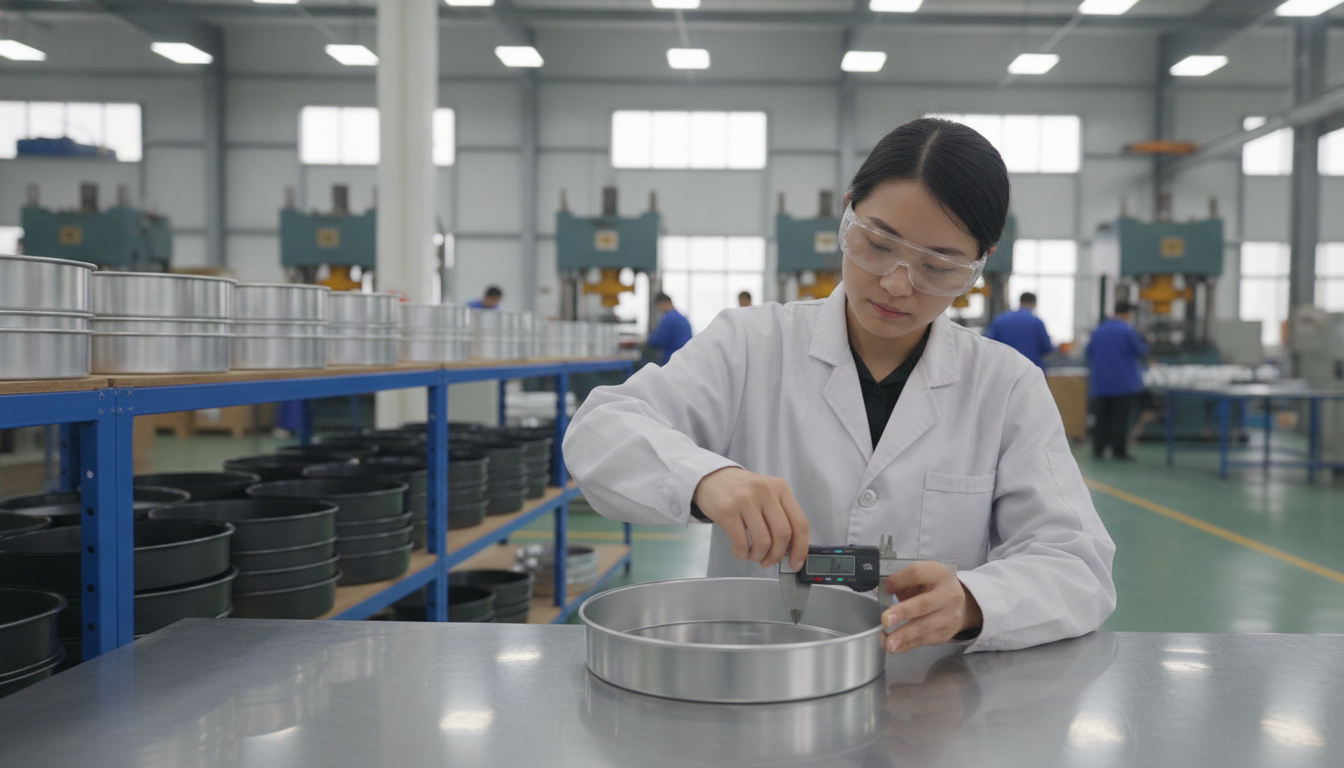
Buyers often receive samples that look acceptable but differ from the bulk order in material, thickness, finish, or packaging. The approved sample is not honored in production, leaving importers with inventory they cannot sell at the agreed retail price point. A structured sample-order process locks in the exact specification before you wire the 30% deposit for bulk.
Carbon steel baking pans stamped at 0.4 mm gauge can arrive in bulk at 0.35 mm, reducing rigidity and causing edge warp under commercial oven loads. When you sample order baking pan before bulk purchase, measure the sample with a digital caliper at three points (center, edge, corner) and record those figures in your approval email. The factory then references your recorded measurements during pre-production inspection.
Non-stick coatings that pass visual inspection may fail the scratch test or release under thermal cycling. Request the factory’s SGS food-contact migration report for the specific coating system on your sample. Verify that the report lists the same coating brand and curing temperature as the sample you received. Suppliers may quote sample costs separately from bulk pricing, and coating-specification charges can add unexpected expense before the buyer has tested the product in real baking use.
Corrugated inner boxes, shrink-wrap quality, and barcode placement affect shelf appeal and warehouse handling cost. Photograph the sample packaging from six angles (front, back, top, bottom, left side, right side) and attach those images to your bulk-order proforma invoice as Annex A. This creates a visual contract that prevents packaging downgrades during mass production.
A repeatable inspection protocol turns subjective quality judgment into objective pass/fail criteria. Follow these seven steps within 48 hours of receiving the sample, while the factory still has time to adjust tooling or coating parameters before bulk production starts.
Measure length, width, depth, and rim thickness with a digital caliper accurate to 0.01 mm. Compare each dimension against the technical drawing or specification sheet the factory provided during quotation. Record any variance greater than ±1 mm. For example, a 40×60 cm sheet pan specified at 20 mm depth should measure 19.5-20.5 mm; anything outside that range requires factory clarification before approval.
Request a material certificate that lists the steel grade (e.g., SPCC cold-rolled steel, 304 stainless steel, 3003 aluminum alloy) and thickness. Cross-reference the certificate batch number with the laser-etched or stamped code on the sample pan. For silicone bakeware, confirm the factory provides FDA 21 CFR 177.2600 compliance documentation showing the silicone meets food-contact migration limits for fatty foods at 175°C.
Perform a three-part coating check within your own facility or a local testing lab. First, scratch the non-stick surface with a stainless steel spatula edge at 45° angle and 500-gram pressure; the coating should show no flaking. Second, bake an oil-free sponge cake at 180°C for 25 minutes, then assess release without greasing. Third, thermal-shock the pan by moving it from a 230°C oven directly into room-temperature water; inspect for bubbling or delamination. Factory pages often emphasize MOQ and product photos but provide limited proof of performance testing, making it hard for buyers to judge whether the pan will hold up in real baking use.
Place the empty sample pan on a flat granite or glass surface and check for rocking. Then load it with 2 kg of sand or rice (simulating a full batter load), bake at 230°C for 20 minutes, and cool to room temperature. Re-check flatness on the same surface. Any new warp greater than 2 mm indicates insufficient gauge or poor metal temper, and the factory must increase material thickness or adjust the stamping process before bulk approval.
For pans with welded or riveted handles, apply 5 kg downward force to each handle while the pan is supported only at the handle attachment points. Inspect the weld bead or rivet for cracks, gaps, or movement. Handles that loosen under this static test will fail during repeated oven-to-counter transfers in commercial bakery environments.
Verify that the sample arrives in the same packaging configuration quoted for bulk: corrugated strength (e.g., B-flute, 3-layer, 125 g/m²), inner poly-bag thickness, and any retail hang-tags or barcode stickers. If you plan to distribute in Nigeria, Kenya, South Africa, Côte d’Ivoire, Senegal, Cameroon, Angola, or Mozambique, confirm that the factory can print country-specific care instructions and compliance marks on the packaging without additional tooling charges.
Match the sample against three factory documents: the quotation specification sheet, the proforma invoice item description, and the technical drawing (if provided). Any discrepancy in material, size, coating type, or packaging must be resolved in writing before you approve the sample for bulk production. Some cookware suppliers stress certifications and negotiation terms, but buyers still face uncertainty about whether non-stick coating claims, heat resistance, and durability are independently verified.
Understanding the financial structure of sampling prevents budget surprises and helps you negotiate sample-cost offsets when you convert to bulk orders. Factories typically charge three components: unit cost, customization setup, and international shipping.
A single carbon steel sheet pan sample may cost $8-12 FOB Ningbo, compared to a bulk unit price of $2.50-3.50 at 500-piece order quantity. The premium reflects the lack of production-line economies and the need to run a small stamping batch outside the normal production schedule. At low MOQ bakeware for startups factories, sample pricing often includes a $20-40 setup fee for coating application when the requested finish differs from the factory’s standard stock.
Air-courier delivery from Ningbo to Lagos, Nairobi, or Johannesburg costs $35-60 for a 2 kg sample shipment (one or two pans plus packaging), with 5-7 day transit. LCL consolidation through a freight forwarder reduces per-unit cost to $15-25 but extends lead time to 12-18 days. Request the factory to consolidate multiple SKU samples into one shipment to spread the courier base charge across several products.
Many factories apply the sample payment as a credit toward your first bulk purchase, provided the order meets a minimum threshold (commonly 30-50 pieces per sampled SKU). Negotiate this offset in writing on the sample proforma invoice. For example, if you paid $45 for a sample and the bulk unit price is $3, the factory credits $45 against your invoice when you order 50 units, reducing your net bulk cost by $0.90 per piece.
Sample MOQ: 1 piece. Bulk MOQ: 30 pieces per SKU. Sampling time: 7-10 days from payment to Ningbo port loading.
If you request a custom size, embossed logo, or proprietary coating color, the factory may quote a one-time tooling or screen-printing charge of $150-400. Clarify whether this charge applies to the sample only or carries over to bulk production. For custom OEM private label bakeware projects, tooling fees are typically amortized across the first bulk order and do not recur on repeat purchases.
A written approval process creates a binding reference point that both parties can cite if the bulk shipment deviates from the sample. This section outlines the documents you should request, the information to include in your approval email, and the factory’s counter-signature protocol.
After completing your seven-step inspection, send a formal approval email that includes measured dimensions, test results, and high-resolution photos. Structure the email in three sections: approval statement, recorded specifications, and next-step instructions. Example wording:
MOQ 1 set on stock configurations. Tell us what you need and we reply on WhatsApp.
Click the button below to open WhatsApp. If you're not logged in to WhatsApp Web yet, scan the QR code first — then come back here and copy the message into the chat.