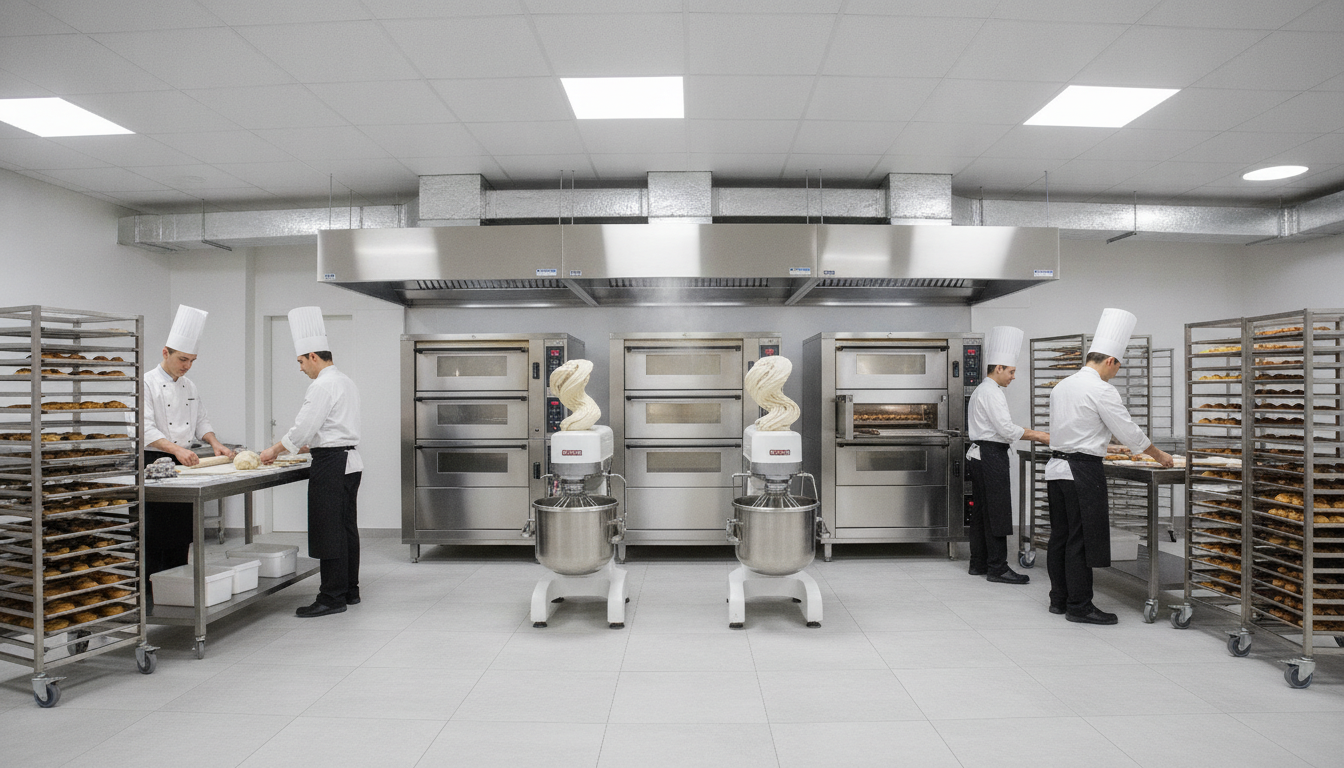
Hotel procurement teams across Africa issue dozens of equipment tenders each quarter, yet many suppliers submit incomplete hotel baking equipment supplier tender documentation and lose bids before technical evaluation begins. Missing a single compliance certificate or submitting generic product specs instead of application-matched matrices can disqualify an otherwise competitive offer. This guide walks through the seven mandatory document categories, market-by-market compliance requirements for Nigeria, Kenya, South Africa, and Francophone/Lusophone markets, and the scoring rubrics procurement committees actually use when evaluating commercial oven, mixer, proofer, and slicing-tool bids.
Executive Summary
Mandatory document categories: Seven core categories appear in hotel equipment tenders, including company registration, tax compliance, past-performance references, product specifications, compliance certificates, commercial terms, and bid security.
Disqualification rate: Procurement officers report that incomplete compliance paperwork eliminates a significant portion of bids before technical scoring begins, particularly in government and NGO hotel-renovation projects.
Technical scoring weight: Product specification matrices and application-match documentation typically carry higher point allocations than price in hotel equipment tenders, with technical responsiveness often weighted at twice the commercial score.
Certification timelines: SGS food-grade testing and FDA alignment documentation require production samples and lab analysis, adding lead time to bid preparation for suppliers without current certificates on file.
Market-specific compliance: Nigeria requires CAC registration and TIN certificates; Kenya mandates KRA PIN and Standard Gauge Railway compliance for port clearance; South Africa enforces B-BBEE scorecards for public-sector hotel projects; Francophone markets often require French-language technical datasheets.
Core Bid Document Categories for Hotel Baking Equipment Tenders
Hotel procurement tenders segment required documentation into distinct categories, each evaluated independently. Submitting all seven categories in the specified format prevents administrative disqualification and ensures your bid reaches technical scoring.
Company Registration and Legal Standing
Procurement committees verify that bidders hold active business registration in the tender jurisdiction or proof of authorized local representation. Required documents include:
Certificate of Incorporation: notarized copy showing company name, registration number, and incorporation date in the supplier’s home country.
Tax Identification Number (TIN): valid tax clearance certificate issued within the past 12 months, demonstrating compliance with national revenue authorities.
Business permit: municipal or national trading license authorizing the sale and import of commercial kitchen equipment.
Authorized signatory list: board resolution or power-of-attorney document naming individuals legally empowered to sign contracts and bind the company.
Suppliers operating through distributors or agents must include agency agreements explicitly covering the tender jurisdiction and product categories. Shansen Bakeware’s Yongkang factory and Yiwu sourcing showroom provide notarized export documentation and can issue country-specific agency letters when distributors submit hotel bids on behalf of the manufacturer.
Past Performance and Reference Projects
Tender committees assess supplier track record through reference letters from previous clients. Effective reference documentation includes:
Client name and contact: full contact details for a procurement officer or executive chef who can verify equipment delivery and performance.
Project scope: itemized list of equipment supplied, quantities, and installation dates, demonstrating experience with similar hotel bakery setups.
Performance confirmation: explicit statement that equipment met specifications, was delivered on schedule, and remains in satisfactory operation.
Contract value: total order value in the reference project, proving capacity to fulfill orders of comparable scale to the current tender.
Suppliers new to hotel tenders but with retail or wholesale bakery-equipment experience should frame references to highlight relevant technical capabilities. A 500-unit wholesale order for wholesale bakeware sets demonstrates production capacity and logistics coordination even if the client was not a hotel chain.
Product Specification Matrices
Generic product catalogs fail technical evaluation. Procurement teams require application-specific specification matrices mapping each tendered item to hotel bakery use cases. The next section details how to structure these matrices for ovens, mixers, proofers, pans, and slicing tools.
Product Specification Matrices for Commercial Baking Equipment
Hotel bakery operations demand equipment that handles high-volume breakfast service, in-room amenity production, and banquet dessert prep. Specification matrices must demonstrate that proposed equipment matches these multi-application requirements.
Commercial Oven Specifications
Oven bids require detailed technical datasheets covering capacity, energy efficiency, temperature range, and construction materials. Procurement officers compare these specs against daily production targets and kitchen space constraints.
Specification
Hotel Bakery Requirement
Compliant Example
Capacity
Minimum 200 bread rolls or 12 full-size sheet pans per batch
Deck oven with 5 chambers, each 1200×800 mm
Temperature range
50°C to 300°C for proofing, baking, and roasting
Digital thermostat ±2°C accuracy, 40-320°C span
Energy source
Electric or gas, compatible with local utility standards
Three-phase 380V electric or LPG with regulator
Construction
Stainless steel interior and exterior for hygiene and durability
Minimum 12 months parts and labor, on-site service
24-month manufacturer warranty plus local service agent
Suppliers should cross-reference oven specs with the hotel’s stated daily production volume. A 200-room property serving breakfast buffets typically requires capacity for 400-500 bread items and 100-150 pastries per morning shift, guiding minimum chamber count and tray dimensions.
Mixer, Proofer, and Ancillary Equipment Specs
Planetary mixers, spiral dough mixers, and walk-in proofers require similar specification detail. Key data points include:
Mixer bowl capacity: liters or kilograms of dough per batch, matched to the hotel’s largest single-recipe requirement (e.g., 20 kg dough for 100 baguettes).
Motor power and speed range: wattage and RPM range for kneading, whipping, and mixing, with overload protection to prevent burnout during heavy dough cycles.
Proofer humidity control: adjustable humidity range (typically 70-90% RH) and temperature precision (±1°C) for consistent yeast activation.
Footprint and clearance: equipment dimensions including door swing, ventilation clearance, and utility connection points, ensuring fit within existing kitchen layouts.
Procurement teams often request AutoCAD floor plans showing equipment placement. Suppliers should provide dimensioned top-view and side-view drawings with utility hookup locations marked.
Bakeware and Tooling Specifications
Hotel baking equipment supplier tender documentation must include detailed specs for pans, molds, racks, and hand tools. Carbon steel pans warp under the rapid heating cycles of commercial deck ovens, a common complaint among hotel pastry chefs. Stainless steel and aluminum alternatives offer better dimensional stability for high-volume operations. Shansen’s seven in-house bakeware lines (silicone, carbon steel, stainless steel, aluminum, cake-decorating tools, strainers and sifters, multi-piece sets) allow distributors to mix materials within a single bid, matching each item to its application: food-grade SGS-FDA certified bakeware in stainless for durability, silicone for release, aluminum for even heat distribution.
Specification matrices for bakeware should list:
Material and gauge: stainless steel grade (304 vs. 430), aluminum alloy, or silicone shore hardness, plus sheet thickness in millimeters.
Dimensions and capacity: length, width, depth in millimeters, and volume in milliliters or number of portions per pan.
Surface finish: non-stick coating type and expected cycle life, or bare metal finish with seasoning instructions.
Temperature rating: maximum safe oven temperature and whether the item is dishwasher-safe for high-temperature commercial machines.
Compliance marks: FDA 21 CFR 177.2600 for silicone, SGS food-contact test reports, and confirmation of PFAS-free and lead-free construction.
Non-stick coatings degrade faster than manufacturers claim, another frequent buyer frustration. Tender responses should state realistic cycle-life expectations (e.g., 500 bake cycles for standard PTFE coatings) rather than vague durability claims, building trust through transparency.
Compliance Documentation by Market
Hotel equipment tenders in Africa impose country-specific regulatory and import-compliance requirements. Submitting the wrong certificate format or missing a mandatory local registration triggers immediate disqualification.
Nigeria: CAC, TIN, and NAFDAC Requirements
Nigerian hotel tenders, particularly those funded by government agencies or international development organizations, require:
CAC registration: Corporate Affairs Commission certificate proving the bidder is a registered Nigerian entity or has a local partner with valid CAC status.
TIN certificate: Federal Inland Revenue Service Tax Identification Number, issued within the past 12 months, confirming tax compliance.
NAFDAC permit (if applicable): National Agency for Food and Drug Administration and Control approval for food-contact equipment, required when tenders specify direct food-contact items like bakeware and utensils.
Port-of-entry declaration: Pre-arrival assessment report (PAAR) or Standard Organization of Nigeria Conformity Assessment Programme (SONCAP) certificate for imported equipment, obtained before shipment from Ningbo or other Chinese ports.
Distributors importing baking tools wholesale for Nigeria should coordinate SONCAP certification during the sampling phase, as the certificate requires product testing and cannot be rushed after a tender award. Shansen’s SGS food-grade test reports streamline SONCAP applications by providing recognized third-party verification.
Kenya: KRA PIN and SGR Compliance
Kenyan hotel procurement mandates include:
KRA PIN certificate: Kenya Revenue Authority Personal Identification Number for individual bidders or company registration number for corporate entities, proving tax registration.
Valid tax-compliance certificate: issued by KRA within the past six months, confirming no outstanding tax liabilities.
Standard Gauge Railway (SGR) cargo declaration: for container shipments through Mombasa port, advance cargo declaration and SGR rail-transport booking, required before vessel arrival.
KEBS certification (for certain items): Kenya Bureau of Standards product certification for electrical appliances and food-contact materials, obtained through local testing or recognition of SGS/Intertek reports.
Mombasa container handling has shifted to mandatory SGR inland transport for most cargo. Suppliers should confirm that freight forwarders include SGR booking fees and timelines in landed-cost calculations, as delays in SGR slot allocation can extend delivery by two to three weeks.
South Africa: B-BBEE and SABS Standards
South African hotel tenders, especially public-sector and parastatal projects, enforce Broad-Based Black Economic Empowerment (B-BBEE) scoring and South African Bureau of Standards (SABS) compliance:
B-BBEE certificate: verified scorecard issued by a SANAS-accredited agency, showing the supplier’s empowerment level (Level 1 through Level 8 or non-compliant). Public tenders allocate up to 20 points (out of 100 total) based on B-BBEE status.
SABS certification: product compliance with SANS standards for electrical safety (SANS 60335 for appliances) and food-contact materials, either through local testing or mutual recognition agreements.
Tax clearance: South African Revenue Service (SARS) tax-clearance certificate, valid for 12 months, confirming good standing.
Central Supplier Database (CSD) registration: mandatory registration on the National Treasury CSD portal for all government and parastatal tenders, including a unique supplier number.
Foreign suppliers without South African B-BBEE status often partner with local distributors who hold Level 1 or Level 2 certificates, allowing the bid to earn empowerment points. Joint-venture or subcontracting agreements must be formalized before tender submission and included in the bid documentation.
Francophone and Lusophone Africa
French-speaking markets (Côte d’Ivoire, Senegal, Cameroon) and Portuguese-speaking markets (Angola, Mozambique) add language and regional-standards requirements:
French or Portuguese technical datasheets: translated product specifications, user manuals, and safety instructions, certified by a sworn translator if the tender specifies.
OHADA compliance (Francophone): Organisation pour l’Harmonisation en Afrique du Droit des Affaires commercial registration and legal documentation in OHADA-standard format.
CEMAC or UEMOA certificates (Francophone): Central African Economic and Monetary Community or West African Economic and Monetary Union import permits and standards compliance for cross-border equipment supply.
Angolan Customs pre-clearance: Angola requires advance import-license approval and detailed customs declarations before shipment, adding four to six weeks to procurement timelines.
Suppliers should budget for certified translation costs and extended compliance timelines when bidding Francophone and Lusophone hotel projects. Shansen’s export team coordinates multilingual documentation for distributors serving these markets, ensuring technical datasheets and certificates arrive in the required language before tender deadlines.
Technical Responsiveness and Scoring Strategy
Procurement committees score bids using weighted matrices that allocate points across technical, commercial, and compliance criteria. Understanding the scoring rubric allows suppliers to prioritize high-value documentation and avoid wasting effort on low-weight sections.
Typical Scoring Breakdown
Hotel equipment tenders commonly allocate 100 total points as follows:
Criterion
Point Allocation
Evaluation Focus
Technical specifications
40 points
Equipment meets or exceeds stated capacity, temperature, and material requirements
Price competitiveness
30 points
Total bid price relative to other compliant bids, scored on a curve
Past performance
15 points
Quality and relevance of reference projects, client feedback
Delivery timeline
10 points
Proposed lead time from contract signing to on-site installation
Warranty and service
5 points
Warranty duration, local service-agent availability, spare-parts stock
Technical specifications carry the highest weight, meaning a bid with superior equipment specs but a mid-range price often outscores the lowest-price bid with marginal technical compliance. Suppliers should invest documentation effort proportional to point allocation, dedicating the most detail to specification matrices and application-match narratives.
Demonstrating Application Match
Technical scoring rewards explicit demonstration that proposed equipment handles the hotel’s specific use cases. Effective application-match documentation includes:
Daily production scenarios: worked examples showing how the proposed oven, mixer, and proofer combination produces the hotel’s stated breakfast volume (e.g., 400 bread rolls, 150 croissants, 80 muffins) within the required time window.
Menu-item mapping: table linking each tendered equipment item to specific menu offerings, such as deck oven for artisan breads, convection oven for pastries, planetary mixer for cake batters.
Energy and space efficiency: calculations demonstrating that proposed equipment fits the available kitchen footprint and operates within the hotel’s utility capacity (e.g., total connected load under 50 kW for a 200-room property).
Hygiene and maintenance: description of cleanability features (removable oven doors, stainless steel surfaces, accessible motor housings) and routine maintenance schedules, aligned with hotel HACCP protocols.
Procurement officers appreciate narrative explanations that connect specs to outcomes. A simple statement like
👋 Wholesale or custom bakeware sets? Chat with us.
Request a Factory Quote
MOQ 1 set on stock configurations. Tell us what you need and we reply on WhatsApp.
Please complete this field.
Please complete this field.
Please enter a valid email address.
Please complete this field.
Please make a selection.
Please make a selection.
Please complete this field.
Inquiry Saved!
Click the button below to open WhatsApp. If you're not logged in to WhatsApp Web yet, scan the QR code first — then come back here and copy the message into the chat.