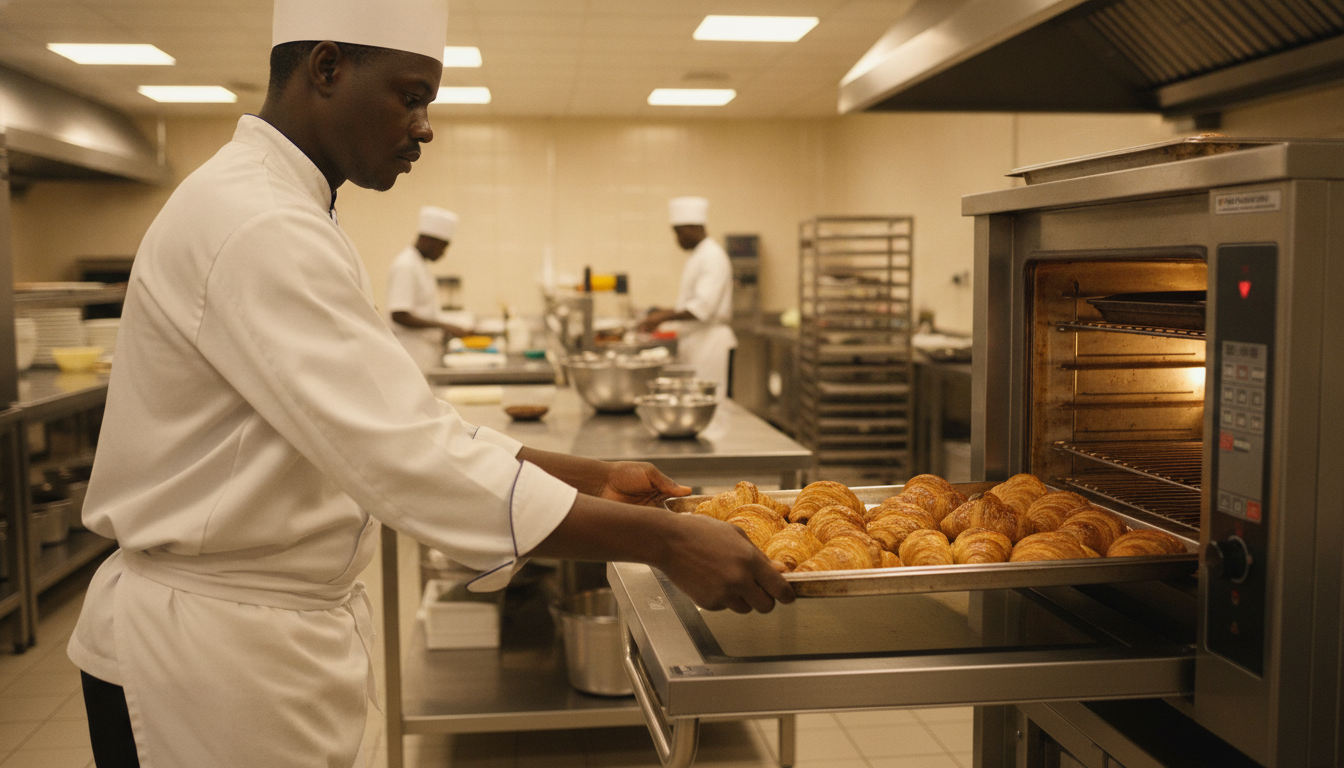
Nairobi’s hospitality sector faces a recurring procurement challenge: sourcing commercial-grade baking trays that meet food-safety standards, arrive on predictable timelines, and support flexible order volumes. Whether you operate a 50-room boutique hotel with a breakfast bakery or manage procurement for a multi-location restaurant chain, identifying the right hotel restaurant baking tray supplier Nairobi requires evaluating material performance, container logistics from Asian ports to Mombasa, and certification alignment with Kenyan food-contact regulations.
📋 Table of Contents
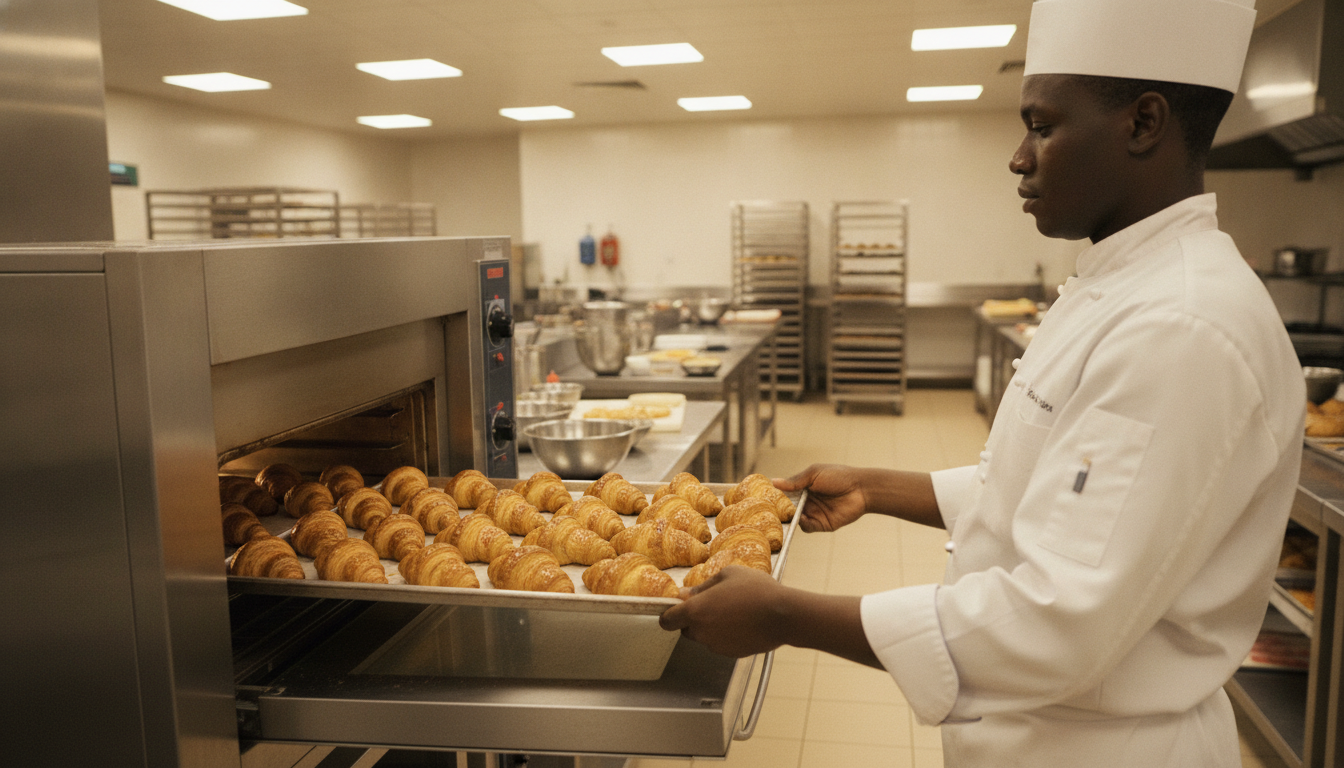
Commercial kitchens in Nairobi operate high-volume baking schedules where tray durability and heat response directly impact food quality and labor efficiency. Material choice determines warp resistance, release performance, and maintenance requirements.
Aluminum conducts heat 2.4 times faster than stainless steel, producing consistent browning across sheet pans loaded with croissants or dinner rolls. Anodized aluminum resists scratches and does not require seasoning. A common complaint buyers raise is that thin-gauge aluminum warps under rapid temperature changes, especially on induction cooktops that heat extremely fast. Specifying 1.0 mm gauge or thicker mitigates this risk for hotel breakfast service where trays cycle between oven and cooling rack multiple times per shift.
Grade 304 stainless steel offers superior corrosion resistance in humid coastal climates and withstands repeated dishwasher cycles without surface degradation. Stainless trays weigh 30 to 40 percent more than equivalent aluminum pans, which increases shipping costs per container. Heat distribution is less uniform, requiring rotation during baking to avoid edge over-browning. Nairobi restaurant buyers prioritize stainless steel for savory applications like roasting vegetables or baking casseroles where precise browning control matters less than long-term durability.
Carbon steel heats quickly and develops a natural non-stick patina when properly seasoned. A carbon steel pan rusted within the 45-day return window even after prep, according to a buyer report on Reddit r/cookware. Nairobi’s high humidity accelerates rust formation if trays are not dried immediately after washing. Hotels with dedicated pastry teams can maintain carbon steel effectively; multi-shift operations with rotating kitchen staff often struggle with consistent seasoning protocols. Wholesale bakeware sets that include maintenance instructions reduce this friction.
Selecting a hotel restaurant baking tray supplier Nairobi procurement teams can rely on requires evaluating operational capabilities beyond product catalogs. The following criteria separate responsive manufacturing partners from transactional vendors.
Suppliers operating multiple material lines under one roof reduce lead time variability and simplify quality audits. Shansen Bakeware runs 7 in-house lines covering silicone, carbon steel, stainless steel, aluminum, cake-decorating tools, strainers, and multi-piece sets at a 500,000 units per month capacity in Yongkang, Zhejiang. Consolidated production eliminates the coordination delays common when a supplier sources different materials from separate subcontractors.
Testing tray performance in your actual oven environment prevents costly bulk orders that fail dimensional or heat-response requirements. Suppliers offering 1-piece sample MOQ allow Nairobi hotel buyers to validate fit with existing racks, assess release properties with signature recipes, and confirm dishwasher compatibility before placing production orders. Sample lead time under 10 days keeps menu development schedules on track.
Maximizing tray count per 20-foot or 40-foot container directly impacts landed cost per unit. Suppliers experienced in African distribution understand Mombasa port handling and design packaging that reduces breakage during inland trucking to Nairobi. Shansen’s container loading is optimized for Lagos Apapa, Mombasa, and Francophone/Lusophone African ports, reflecting years of East African logistics experience.
Kenyan food-safety inspectors increasingly request third-party test reports for commercial kitchen equipment. SGS food-contact testing verifies compliance with lead-free and PFAS-free standards before shipment. Suppliers providing test certificates in English with each order simplify customs clearance and satisfy regulatory audits. Non-stick longevity is routinely over-claimed; coatings degrade sooner than advertised, according to Prudent Reviews. Requesting SGS-tested bakeware with documented wash-cycle durability data addresses this gap.
Time-zone differences between Nairobi and Asian manufacturing hubs create communication lag. Suppliers maintaining a sourcing showroom at Yiwu International Trade Market offer face-to-face product review for buyers visiting China, plus faster email response during East African business hours. WhatsApp-enabled sales teams reduce friction for urgent reorder requests.
Independent restaurants testing seasonal menu additions cannot commit to 500-unit minimums per SKU. Suppliers offering tiered MOQ structures (1 piece for samples, 30 pieces for initial orders, 200+ for bulk pricing) accommodate both validation and scaling phases. This flexibility proves especially valuable for Nairobi restaurant groups rolling out new concepts across multiple locations on staggered timelines.
Warranty claims and replacement logistics determine whether a supplier relationship survives the first quality issue. Suppliers offering photo-based claim review and replacement shipment within the next production cycle minimize operational disruption. Clear warranty terms (typically 12 months for manufacturing defects, excluding user damage) set realistic expectations.
In practice: A Nairobi hotel chain validated three aluminum tray sizes with 1-piece samples, confirmed oven-rack fit and browning consistency, then placed a 90-unit initial order (30 per size) without locking up procurement budget in untested inventory.
Understanding the full supply chain from Chinese factory to Nairobi kitchen helps buyers set realistic inventory planning timelines and identify delay risk points.
Container ships departing Ningbo port reach Mombasa in 18 to 22 days under normal sailing conditions. Seasonal congestion during peak export periods (September through November) can extend transit by 3 to 5 days. Booking space 4 weeks before your target arrival date accounts for schedule variability. Shansen ships from Ningbo, offering direct weekly sailings to Mombasa that simplify coordination.
Documentation completeness determines clearance speed. Shipments with pre-filed import declarations, commercial invoices matching packing lists, and SGS test certificates clear in 24 to 48 hours. Missing or inconsistent paperwork triggers physical inspection, adding 3 to 7 days. Working with a Mombasa-based customs broker familiar with kitchenware HS codes (typically 7323.93 for stainless steel bakeware, 7615.10 for aluminum) reduces this risk.
The 480-kilometer route from Mombasa port to Nairobi takes 2 to 4 days depending on truck availability and weigh-station delays. Consolidating multiple SKUs into a single container reduces per-unit trucking cost. Suppliers offering low-MOQ orders allow buyers to mix tray sizes and materials in one shipment, maximizing container utilization.
New hotel launches in Nairobi require coordinating bakeware delivery with kitchen equipment installation and staff training schedules. Ordering 60 days before the target opening date accommodates supply-chain variability and allows time for pre-opening recipe testing. Suppliers offering split shipments (samples first, bulk order second) let culinary teams validate equipment choices before the full kitchen is operational.
Kenyan health inspectors evaluate commercial kitchens against food-contact safety standards adapted from international frameworks. Understanding which certifications matter for hotel restaurant baking tray supplier Nairobi procurement prevents compliance gaps.
SGS laboratories test bakeware for heavy-metal migration (lead, cadmium) and PFAS residues that can leach into food during high-temperature baking. Test reports specify the material composition, temperature limits, and food-type compatibility (acidic vs. alkaline). Nairobi buyers should request SGS certificates dated within 12 months, as formulation changes in coatings or alloys require re-testing.
FDA 21 CFR 177.2600 defines food-contact safety limits for silicone bakeware, while 21 CFR 175.300 covers resinous and polymeric coatings. Suppliers manufacturing for North American and European markets typically align with these standards, offering a recognized compliance benchmark even when FDA certification is not legally required for Kenya. Shansen’s bakeware is SGS-tested and FDA food-grade aligned, simplifying multi-market distribution for buyers serving international hotel brands in Nairobi.
Per- and polyfluoroalkyl substances (PFAS) in non-stick coatings have drawn regulatory scrutiny across multiple jurisdictions. California Proposition 65 and AB 1200 restrict PFAS in food-contact products sold in that state. Nairobi hotels catering to international guests increasingly request PFAS-free verification to align with guest expectations and corporate sustainability policies. Third-party test reports confirming PFAS absence provide documentation for internal audits.
Detailed material composition documentation helps procurement teams assess allergen cross-contact risk and environmental impact. Suppliers providing material declaration sheets listing alloy grades (e.g., 304 stainless, 3003 aluminum) and coating types enable transparent lifecycle assessments. This documentation proves especially valuable for hotel chains with centralized sustainability reporting.
Order quantity flexibility determines whether a supplier relationship works for both initial validation and long-term scaling. Understanding how MOQ tiers affect per-unit cost helps Nairobi buyers optimize procurement budgets.
Requesting 1-piece samples of each tray size and material allows side-by-side performance testing in your actual kitchen environment. Sample pricing typically runs 2 to 3 times the bulk unit cost, reflecting individual packaging and expedited shipping. A sample investment of $50 to $150 prevents committing thousands of dollars to trays that do not fit existing racks or meet release-performance expectations. Shansen offers 1-piece sample MOQ, enabling validation without bulk commitment.
First production runs balance inventory investment against per-unit cost efficiency. 30 pieces per SKU represents a common minimum for aluminum and stainless trays, filling approximately one pallet and qualifying for container consolidation with other products. Per-unit cost at this tier typically sits 15 to 20 percent above bulk pricing but avoids the cash-flow strain of 500-unit minimums.
Volume discounts activate at defined quantity breaks. A typical structure might offer base pricing at 200+ units per SKU, with an additional 8 to 12 percent discount at 500+ units, and another 5 to 8 percent reduction at 1,000+ units. Nairobi restaurant chains standardizing equipment across multiple locations can aggregate demand to reach these thresholds. Custom branding on trays (logo etching or handle embossing) typically requires 300-unit minimums to justify tooling setup.
Sample MOQ: 1 piece per SKU. Initial order MOQ: 30 pieces per SKU. Bulk discount threshold: 200+ units per SKU. Custom branding minimum: 300 units.
Standard terms for new supplier relationships involve 30 percent deposit upon order confirmation, 70 percent balance before shipment. Established buyers with 3+ successful orders may negotiate net-30 terms. Pricing in US dollars simplifies budgeting against Kenya shilling volatility. Some suppliers offer euro or yuan pricing for buyers with currency hedging strategies.
Nairobi hotel and restaurant buyers ready to evaluate a hotel restaurant baking tray supplier Nairobi can rely on should follow a structured validation process that balances speed with due diligence.
Document the tray dimensions, material preferences, and performance requirements specific to your menu and equipment. Include oven rack measurements, dishwasher model compatibility, and any branding or customization needs. A clear specification sheet reduces back-and-forth during quotation and ensures suppliers quote comparable products.
Order 1-piece samples of your top 2 to 3 material and size combinations along with current SGS test certificates. Run samples through your full workflow (baking, cooling, washing, storage) to identify any fit or performance issues before placing production orders. Compare release properties, warp resistance, and edge durability across materials.
Confirm the supplier’s production schedule, Ningbo sailing frequency, and Mombasa clearance support. Ask for references from other East African buyers to verify on-time delivery performance. Clarify whether the supplier handles export documentation or if you need to engage a freight forwarder.
Once samples pass validation, negotiate payment terms and place an initial order at the 30-piece-per-SKU tier to test the full order-to-delivery process. Monitor production updates, shipment tracking, and product condition upon arrival. Document any issues and evaluate the supplier’s responsiveness before committing to larger volumes.
Ready to source commercial baking trays with 1-piece sample MOQ, SGS food-contact testing, and Mombasa-optimized logistics?
Request Samples & Lead Times →
Nairobi buyers can source commercial baking trays through direct import from Chinese manufacturers, local kitchenware distributors in Industrial Area, or regional suppliers in Mombasa. Direct factory import offers the lowest per-unit cost and access to custom sizing, but requires managing ocean freight and customs clearance. Local distributors provide immediate availability but typically mark up pricing by 40 to 60 percent. Evaluating total landed cost including freight, duties, and lead time determines the most cost-effective channel for your order volume.
Full-size sheet pans (18 x 26 inches / 46 x 66 cm) are the commercial kitchen standard, fitting most convection ovens and speed racks used in Nairobi hotels. Half-size pans (18 x 13 inches / 46 x 33 cm) suit smaller batch baking and buffet service. Quarter-size pans work for individual portion desserts or side dishes. Measure your oven rack dimensions and cooling-rack spacing before ordering to ensure fit. Many hotels stock a 3:2:1 ratio of full, half, and quarter pans to handle diverse menu requirements.
Aluminum trays conduct heat faster and more evenly than stainless steel, producing consistent browning for pastries and breads. Aluminum costs 20 to 30 percent less per unit and weighs less, reducing shipping expense. Stainless steel resists corrosion better in humid environments and withstands higher mechanical stress from heavy loads. Choose aluminum for high-volume baking where even heat matters most, and stainless steel for roasting applications or kitchens prioritizing long-term durability over heat performance. Many Nairobi hotel kitchens stock both materials to match tray type to specific menu items.
Wholesale baking tray suppliers serving Kenya include direct Chinese manufacturers shipping to Mombasa, regional distributors based in Nairobi’s Industrial Area, and multi-country kitchenware importers. Direct factory relationships offer the lowest per-unit pricing and access to custom specifications, with typical MOQs starting at 30 pieces per SKU for initial orders. Regional distributors provide faster delivery but narrower product selection. Evaluate suppliers based on material range, certification documentation, sample availability, and Mombasa logistics experience to identify the best fit for your procurement requirements.
Choosing a commercial baking tray supplier requires evaluating production capacity, material options, certification documentation, sample availability, and logistics support. Request 1-piece samples to test tray performance in your actual kitchen environment before committing to bulk orders. Verify SGS food-contact test reports to confirm lead-free and PFAS-free compliance. Assess the supplier’s Mombasa shipping experience and customs clearance support to ensure predictable delivery timelines. Compare MOQ flexibility across suppliers to find one that accommodates both initial validation orders and long-term scaling. Reference checks with other East African buyers provide insight into on-time delivery and after-sales responsiveness.
Written by the Shansen Bakeware Export Team.
MOQ 1 set on stock configurations. Tell us what you need and we reply on WhatsApp.
Click the button below to open WhatsApp. If you're not logged in to WhatsApp Web yet, scan the QR code first — then come back here and copy the message into the chat.