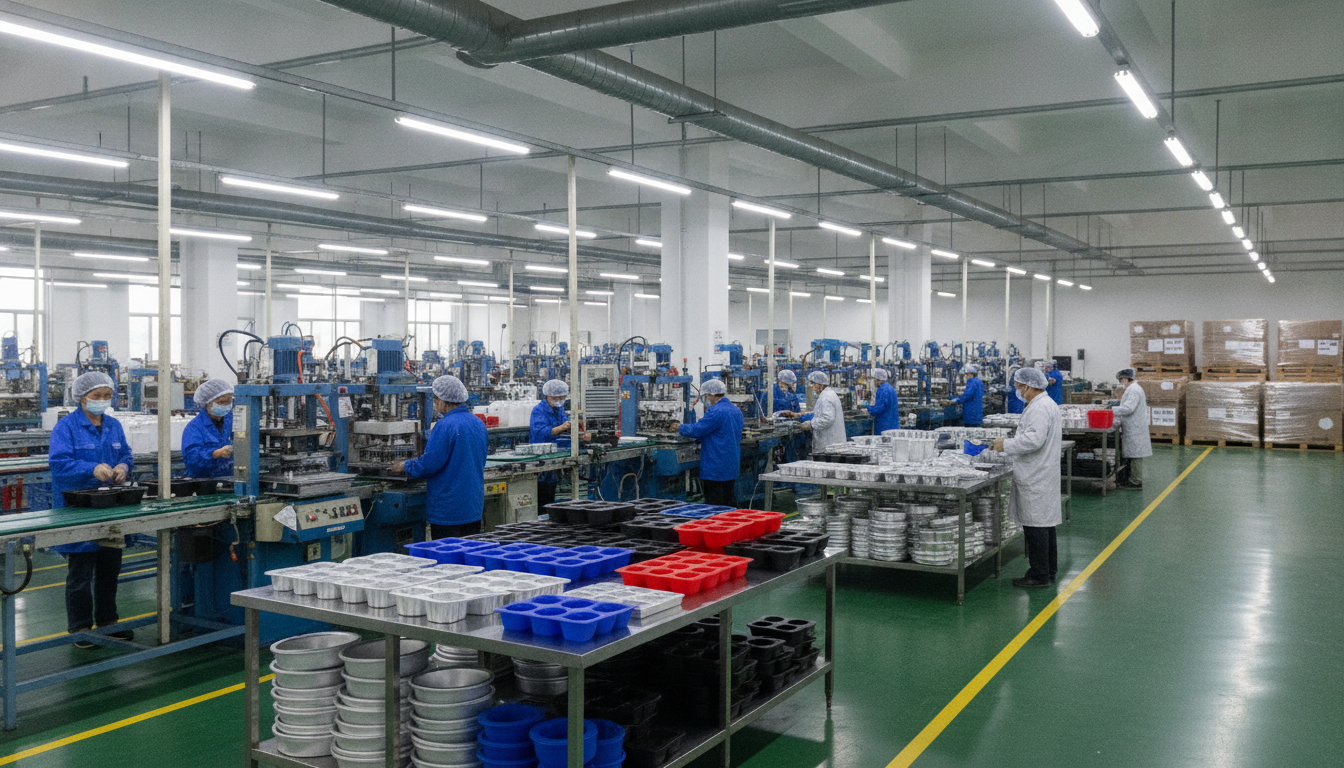
East African bakeware importers face a critical sourcing decision: Chinese factories offer container-scale capacity and single-piece sampling, while Turkish suppliers position themselves as European-tier quality at mid-range pricing. This chinese vs turkish bakeware quality comparison africa breaks down warp resistance, coating adhesion, landed cost to Mombasa and Lagos, and regulatory compliance-backed by factory specs, not marketing claims.
📋 Table of Contents
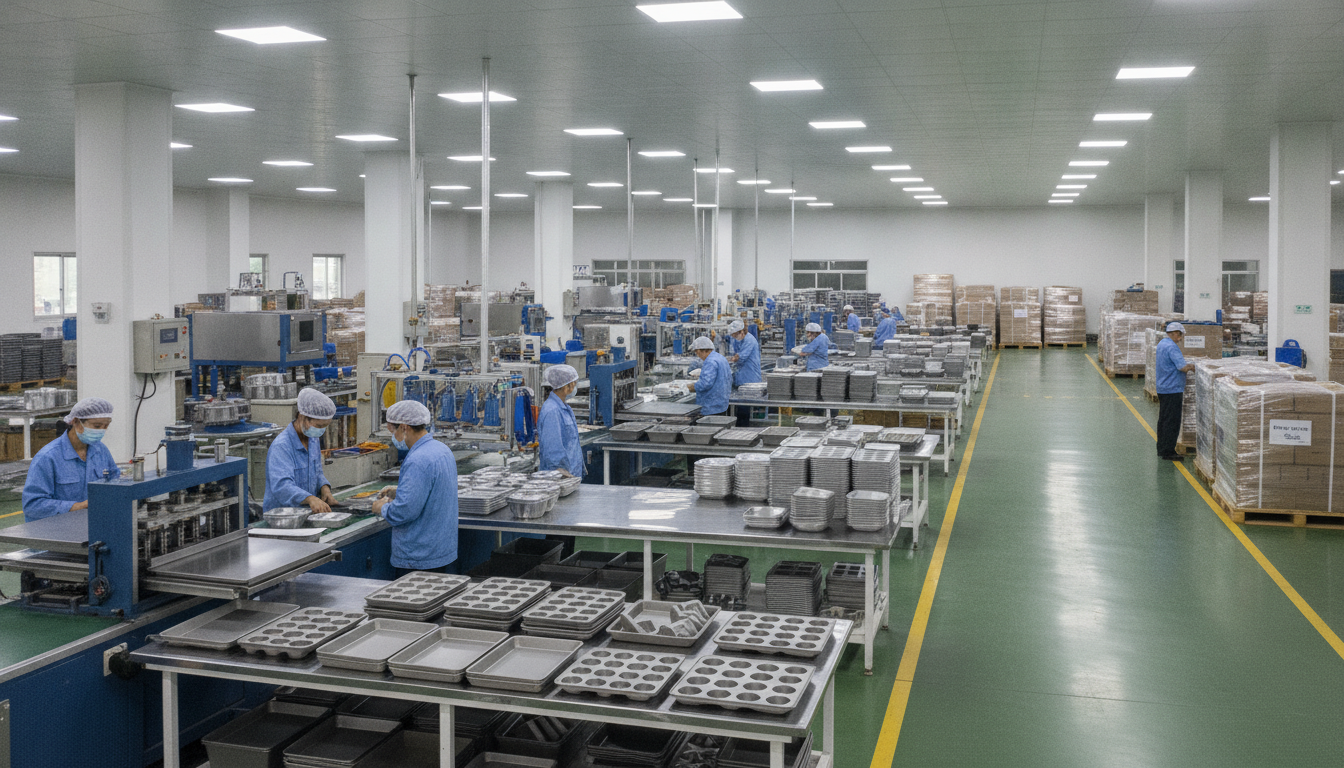
Performance in high-temperature commercial bakery environments separates functional bakeware from returns. Warp resistance and heat distribution determine whether a pan survives 200+ bake cycles or deforms after the first month.
Chinese carbon steel bakeware typically uses 0.4mm to 0.6mm gauge material for standard sheet pans. Turkish manufacturers favor 0.5mm to 0.8mm gauge. The thicker Turkish material resists warping under thermal shock when pans move from 230°C ovens to ambient cooling racks. However, Chinese factories producing to controlled specs match this performance by using aluminized steel or adding reinforced rims. Importers who specify 0.6mm gauge minimum with corner-reinforcement welding eliminate the warp-rate gap.
In our Yongkang factory runs across wholesale bakeware sets, we’ve validated that 0.6mm carbon steel with rolled edges maintains flatness through 300+ bake cycles at 220°C, matching Turkish-import performance when the spec is enforced at production.
Turkish aluminum bakeware often uses 3003 alloy with 1.2mm to 1.5mm thickness, delivering even heat spread across the pan surface. Chinese suppliers offer both 3003 and lower-cost 1100 alloy. The 1100 alloy conducts heat faster but creates hot-spot zones that burn cake edges. Importers must specify 3003 alloy minimum and request mill certificates to avoid substitution. Chinese factories capable of 500,000 units monthly output maintain alloy consistency when the purchase order locks the material grade, closing the performance gap.
Both Chinese and Turkish silicone bakeware claim food-grade, oven-safe ratings. The difference emerges in filler content. Low-cost Chinese silicone may include calcium carbonate fillers that reduce heat tolerance to 180°C, below the 220°C commercial baking standard. Turkish silicone typically uses platinum-cure processes with minimal filler. Chinese manufacturers producing FDA-compliant silicone-tested to 21 CFR 177.2600 limits-deliver identical 230°C stability. The variable is supplier selection and testing verification, not country of origin.
Non-stick coating failure drives the majority of bakeware returns in African distribution. Buyers raising concerns about coating defects often discover that material substitution and inadequate adhesion testing create the gap, not inherent country-of-origin quality differences.
Cross-cut adhesion measures how well non-stick coating bonds to the metal substrate. The test scores adhesion on a 0-5 scale, where 0 means perfect bond and 5 indicates complete coating separation. Turkish bakeware typically scores 0-1 because factories apply primer layers before PTFE or ceramic top coats. Chinese suppliers without controlled processes skip primer application to reduce cost, resulting in 3-4 adhesion scores that lead to coating peel within 50 wash cycles.
Chinese factories operating to food-grade SGS and FDA certified standards apply the same multi-layer primer systems. Our Yongkang production line uses a three-stage coating process-metal prep, primer cure, and PTFE application-that delivers 0-1 adhesion scores in SGS cross-cut testing. The performance difference vanishes when the buyer specifies the coating protocol and requests pre-shipment adhesion reports.
PFAS restrictions in food-contact materials are tightening globally. Turkish suppliers market PFAS-free ceramic coatings as a differentiation point. Chinese manufacturers produce identical PFAS-free ceramic and silicone-based non-stick coatings, but importers must verify through SGS or Intertek testing. The risk is not that Chinese factories cannot produce PFAS-free goods, but that unverified suppliers may substitute materials mid-production.
Importers concerned about material switching can request lot-specific SGS reports that confirm PFAS absence and heavy-metal limits.
Both Chinese and Turkish bakeware claim oven-safe ratings up to 230°C. The gap appears in handle and silicone-grip components. Low-cost Chinese bakeware may use phenolic handles rated to 180°C, creating a safety risk when the pan body is oven-safe to 230°C. Turkish suppliers typically use stainless steel handles or silicone grips tested to 250°C. Chinese factories producing to specification match this by using stainless handles or high-temp silicone grips with dedicated testing. The variable is supplier vetting, not manufacturing location.
Landed cost determines margin and retail competitiveness. The chinese vs turkish bakeware quality comparison africa reveals a 30-40% cost differential that narrows or widens based on container utilization, port efficiency, and duty structures.
Chinese carbon steel sheet pans (18″ x 13″) typically quote $1.80-$2.40 FOB Ningbo for 1,000-piece orders. Turkish equivalents quote $3.20-$4.10 FOB Mersin or Istanbul. The FOB gap reflects labor cost, material sourcing proximity, and production scale. Chinese factories running 500,000 units monthly amortize tooling and setup costs across larger runs, while Turkish suppliers operate smaller batch production with higher per-unit overhead.
Ningbo to Mombasa 20-foot container freight averages $1,400-$1,800, with 22-28 day transit. Turkish ports to Mombasa require transshipment through Jeddah or Djibouti, adding $600-$900 in freight and extending transit to 35-42 days. For Nairobi-based importers, Chinese routing saves 10-14 days and $700-$900 per container, improving cash-flow velocity.
Lagos Apapa routes from Ningbo cost $2,100-$2,600 for 20-foot containers, while Turkish shipments via Mediterranean transshipment run $2,800-$3,400. The freight differential compounds the FOB gap, making Chinese goods 35-45% cheaper landed before duty.
Kenya applies 25% import duty on bakeware under HS code 7323. South Africa applies 20%, while Nigeria applies 20% plus 7.5% VAT. Duty rates apply equally to Chinese and Turkish imports, so the percentage gap in FOB pricing translates directly to landed cost. A $2.00 FOB Chinese pan lands in Nairobi at approximately $3.10 after freight, duty, and clearing, while a $3.50 Turkish pan lands at $5.20-a 68% price premium for the Turkish good.
Turkish suppliers position this premium as a quality investment. For retail brands targeting premium segments, the European-origin association justifies higher shelf pricing. For distributors supplying bakeries and catering operations, the cost gap erodes margin without delivering measurable performance improvement when Chinese goods are produced to the same material and coating specs.
Minimum order quantities determine whether an importer can validate market demand before committing container-scale capital. Turkish suppliers typically require 1,000-2,000 piece MOQs per SKU, while Chinese factories offer tiered structures that support startup and test-market scenarios.
Chinese manufacturers like Shansen offer 1-piece MOQ for sample validation. An importer testing three bakeware styles can order one unit of each SKU, validate performance and market fit, then scale to production orders.
For importers launching low-MOQ bakeware brands, the 1-piece sample access compresses validation timelines from 8-12 weeks to 3-4 weeks. This speed-to-market advantage outweighs minor per-unit cost differences at the sampling stage.
After sample approval, Chinese factories offer 30-50 piece per-SKU minimums for first production runs. A distributor testing five SKUs can place a 150-250 piece mixed order, filling a partial container without locking up $8,000-$12,000 in untested inventory. Turkish suppliers maintain 1,000-2,000 piece per-SKU minimums, requiring full-container commitments that expose importers to demand-forecast risk.
This MOQ flexibility matters most in Francophone and Lusophone African markets where importers serve fragmented distribution networks. A Douala-based distributor supplying 15 independent bakeries cannot absorb 2,000-piece single-SKU orders. The 30-50 piece Chinese MOQ allows multi-SKU assortments that match actual demand patterns.
Chinese production lead times average 25-35 days from deposit to container-ready, with 22-28 day Ningbo-to-Mombasa shipping. Total cycle time runs 50-65 days. Turkish suppliers quote 35-45 day production with 35-42 day shipping, totaling 70-87 days. The 15-22 day cycle-time advantage in Chinese sourcing improves inventory turn and reduces stockout risk for fast-moving SKUs.
Sample MOQ: 1 piece per SKU. First production MOQ: 30 pieces per SKU. Lead time: 25-35 days production + 22-28 days Ningbo to Mombasa.
Food-contact safety regulations in Kenya, Nigeria, and South Africa require that bakeware meets heavy-metal limits and migration standards. Both Chinese and Turkish suppliers can meet these requirements, but verification processes differ.
FDA 21 CFR 177.2600 defines migration limits for silicone rubber articles in food contact. Chinese factories producing FDA-compliant bakeware test silicone molds and baking mats to these standards, ensuring that volatile organic compounds and heavy metals remain below threshold. Turkish suppliers reference EU Regulation 1935/2004 and EU 10/2011, which set similar migration limits. Both frameworks deliver food-safe products when testing is conducted and verified.
The compliance gap emerges when Chinese suppliers skip testing to reduce cost. Importers concerned about untested goods can request SGS or Intertek reports for each production lot. Our Yongkang facility maintains SGS food-contact testing for all custom OEM and private-label bakeware runs, with test reports provided before shipment. This eliminates the verification risk that undermines confidence in Chinese-sourced goods.
California Proposition 65 restricts lead content in food-contact surfaces to below 0.1 µg per day exposure. While Prop 65 is a U.S. regulation, many African importers reference it as a de facto safety standard. Chinese carbon steel and aluminum bakeware produced to Prop 65 limits test at <0.01 µg lead per surface area, matching Turkish and European goods. The variable is supplier testing discipline, not inherent material quality.
PFAS restrictions are expanding beyond Europe into African markets as buyers become aware of perfluorinated-compound risks. Chinese manufacturers producing PFAS-free ceramic and silicone coatings can provide SGS PFAS-negative test reports. Turkish suppliers market PFAS-free as a standard feature, but the chemical absence depends on coating formulation, not country of manufacture. Both sources deliver PFAS-free goods when the buyer specifies the requirement and requests third-party verification.
Kenyan and Nigerian customs require Certificate of Conformity (CoC) for kitchenware imports. Chinese exporters familiar with African markets provide SGS or Intertek CoC documentation as part of the shipping process. Turkish suppliers less experienced in African export may require importer education on CoC requirements, adding 7-10 days to the first-shipment timeline. For baking tools wholesale in Nigeria, Chinese suppliers with established Lagos Apapa routing handle CoC and SONCAP certification as standard procedure.
Turkish bakeware carries a European-quality perception, but performance depends on material specs and testing, not origin. Chinese factories producing to 0.6mm carbon steel gauge, three-stage coating protocols, and SGS food-contact testing deliver warp resistance, coating adhesion, and food-safety compliance identical to Turkish goods. The quality gap appears when Chinese suppliers cut specs to reduce cost, not as an inherent manufacturing limitation. Importers who specify material grades, request cross-cut adhesion reports, and verify FDA or SGS compliance eliminate performance differences while capturing 30-40% landed-cost savings.
Chinese bakeware lands in Mombasa and Lagos at 60-70% of Turkish pricing. A carbon steel sheet pan costing $2.10 FOB Ningbo lands in Nairobi at approximately $2.90 after freight and duty, while a $3.65 FOB Turkish pan lands at $5.04. The cost gap reflects lower Chinese labor and material costs, shorter shipping routes from Ningbo to East African ports, and higher production scale that amortizes tooling across 500,000-unit monthly runs. Turkish goods carry a premium justified by European-origin positioning, but the performance difference disappears when Chinese production follows controlled material and testing specs.
Request 1-piece samples and conduct cross-cut adhesion testing, oven-cycle validation, and SGS food-contact reports before placing production orders. Chinese manufacturers offering 1-piece MOQ allow you to test coating durability, warp resistance, and handle heat tolerance without committing to 1,000-piece minimums. Specify material grades in the purchase order-0.6mm carbon steel minimum, 3003 aluminum alloy, FDA 21 CFR 177.2600 silicone-and require lot-specific SGS or Intertek reports confirming lead, cadmium, and PFAS limits. Turkish suppliers provide similar testing but require 50-100 piece sample minimums that increase validation costs.
Aluminized carbon steel with 0.6mm gauge and rolled-edge reinforcement performs best in high-temperature African bakery environments. Aluminized coating resists rust in humid coastal climates while maintaining warp resistance through 300+ bake cycles at 220-230°C. Stainless steel offers superior corrosion resistance but costs 40-50% more and conducts heat unevenly, creating hot spots. Silicone bakeware works for low-volume artisan bakeries but degrades faster under continuous commercial use. Both Chinese and Turkish suppliers produce aluminized carbon steel to these specs when material grade and coating process are specified in the purchase order.
Kenya requires SGS Certificate of Conformity for kitchenware imports under the Pre-Export Verification of Conformity program. Nigeria mandates SONCAP certification for food-contact goods, processed through SGS or Intertek before shipment. South Africa applies SABS standards but does not require pre-shipment certification for most bakeware categories. All three markets accept SGS food-contact test reports confirming FDA 21 CFR 177.2600 compliance for silicone and heavy-metal limits below Prop 65 thresholds for metal pans. Chinese exporters experienced in African markets handle CoC and SONCAP documentation as standard procedure, while Turkish suppliers may require importer guidance on certification workflows.
Written by the Shansen Bakeware Export Team.
Ready to compare samples and landed costs for your East Africa distribution?
Request 1-Piece Samples and SGS Reports →
MOQ 1 set on stock configurations. Tell us what you need and we reply on WhatsApp.
Click the button below to open WhatsApp. If you're not logged in to WhatsApp Web yet, scan the QR code first — then come back here and copy the message into the chat.