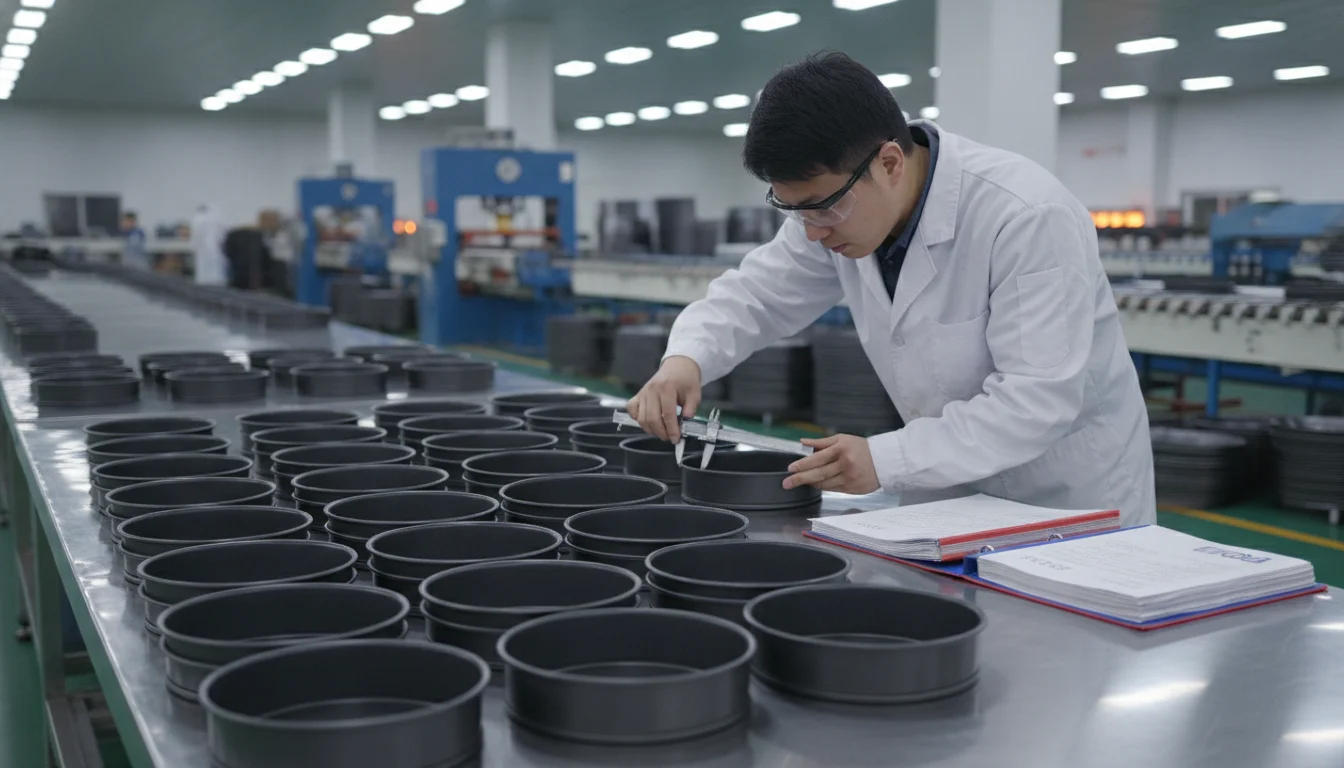
An 8 inch cake pan is a round baking vessel with an 8-inch diameter, typically available in 2-inch or 3-inch depths, manufactured in carbon steel, aluminum, stainless steel or silicone. For wholesale buyers, MOQ starts at 1 pc for sampling and 500 pcs for OEM production runs on metal lines, with SGS/FDA test reports issued per order.
📋 Table of Contents
An 8 inch cake pan is a circular baking vessel with an 8-inch inside diameter, measured at the top rim. Depth options include 2 inches for single-layer cakes and 3 inches for taller wedding tiers or deep sponge cakes. The pan’s base diameter is typically 6.5 to 7 inches, creating a slight taper that aids cake release.
The 8 x 2-inch configuration is the most common retail size, holding approximately 6 cups of batter and baking a single layer suitable for birthday cakes. The 8 x 3-inch variant accommodates 9 cups of batter and is preferred for wedding cakes, where taller tiers reduce the number of pans needed per tier. Bakeries ordering in bulk often request both depths to serve different cake styles without retooling.
Straight sidewalls create vertical cake edges, while slightly tapered walls (1 to 3 degrees) improve release by reducing suction during inversion. Buyers report that pans with excessively rolled or welded rims retain wash water, complicating drying and creating hygiene risks in commercial kitchens. Specifying a clean-edge or wire-reinforced rim during OEM design avoids this issue.
Uneven or lopsided baking signals base-flatness problems or inconsistent material thickness. Distributors serving professional bakeries should request flatness tolerance data (typically ±0.5 mm across the base diameter) and confirm gauge consistency during pre-production sampling. A warped base causes center doming and uneven browning, which professional bakers reject immediately.
Material selection determines heat response, durability, weight and price point. Carbon steel, aluminum, stainless steel and silicone each serve distinct buyer segments, and matching material to end-user needs prevents returns and supports repeat orders.
Carbon steel combines moderate thermal conductivity with excellent structural rigidity, making it the preferred choice for commercial bakeries running multiple batches daily. The material resists warping under repeated heating cycles and supports non-stick coatings that withstand industrial dishwashing. Our Yongkang factory runs a dedicated carbon steel bakeware line at 500,000 units per month capacity, with SGS-verified FDA 21 CFR 175.300 coating compliance tested in 2020.
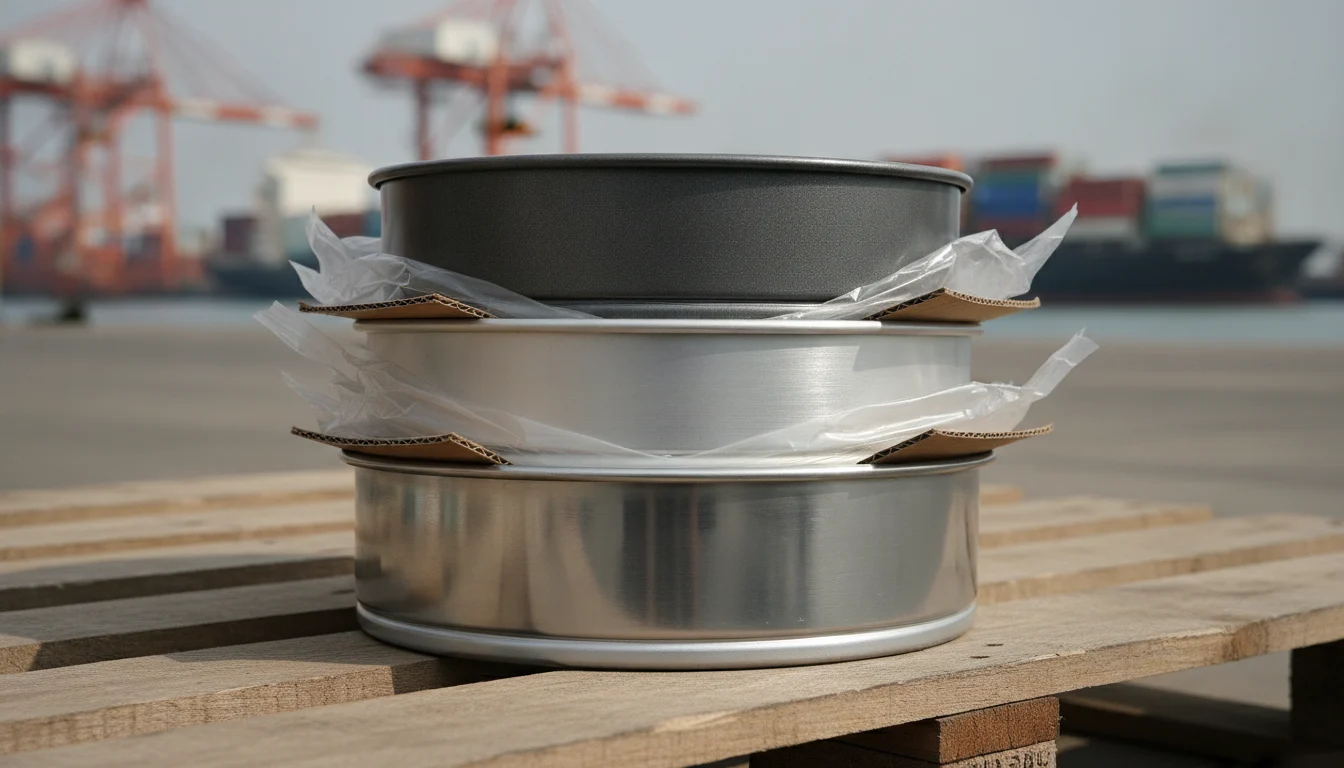
Aluminum’s light weight and rapid heat response appeal to home bakers who prioritize ease of handling and faster baking times. The material dents more easily than carbon steel, which distributors must account for when planning shipping protection and shelf display. Anodized-aluminum variants improve scratch resistance and reduce reactivity with acidic batters, but buyers report that shipping damage remains a common complaint even with upgraded finishes.
Stainless steel pans marketed as non-toxic and dishwasher-safe attract health-conscious retail buyers, but the material’s poor thermal conductivity creates uneven baking unless paired with an aluminum or copper core. Buyers report lopsided cakes and inconsistent browning when single-layer stainless pans are used without a heat-spreading base, making core construction a critical spec point during sourcing.
Non-stick coating performance determines cake release, cleanup speed and pan lifespan. Buyers report that coatings flake off after minimal use, cakes stick despite non-stick marketing claims, and adhesive label residue interferes with food contact, creating return rates that erode distributor margins.
Coating delamination after a single use signals poor substrate preparation or insufficient curing during manufacturing. Distributors should request coating adhesion test data (cross-hatch or pull-off test results) and confirm that the coating supplier meets FDA 21 CFR 175.300 migration limits before placing bulk orders. The 2020 SGS report on our carbon-steel line verifies PFAS-free and lead-free coating chemistry, which you can request alongside samples.
Cake batter sticking to a marketed non-stick surface often results from insufficient coating thickness (typically under 15 microns) or poor surface preparation that leaves micro-pits where batter lodges. Sampling one piece before committing to a 500-piece production run lets you test actual release performance with your target batter formulations, rather than relying on supplier claims alone.
Buyers report difficulty removing product labels and adhesive residue that traps food particles during washing. Specifying water-soluble or peel-clean labels during OEM design eliminates this pain point. Distributors targeting food-service buyers should flag hygiene-critical details like label placement and adhesive type in the initial RFQ to avoid post-shipment complaints.
MOQ and sampling flexibility determine whether a distributor can validate market demand before tying up working capital in bulk inventory. Rigid MOQ structures force untested SKUs into the supply chain, while accessible sampling terms let buyers confirm coating quality, dimensional accuracy and end-user acceptance before scaling.
Sample: 1 pc (metal line). OEM production run: 500 pcs per SKU. Bakeware sets: from 1 set.
Shansen’s metal and carbon-steel lines allow 1-piece sampling, so you can physically test an 8 inch cake pan with your own batter recipes, oven conditions and release protocols before committing to a 500-piece order. Sampling cost and lead time are confirmed at quotation, and the sample ships from our Ningbo export hub to Lagos, Mombasa or your nominated port.
The 500-piece MOQ per SKU on metal lines balances tooling amortization with accessible entry volume for small distributors and private-label startups. A single 20-foot container optimized for African ports can accommodate multiple SKUs (8-inch, 9-inch, rectangular pans) within the 500-piece threshold, spreading freight cost across a mixed assortment rather than forcing a single-SKU commitment.
Our wholesale bakeware sets start from 1 set, allowing you to sample a complete retail-ready assortment (e.g., 6-inch, 8-inch, 10-inch round pans) without ordering each size separately. Set-based sampling is particularly useful for distributors testing bundled SKUs in retail channels where shelf space favors multi-piece packaging.
In practice: Ordering a 1-piece sample of an 8 inch cake pan in carbon steel and aluminum lets a distributor compare coating release, weight and baking performance side by side before selecting the material for a 500-piece production run
Food-contact compliance documentation determines whether a shipment clears customs, satisfies retailer due-diligence requirements and protects the distributor from liability claims. SGS and FDA test reports verify that coating chemistry, migration limits and heavy-metal content meet regulatory thresholds, but reports must be current and product-specific to carry weight with importers.
FDA 21 CFR 175.300 defines the food-contact safety limits for resinous and polymeric coatings used on bakeware. The 2020 SGS report on our carbon-steel line tests coating migration under simulated baking conditions and confirms PFAS-free and lead-free chemistry. Reports are issued per order and per production batch, so you receive documentation tied to your specific shipment rather than a generic factory certificate.
SGS test reports dated 2020, 2021 and 2023 are on file and available on request. Each report links test results to a specific production batch, creating traceability that supports due-diligence audits by retailers and food-service buyers. Distributors targeting Nigeria, Kenya and South Africa should request test reports during sampling to confirm that documentation will accompany the bulk shipment.
PFAS-free and lead-free claims require third-party verification to avoid greenwashing accusations and regulatory challenges. The SGS-verified badges on our carbon-steel line are sourced from the 2020 test report and apply specifically to that line’s non-stick coating. Distributors planning private-label packaging should confirm which product lines carry which certifications before printing marketing claims that exceed tested scope.
Freight optimization for African distributors requires container loading that maximizes cube utilization, protects pans from transit damage and aligns with port-specific handling conditions at Lagos Apapa, Mombasa and Francophone or Lusophone African ports. Poor packing leads to dents, scratches and finish damage that buyers cite as a recurring complaint.
An 8 inch cake pan with a 3-inch depth stacks more efficiently than a 2-inch shallow variant, but mixed-depth loading within a single carton creates instability during transit. Our Ningbo export team pre-plans container loading to pair complementary SKUs (round pans, rectangular trays, multi-piece sets) that nest or stack without wasted air space, reducing per-unit freight cost and improving landed economics for African distributors.
Buyers report scratches, dents and finish damage caused by inadequate shipping protection. Specifying individual poly-bag wrapping, corrugated dividers and corner bracing during the OEM order prevents metal-on-metal contact that mars non-stick coatings. Distributors should request packing photos or a pre-shipment inspection report to verify protection measures before the container leaves Ningbo port.
Lagos Apapa, Mombasa and Luanda each have distinct customs-clearance and handling protocols. Our team optimizes documentation (commercial invoice, packing list, SGS/FDA test reports) for the destination port you nominate, reducing clearance delays and demurrage charges. Lead time, transit days and documentation requirements are confirmed at quotation based on your target market.
An 8 x 2-inch cake pan holds approximately 6 cups of batter, suitable for a single layer. An 8 x 3-inch pan accommodates 9 cups, which supports taller wedding-tier cakes or deep sponge recipes. Overfilling beyond these volumes causes batter overflow and uneven baking, while underfilling creates thin, dry layers.
An 8-inch pan measures 20.32 cm in diameter, making it functionally equivalent to a 20 cm pan for most baking purposes. The 0.32 cm difference does not significantly affect batter volume or baking time. Distributors serving metric markets can label an 8-inch pan as 20 cm without material performance issues.
A 9-inch pan has approximately 27% more surface area than an 8-inch pan, requiring proportionally more batter and longer baking time. Using an 8-inch recipe in a 9-inch pan creates a thinner, drier layer, while forcing a 9-inch recipe into an 8-inch pan causes overflow. Distributors offering both sizes should provide conversion guidance to avoid end-user baking failures.
Written by the Shansen Bakeware Export Team.
Ready to validate coating quality and dimensional accuracy before committing to bulk inventory?
Request Your 1-Piece Sample Today →
MOQ 1 set on stock configurations. Tell us what you need and we reply on WhatsApp.
Click the button below to open WhatsApp. If you're not logged in to WhatsApp Web yet, scan the QR code first — then come back here and copy the message into the chat.