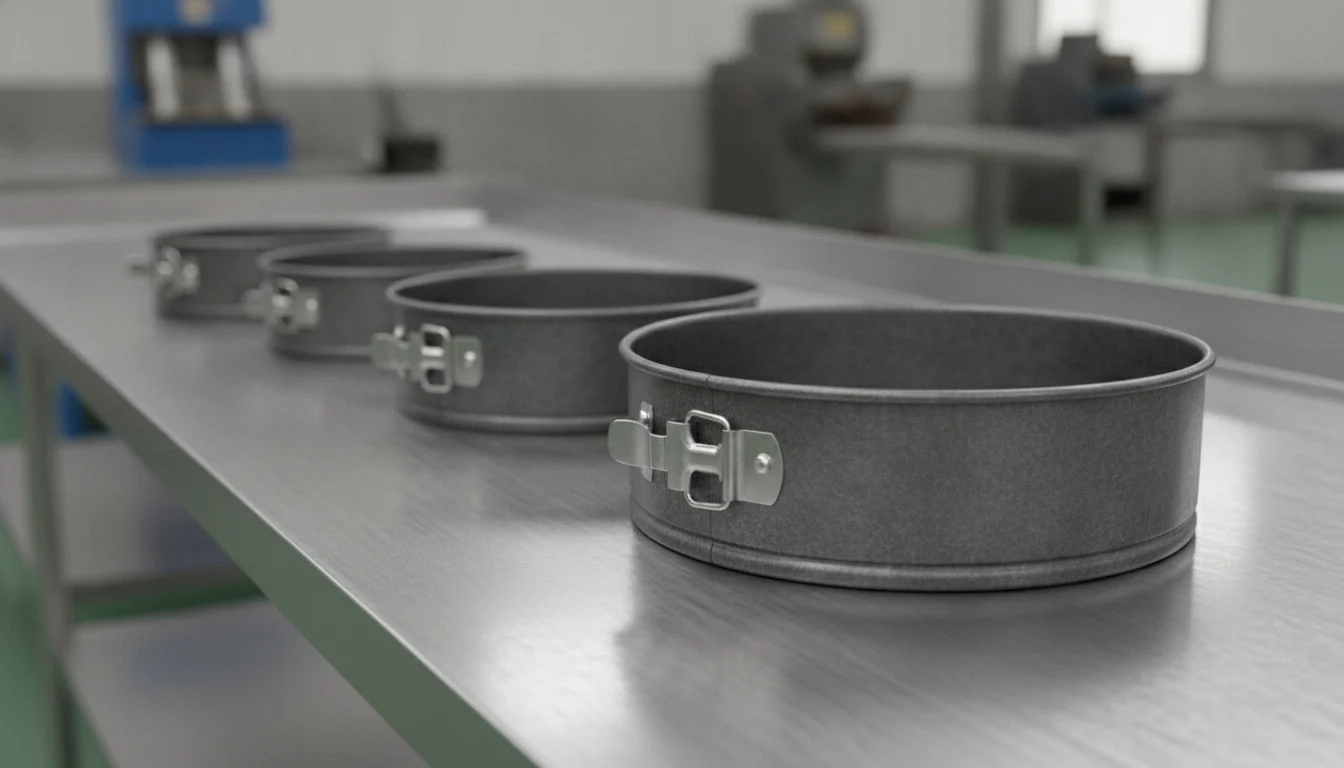
Springform pan sizes typically range from 6 inches to 10 inches in diameter, with 9 inches being the industry standard for most cheesecake recipes. Depth usually sits between 2.75 and 3 inches across all sizes. For distributors ordering carbon-steel springform pans from our Yongkang factory, the MOQ is 1 piece for sampling and 500 pieces per SKU for an OEM production run.
📋 Table of Contents
Springform pan sizes follow a consistent inch-based scale that originated in North American and European bakeware manufacturing. The five core diameters address different portion sizes and recipe traditions.
A 6-inch springform pan yields 4 to 6 individual servings. Small bakeries in Lagos and Nairobi use this size for single-portion cheesecakes sold in display cases. The compact footprint also suits home bakers working with countertop ovens or testing new recipes before scaling up. Our carbon-steel 6-inch pans ship in sets or as individual SKUs for distributors targeting the premium single-serve dessert segment.
Seven-inch pans bridge the gap between individual and small-family portions, serving 6 to 8 people. This diameter has gained traction in pressure-cooker baking because it fits comfortably inside 6-quart and 8-quart Instant Pot models without touching the inner wall. Buyers report that nominal diameter alone does not guarantee cooker compatibility; the pan’s outer base and latch mechanism must clear the insert rim, so distributors should request exact exterior measurements before placing bulk orders.
An 8-inch springform pan serves 8 to 10 people and works well for smaller households or recipe developers who want to reduce ingredient waste during testing. This size is common in European baking traditions, where metric recipes often specify a 20-centimetre pan. Distributors serving South African and Francophone markets should verify that the interior diameter measures close to 20 cm after accounting for wall thickness.
Nine inches is the default springform pan size in the United States and appears in the majority of published cheesecake recipes. A 9-inch pan serves 10 to 12 people and holds roughly 10 cups of batter when filled to the recommended three-quarters mark. Our Yongkang production line runs 9-inch carbon-steel pans at the highest volume because this diameter dominates wholesale orders from African kitchenware distributors stocking retail chains.
Ten-inch springform pans suit catering operations, large family gatherings, and commercial bakeries producing party-sized desserts. This diameter serves 12 to 16 people and requires batter volumes 30 to 40 percent greater than a 9-inch pan. Buyers sometimes underestimate the jump in ingredient cost when scaling recipes up to 10 inches, so distributors should educate retail customers on volume calculations before they commit to this size.
Distributors shipping wholesale bakeware sets to Nigeria, Kenya, South Africa, and Francophone markets need accurate centimetre conversions because most African and European recipes specify pan dimensions in metric units. A mismatch between the pan size and the recipe can result in batter overflow or underfilled desserts, which drives customer returns.
An 8-inch pan at 20.32 centimetres is effectively interchangeable with recipes calling for a 20-centimetre springform pan. The 0.32-centimetre difference falls within normal manufacturing tolerance and has negligible impact on batter volume. Distributors should print this conversion chart on product packaging or include it in retail training materials to reduce confusion at the point of sale.
Springform pan depth typically ranges from 2.75 inches to 3 inches across all diameters. This height accommodates the batter volume for a standard New York-style cheesecake, which rises slightly during baking and then settles. Pans shallower than 2.5 inches risk batter overflow when customers follow traditional recipes without adjusting quantities.
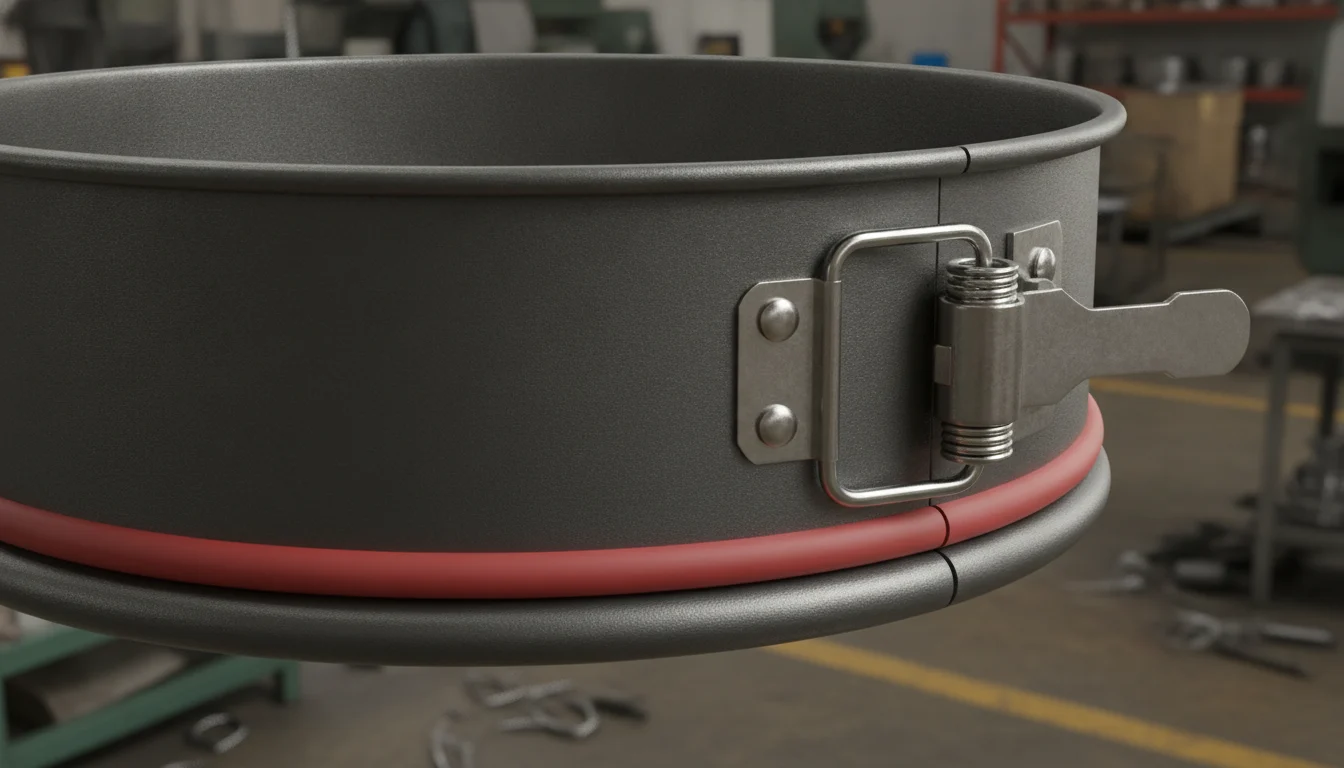
A 3-inch wall height provides a safety margin for recipes that call for 8 to 10 cups of batter in a 9-inch pan. This depth also allows bakers to use a water bath without the pan’s rim sitting below the water line, which would compromise the seal and allow seepage. Buyers report that inexpensive springform pans leak batter and allow water-bath seepage, making them unreliable for cheesecake baking. Our carbon-steel pans use a silicone gasket between the base and collar to prevent leaks during water-bath baking.
Some European manufacturers offer 2-inch springform pans for thin tarts and tortes that do not require the full height of a cheesecake pan. These shallow models are less common in African wholesale markets because they serve a narrower range of recipes. Distributors stocking retail chains should prioritize 3-inch depth to cover the broadest customer base.
Four-inch springform pans cater to multi-layer cakes and tall mousse desserts. This specialty size appears in professional pastry supply catalogs but rarely in general kitchenware retail. The added material cost and limited recipe compatibility make 4-inch pans a poor fit for startup brands testing the market with a low-MOQ bakeware order.
Recipe scaling between springform pan sizes depends on the area of the pan’s base, not its diameter. A 9-inch pan has a base area of roughly 64 square inches, while an 8-inch pan measures 50 square inches. Moving from a 9-inch to an 8-inch pan requires reducing the batter volume by approximately 22 percent, not the 11 percent that a simple diameter comparison would suggest.
Distributors educating bakery customers should emphasize that a 10-inch pan requires 23 percent more batter than a 9-inch pan, not just 11 percent. This calculation prevents underfilled desserts that look flat and unprofessional. Recipe developers working with African ingredients can use these scaling factors to adapt Western cheesecake recipes to local portion preferences and ingredient availability.
Product dimensions can be misleading because the external base, collar, and usable interior diameter may differ substantially. One reviewed pan had a 9.8-inch base, a 9.3-inch collar, and an 8.8-inch interior. The nominal 9-inch label referred to the collar diameter, but the actual cooking surface was a full inch smaller. Bakers following a recipe designed for a true 9-inch interior ended up with excess batter and overflow.
Most factories measure springform pan sizes at the top edge of the collar, which includes the thickness of the metal wall. A carbon-steel pan with 1.2-millimetre walls loses roughly 0.1 inch of interior diameter per side, reducing the usable cooking surface by 0.2 inch compared to the nominal size. Stainless-steel pans with thicker 1.5-millimetre walls can lose 0.25 inch or more.
A half-inch discrepancy between nominal and interior diameter changes the base area by roughly 8 percent, enough to cause noticeable differences in baking time and texture. Distributors ordering custom OEM private-label bakeware should request interior diameter measurements during the sampling phase and print that figure on retail packaging alongside the nominal size.
The spring-release latch and hinge assembly add 0.3 to 0.5 inch to the pan’s external footprint. This protrusion matters when the pan must fit inside an oven rack, a pressure cooker insert, or a shipping carton. Buyers need to verify cooker compatibility because a pan’s nominal diameter does not by itself confirm that it will fit a 6-quart or 8-quart pressure cooker. Our export team provides full exterior dimension drawings for each SKU to help distributors plan container loading and retail shelf layouts.
Pressure-cooker baking has grown in African markets where electricity costs make traditional ovens expensive to operate. A springform pan designed for pressure cooking must clear the cooker’s inner pot diameter and leave enough space for steam circulation. The 7-inch springform pan is the most reliable option for both 6-quart and 8-quart models.
A 6-quart pressure cooker typically has an inner pot diameter of 8 to 8.25 inches. A 7-inch springform pan with an external base diameter of 7.5 inches (including latch) fits with 0.5 inch of clearance on each side. An 8-inch pan is too large and will not fit, even if the nominal diameter suggests otherwise. Distributors should measure the actual exterior base and latch assembly before listing a pan as 6-quart compatible.
Eight-quart cookers have inner pot diameters around 9 to 9.25 inches, allowing a 7-inch or even an 8-inch springform pan to fit. The 8-inch option provides more servings but leaves less room for steam circulation, which can extend cooking time by 10 to 15 percent. Bakery customers targeting pressure-cooker cheesecakes should test both sizes during product development to balance portion size against cooking efficiency.
Pressure-cooker springform pans sit on a trivet or steamer rack to keep the base above the water line. The combined height of the trivet and the pan must not exceed the cooker’s maximum fill line, typically 6 to 7 inches from the bottom. A 3-inch-deep springform pan on a 2-inch trivet reaches 5 inches, leaving adequate headroom. Distributors should include trivet compatibility in their product specifications to prevent customer confusion.
Carbon steel, stainless steel, and aluminum each have different wall thicknesses and thermal expansion properties that influence final pan dimensions. Our Yongkang factory runs three separate production lines for these materials, and each line holds different tolerances.
Carbon-steel springform pans use 0.8- to 1.2-millimetre gauge steel, producing a lightweight pan with thin walls. The thinner material maximizes interior diameter for a given nominal size. Our carbon-steel line is tested against FDA 21 CFR 175.300 for food-contact non-stick coatings, with SGS reports dated 2020 covering PFAS-free and lead-free compliance. These pans ship from Ningbo to Lagos Apapa, Mombasa, and Francophone African ports in optimized container loads.
Stainless-steel pans require 1.2- to 1.5-millimetre walls to maintain rigidity without a non-stick coating. The thicker gauge reduces interior diameter by 0.2 to 0.3 inch compared to a carbon-steel pan of the same nominal size. Users encounter latches that loosen after repeated use and bases that warp, preventing the pan from sitting flush. Our stainless-steel springform pans use a reinforced base with a rolled edge to resist warping under thermal stress.
Aluminum springform pans combine light weight with good heat conduction. Wall thickness sits between carbon steel and stainless steel at 1.0 to 1.3 millimetres. Aluminum is softer than steel, so latch mechanisms require reinforced mounting points to prevent the collar from deforming when the spring is released. Distributors stocking food-grade SGS-FDA-certified bakeware should verify that aluminum pans carry current test reports, because older coatings sometimes contained restricted substances.
In practice: Ordering a 1-piece sample of each material in the same nominal size lets a distributor measure actual interior diameter, wall thickness, and latch clearance before committing to a 500-piece OEM production run
You can adapt a 9-inch recipe to an 8-inch pan by reducing all ingredient quantities by 22 percent, because the 8-inch base area is 78 percent of the 9-inch area. Alternatively, use the full recipe and bake the excess batter in a separate ramekin. Do not simply pour the full 9-inch batter into an 8-inch pan, as it will overflow during baking.
The interior cooking surface of a nominal 9-inch springform pan typically measures 8.7 to 8.9 inches after accounting for wall thickness. Carbon-steel pans with thinner walls yield interiors closer to 8.9 inches, while stainless-steel pans with thicker walls may measure 8.7 inches. Request interior diameter specifications from your supplier during the sampling phase to ensure recipe compatibility.
Nominal sizes follow industry standards, but actual dimensions vary based on wall thickness, material choice, and where the manufacturer measures. Some factories measure at the collar’s outer edge, others at the base rim, and a few measure the true interior. Distributors should request detailed dimension drawings showing exterior base, collar diameter, interior diameter, and latch clearance to avoid compatibility issues during bulk orders.
Written by the Shansen Bakeware Export Team.
Need springform pans in multiple sizes for your distribution network?
Request samples and MOQ details →
See the range: every size we make, with specs and MOQ, is on our cake pans and tins page.
MOQ 1 set on stock configurations. Tell us what you need and we reply on WhatsApp.
Click the button below to open WhatsApp. If you're not logged in to WhatsApp Web yet, scan the QR code first — then come back here and copy the message into the chat.