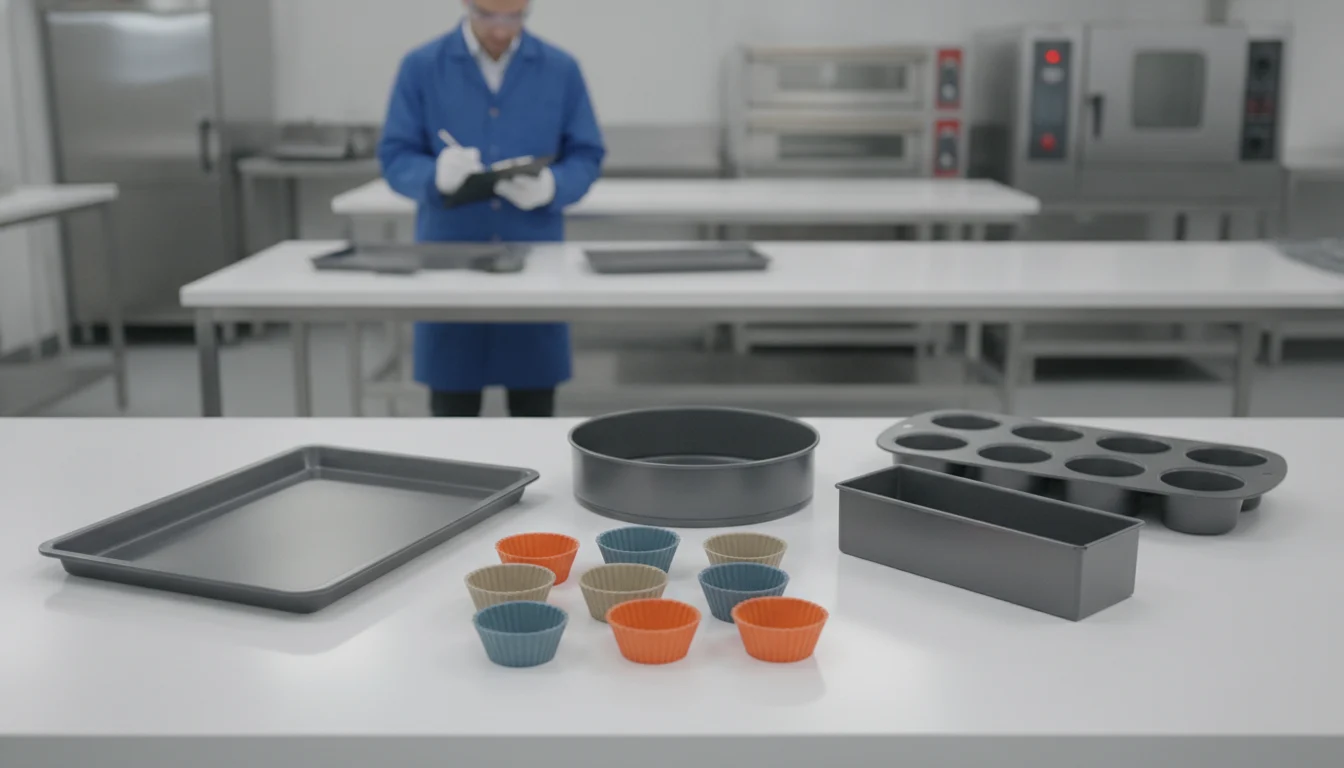
A nonstick bakeware set is a multi-piece collection of baking pans with a coating engineered to release food without greasing, typically offered in carbon-steel, aluminum, or ceramic-coated variants. Factory MOQ starts at 1 set for sampling and 500 pieces per SKU for OEM production runs on metal lines, with SGS and FDA 21 CFR 175.300 test reports issued per order.
📋 Table of Contents
Coating choice determines food-release performance, heat tolerance, and the regulatory path for food-contact compliance. Three coating families dominate factory production: PFAS-free carbon-steel coatings, ceramic sol-gel layers, and silicone rubber molding. Each addresses different buyer priorities around durability, ease of cleaning, and price sensitivity.
Carbon-steel substrates carry a polymer coating formulated without perfluoroalkyl substances, tested under FDA 21 CFR 175.300 for food-contact safety. The 2020 SGS report on file confirms lead-free and PFAS-free status for the carbon-steel line. Buyers targeting U.S. import lanes or health-conscious retail segments prioritize this certification path. Heat tolerance reaches 230°C, and the coating withstands repeated oven cycles when buyers follow the factory curing protocol.
Ceramic coatings bond an inorganic silica layer to aluminum or steel substrates through a sol-gel process. The surface resists scratching better than polymer coatings, but thermal shock during rapid cooling can cause micro-cracking that shortens nonstick life. Distributors serving markets with heavy stovetop-to-oven workflows report higher return rates when end-users skip gradual cooling steps. No SGS or FDA report extends to the ceramic line; compliance verification happens per production batch when the buyer requests third-party testing.
Silicone bakeware uses food-grade platinum-cured or peroxide-cured silicone rubber molded into pan shapes. The material itself is the nonstick surface, eliminating coating-adhesion risks. Flexibility allows nesting for compact storage, a key selling point for space-constrained urban kitchens. Buyers ordering wholesale bakeware sets for retail chains often bundle one or two silicone pieces with metal pans to offer material variety in a single SKU.
Food-safety verification starts with requesting test reports that match the coating type and substrate material in the production batch. SGS and FDA reports on file cover specific product lines, not every SKU or coating variant. Buyers must confirm which line the report applies to before citing compliance in retail packaging or import declarations.
The 2020 SGS report tests the carbon-steel line’s nonstick coating against FDA 21 CFR 175.300, confirming PFAS-free and lead-free status. That report does not extend to ceramic-coated aluminum or silicone lines. Distributors ordering mixed-material sets need separate batch reports for each coating family. Reports are issued per order on request and are not published publicly, so the buyer receives the certificate tied to their production lot.
Suppliers should disclose whether the nonstick layer uses PTFE derivatives, sol-gel ceramics, or silicone rubber. PTFE-based coatings fall under stricter PFAS scrutiny in California and the European Union, even when formulated without PFOA. Buyers targeting those markets cross-check the supplier’s composition statement against the SGS test parameters to confirm the coating formulation matches the certified sample.
FDA 21 CFR 175.300 specifies migration limits for substances that could transfer from the coating into food during baking. The test protocol simulates oven heat and acidic food contact over repeated cycles. Buyers should ask whether the factory’s curing oven reaches the temperature and dwell time stated in the test report, because under-cured coatings release volatile compounds that fail migration tests even when the formulation itself is compliant.
SGS/FDA coverage: The 2020 report applies to the carbon-steel line only. Ceramic and silicone lines require separate batch testing, confirmed at quotation.
MOQ structure differs by product line. Bakeware sets sample from 1 set, allowing distributors to evaluate packaging, piece mix, and retail fit before committing to a container. The metal and carbon-steel line follows a two-tier model: 1 piece for sampling and 500 pieces per SKU for OEM production runs.
A single set ships as a sample, complete with retail packaging and any included accessories like cooling racks or silicone brushes. Buyers use this sample to photograph product listings, test nonstick performance in their own ovens, and validate that piece sizes match the target market’s baking habits. Sampling cost and freight are quoted separately and are not deducted from the production-run invoice.
Individual pans from the carbon-steel or aluminum line sample at 1 piece, enabling buyers to test coating adhesion and gauge thickness before scaling. The OEM production run requires 500 pieces per SKU, which fills approximately one pallet when stacked with protective interleaving. Buyers ordering multiple SKUs in the same coating family can mix SKUs within the 500-piece minimum, but each SKU must meet a 100-piece sub-lot to justify tooling setup.
Sample preparation turnaround is confirmed at quotation. Production lead time for a 500-piece OEM run is confirmed at quotation and depends on coating-line capacity and tooling availability. Buyers planning a product launch around a specific retail season should request a production slot well ahead of the desired ship date to account for coating curing, quality inspection, and container booking.
Piece count determines retail price positioning and shelf space. Six-piece sets anchor entry-level price points for first-time home bakers, while ten-piece and twelve-piece configurations appeal to buyers outfitting commercial kitchens or gifting markets. Distributors serving Lagos, Mombasa, and Francophone Africa adjust piece mix based on local oven sizes and baking habits.
A six-piece nonstick bakeware set typically includes a rectangular sheet pan, a square brownie pan, a round cake pan, a muffin tin, a loaf pan, and a cooling rack. This mix covers everyday baking tasks without overwhelming buyers who lack storage space. Retail price sensitivity in Nigeria and Kenya pushes distributors toward six-piece sets that hit accessible price bands while still offering material variety.
Ten-piece sets add a second sheet pan, a springform pan, a pie dish, and silicone baking cups to the six-piece base. The expanded piece count supports buyers who bake frequently or run small catering operations. Distributors report stronger sell-through when the set includes at least one silicone item, because the material difference signals quality and justifies a higher price point.
Twelve-piece configurations bundle utensils like silicone spatulas, oven mitts, or measuring spoons alongside the core bakeware pieces. Gift buyers value the all-in-one packaging, and commercial buyers appreciate the convenience of receiving tools and pans in a single SKU. Container loading efficiency improves when the factory nests smaller utensils inside larger pans, reducing cubic volume per set.
Nonstick performance degrades when buyers skip curing, use metal utensils, or expose thin-gauge pans to rapid temperature swings. Distributors fielding return claims trace most failures to end-user handling rather than coating defects, but factory specs still determine the baseline durability floor.
Buyers report that nonstick surfaces release food well initially, but performance drops after repeated use when end-users scrape pans with metal spatulas or knives. The polymer coating on carbon-steel pans is softer than ceramic, so scratches accumulate faster. Distributors mitigate this by printing care instructions directly on the packaging, emphasizing silicone or wooden utensils. Factory QC checks coating hardness with a pencil-scratch test, but that test does not simulate the lateral shear force of a metal spatula dragged across a hot surface.
Thin coated steel warps when buyers preheat empty pans at maximum oven temperature or move pans directly from a hot oven to a cold countertop. Warping creates an unstable base that rocks on flat surfaces and causes uneven baking. Gauge thickness drives warp resistance: 0.6 mm carbon steel warps more readily than 0.8 mm or 1.0 mm substrates. Buyers ordering sets for markets with gas ovens, where temperature spikes are common, should specify a minimum 0.8 mm gauge and request a thermal-shock test report if available.
Some nonstick sets carry a hand-wash-only care label because high-heat dishwasher cycles degrade polymer coatings faster than hand washing. Buyers expecting easy maintenance discover this restriction only after purchase, leading to dissatisfaction. Distributors serving busy urban professionals prioritize dishwasher-safe ceramic coatings or silicone pieces, even when the upfront cost is higher, to reduce return rates tied to care-instruction friction.
Sampling each SKU at 1 piece before a 500-piece OEM run allows verification of gauge thickness and coating hardness against the factory spec sheet, reducing the risk of warping complaints after the container lands.
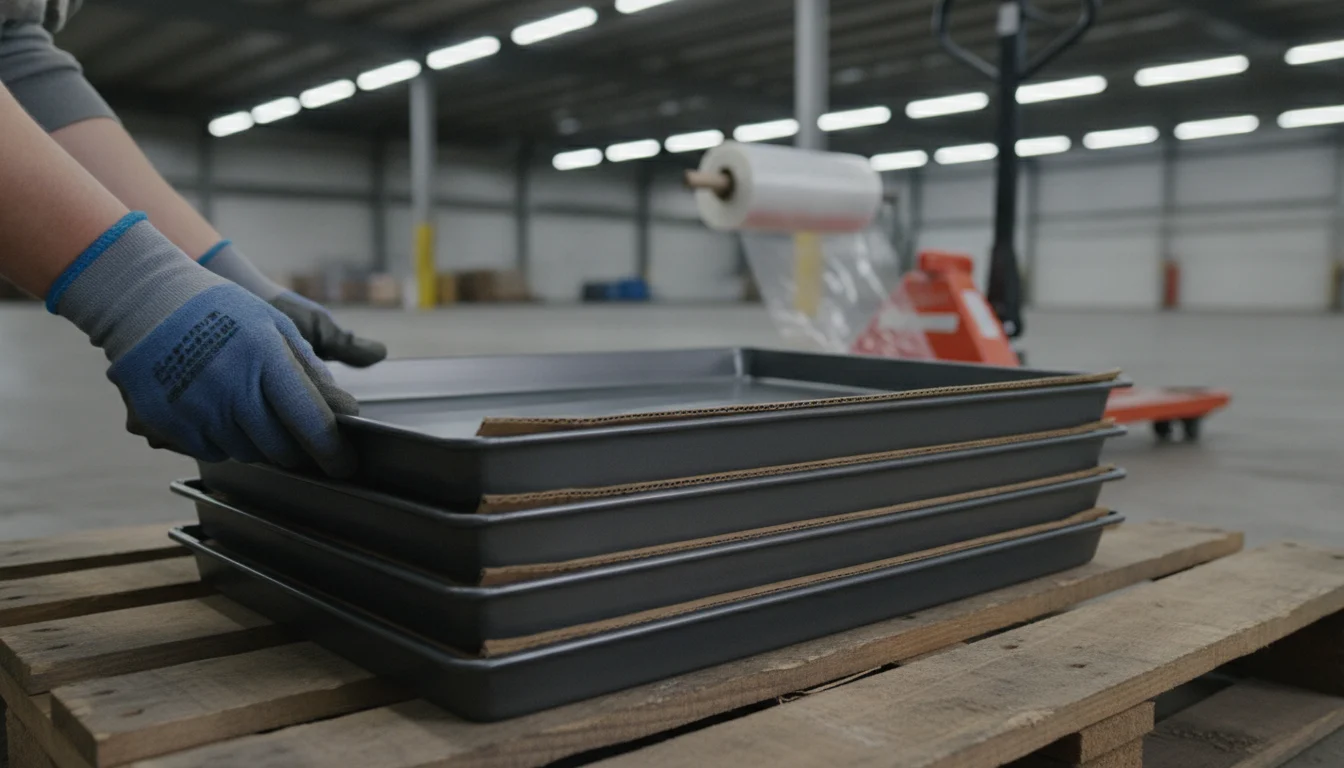
Container loading from Ningbo port optimizes cubic efficiency for shipments to Lagos Apapa, Mombasa, and Francophone/Lusophone African ports. Nesting smaller pans inside larger ones and using corrugated interleaving reduces wasted space and lowers per-unit freight cost.
Sheet pans and rectangular baking trays nest with minimal air gaps when the factory uses graduated sizing. A 40-foot container holds approximately 1,800 to 2,200 ten-piece sets when pans are nested and stacked on pallets with shrink-wrap stabilization. Distributors ordering mixed SKUs should confirm that the factory groups same-size pans together on each pallet to maintain nesting integrity during transit.
Lagos Apapa and Mombasa ports require pre-arrival notifications and detailed packing lists that specify piece count, material composition, and HS code for each SKU. Francophone and Lusophone African ports add French or Portuguese translations of product descriptions to customs declarations. The factory prepares commercial invoices and packing lists in English by default; buyers targeting Côte d’Ivoire, Senegal, Angola, or Mozambique should request bilingual documentation at the quotation stage to avoid clearance delays.
Ningbo to Lagos Apapa averages 35 to 42 days by ocean freight, while Ningbo to Mombasa runs 28 to 35 days. Inland delivery from the port to distributor warehouses in Nairobi, Kampala, or inland Nigerian cities adds 5 to 10 days depending on road conditions and customs clearance speed. Buyers planning retail launches around holiday seasons should book container space 90 days ahead of the target in-store date to absorb potential delays.
Port optimization: Ningbo ships to Lagos, Mombasa, and West/Lusophone African ports. Container loading nests pans to maximize cubic efficiency; transit days confirmed at quotation.
Distributors ordering low-MOQ bakeware for startups benefit from the 1-set sampling model, which lets them validate piece mix and packaging before committing to a 500-piece production run. Our Yongkang factory runs 7 in-house bakeware lines at 500,000 units per month capacity, with container loading optimized for African distributor lanes and SGS/FDA test reports issued per order.
PFAS-free coatings use polymer formulations that exclude perfluoroalkyl substances, tested under FDA 21 CFR 175.300 for food-contact safety. Ceramic coatings bond an inorganic silica layer through a sol-gel process, offering higher scratch resistance but lower thermal-shock tolerance. The carbon-steel line carries SGS verification for PFAS-free status; ceramic lines require separate batch testing per production order.
Yes, the factory assembles custom sets that combine carbon-steel pans, silicone baking cups, and aluminum trays within a single SKU. Mixed-material sets require separate test reports for each coating family, and the MOQ follows the bakeware-set structure: 1 set for sampling and a production run confirmed at quotation based on piece count and packaging complexity.
Specify a minimum 0.8 mm substrate gauge in the purchase order and request a thermal-shock test report if available. Educate end-users to avoid preheating empty pans at maximum oven temperature and to cool pans gradually rather than transferring directly to cold surfaces. Thicker gauges cost more per unit but reduce return claims tied to warp-induced instability.
Ready to source a nonstick bakeware set with verified SGS/FDA compliance and 1-set sampling?
Request Your Sample Set →
Written by the Shansen Bakeware Export Team.
MOQ 1 set on stock configurations. Tell us what you need and we reply on WhatsApp.
Click the button below to open WhatsApp. If you're not logged in to WhatsApp Web yet, scan the QR code first — then come back here and copy the message into the chat.