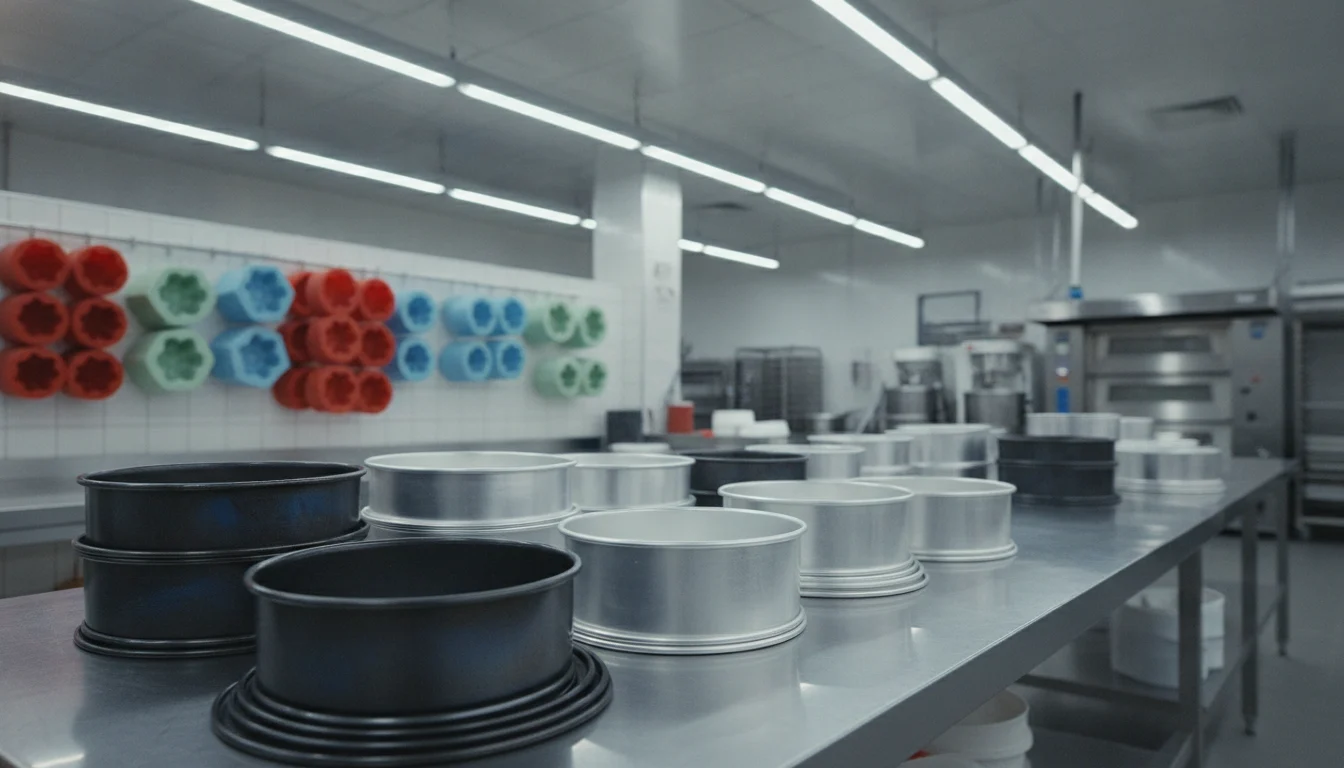
A reliable springform pan alternative for commercial baking includes removable-bottom cake pans, loose-base tart pans, silicone round pans with push-up bottoms, and aluminum foil-lined standard cake pans. Each option addresses the core function of a springform pan-easy release and presentation-without the latch mechanism that can leak or fail under repeated commercial use.
📋 Table of Contents
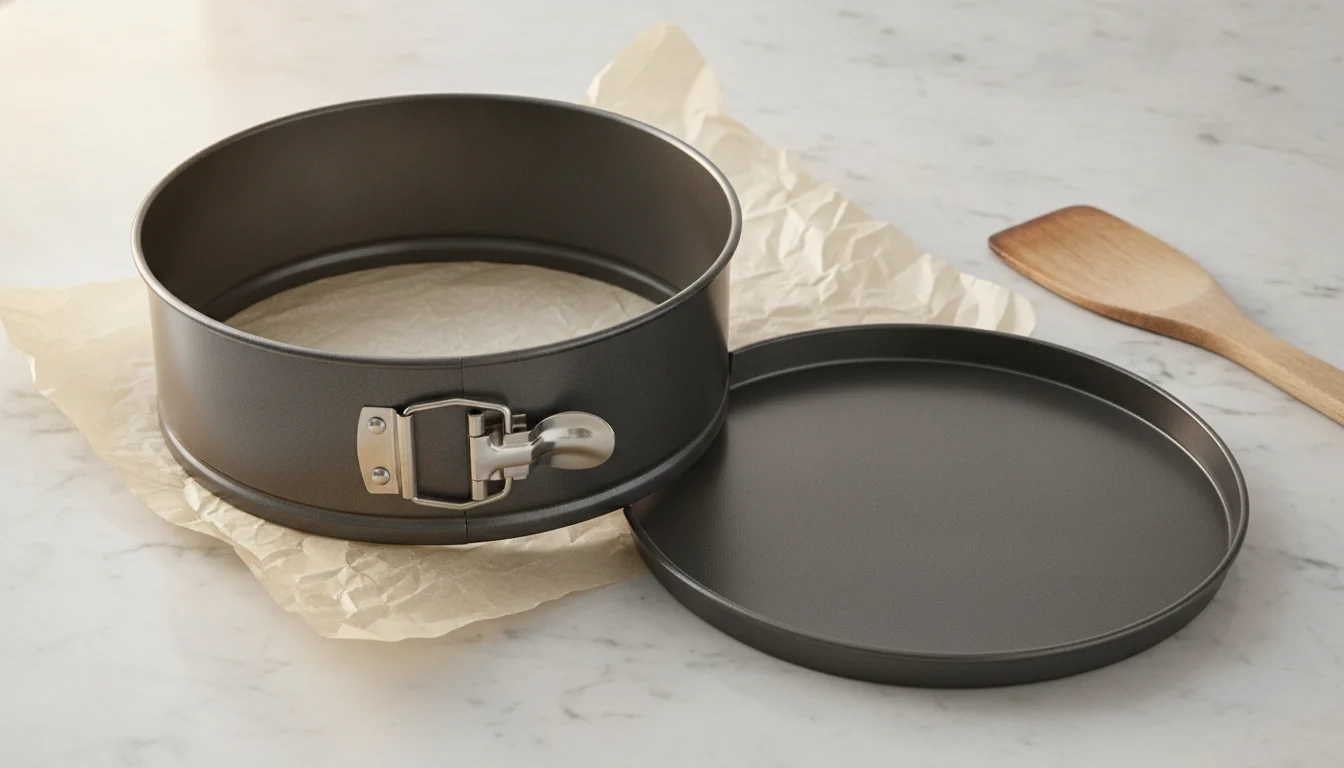
Commercial bakeries and foodservice buyers in Nigeria, Kenya, and South Africa frequently encounter three failure modes with budget springform pans: latch-seam leakage during water-bath cheesecake production, nonstick coating degradation after 50-100 cycles, and base-plate warping that allows batter to seep underneath. Each failure increases labor cost and product waste.
Thin batter formulations for cheesecakes and mousse cakes migrate through the latch mechanism on lower-grade springform pans, particularly when pans are stacked during refrigeration or transported between prep and baking stations. Buyers discover the leak only after batter has pooled in oven cavities or refrigerator shelves, creating cleanup overhead and batch loss.
Nonstick coatings on budget springform pans scratch and peel when staff use metal spatulas or stack pans without protective layers. Once the coating fails, batter adheres to exposed metal, forcing bakers to increase release-agent use or discard the pan entirely. Commercial operations running 200-300 bakes per month need coatings that survive abrasion and thermal cycling without degradation.
Removable bases on cheaper springform pans do not sit flush against the side wall, leaving a gap where batter seeps through before the pan reaches oven temperature. Warping occurs when pans are washed at high temperatures or dropped during handling, permanently compromising the seal and making the pan unusable for liquid batters.
Distributors sourcing for bakery-supply chains can replace springform functionality with six alternative pan formats, each addressing specific release and presentation needs without relying on latch mechanisms.
A removable-bottom cake pan uses a flat base that pushes upward through the side ring after baking, releasing the cake without inverting. The base sits inside a continuous metal wall with no latch, eliminating the seam where batter leaks occur. Carbon-steel versions with SGS-verified nonstick coatings maintain release performance across hundreds of cycles. Our Yongkang factory produces removable-bottom pans in the carbon-steel line, with wholesale bakeware sets available from 1 set for market testing.
Tart pans with loose bases function identically to removable-bottom cake pans but feature fluted edges for decorative presentation. The base diameter is slightly smaller than the inner wall diameter, allowing it to drop out cleanly once the side ring is lifted. Aluminum and carbon-steel versions resist warping better than thin tinplate, maintaining a flush fit even after repeated thermal cycles and washing.
Food-grade silicone molds with integrated push-up mechanisms combine the flexibility of silicone release with the structured support of a rigid base plate. Bakers press upward on the base after cooling, and the silicone walls flex away from the cake without requiring a latch. These molds tolerate freezer-to-oven temperature swings and resist coating degradation because silicone is inherently nonstick. Distributors serving high-humidity markets appreciate that silicone does not rust during storage or transport.
A standard round cake pan becomes a functional springform pan alternative when lined with parchment paper cut to extend 5-8 cm above the rim. After baking, the baker lifts the cake by grasping the parchment overhang, then peels the paper away. This method works for cheesecakes, mousse cakes, and layered tortes that do not require water-bath baking. Carbon-steel and aluminum pans provide the thermal conductivity needed for even baking, and the parchment layer protects the coating from scratches during release.
Wrapping the exterior of a deep round cake pan with heavy-duty aluminum foil creates a leakproof barrier for water-bath cheesecake methods. The foil prevents water from seeping into the pan during baking, and the baker can lift the foil-wrapped pan out of the water bath without disturbing the set cheesecake. Once cooled, the foil peels away, and the cake releases from the pan using a knife run around the perimeter. This approach eliminates the latch-seam leak risk entirely.
Professional pastry operations use stainless-steel cake rings placed on parchment-lined sheet pans, with acetate collars lining the interior wall. The acetate provides a nonstick surface, and the ring lifts straight up after the cake sets, leaving a clean edge. This method suits mousse cakes, entremets, and layered desserts that require precise diameter control and vertical presentation. Stainless rings do not warp, rust, or degrade, making them a one-time capital investment for high-volume bakeries.
Distributors shipping to Lagos, Mombasa, and Francophone West African ports prioritize materials that resist humidity-driven corrosion and maintain coating integrity during container transit and retail storage.
Carbon-steel pans coated under FDA 21 CFR 175.300 standards deliver consistent nonstick performance without PFAS or lead contamination. The 2020 SGS report on our carbon-steel line confirms compliance with these food-contact safety limits, and the coating withstands abrasion from metal utensils better than budget alternatives. Carbon steel conducts heat efficiently, reducing bake times and energy cost in commercial ovens. Rust prevention requires proper drying after washing, but the coating itself acts as a moisture barrier when intact.
Aluminum pans weigh 30-40 percent less than equivalent carbon-steel models, reducing shipping cost per container and easing handling for bakery staff who move dozens of pans daily. Anodized aluminum resists oxidation and does not require coating, though plain aluminum benefits from nonstick treatment for easy release. Aluminum’s thermal conductivity promotes even browning, critical for cheesecakes and sponge cakes that require gentle, uniform heat.
Silicone bakeware does not corrode, rust, or degrade in high-humidity environments, making it ideal for coastal distribution hubs and tropical climates. The material tolerates temperature ranges from negative 40 degrees Celsius to positive 230 degrees Celsius, supporting freezer storage and oven baking without brittleness or warping. Buyers verify food-grade status by requesting test reports that confirm the silicone meets FDA or equivalent standards for food contact.
Importers launching bakeware lines or expanding product assortments need flexible order quantities that allow market validation without tying up working capital in untested inventory.
Bakeware sets containing multiple pan sizes and formats ship from 1 set, enabling distributors to photograph, test, and list products before committing to bulk orders. A typical set includes three round cake pans in graduated diameters, one removable-bottom pan, and one silicone mold, covering the range of springform pan alternative use cases a retail or foodservice buyer encounters. This structure reduces the cash outlay required to validate product-market fit in a new geography.
The carbon-steel and aluminum lines support 1-piece sampling, allowing buyers to physically inspect coating quality, wall thickness, and base-plate fit before ordering. OEM production runs start at 500 pieces per SKU, balancing factory efficiency with distributor inventory risk. Buyers use the sample to conduct internal bake tests, verify nonstick performance, and confirm compatibility with existing packaging and retail fixtures.
Sample: 1 pc (metal line). OEM run: 500 pcs per SKU. Sets: from 1 set.
Our team loads containers at Ningbo port with stacking patterns optimized for Lagos Apapa, Mombasa, and Francophone West African destinations. Nested pan designs reduce void space, increasing the unit count per 20-foot or 40-foot container and lowering per-unit freight cost. Distributors receive packing lists that detail carton dimensions, weight distribution, and SKU placement within the container, simplifying customs clearance and warehouse intake.
Sampling each pan format at 1 set before a full order allows verification of coating durability and release performance against local baking methods without committing to untested inventory.
Production lead times and transit schedules are confirmed at quotation, accounting for factory capacity, container availability, and destination port. SGS and FDA test reports dated 2020, 2021, and 2023 are issued per order, with the 2020 report covering the carbon-steel line’s compliance with FDA 21 CFR 175.300 for food-contact nonstick coatings. Buyers receive digital copies of applicable reports with each shipment, supporting customs declarations and retail compliance audits.
A removable-bottom pan requires wrapping the exterior with heavy-duty aluminum foil to create a watertight seal during water-bath cheesecake baking. The foil prevents water from seeping between the base plate and the side wall. Without foil, water infiltrates the pan and creates a soggy crust. Distributors who supply bakeries using water-bath methods should stock both removable-bottom pans and commercial-grade foil to support the complete workflow.
Buyers request SGS or equivalent test reports that confirm the silicone compound meets FDA standards for food contact, specifically verifying the absence of volatile organic compounds and heavy metals. The report should include the test date, the specific product SKU tested, and the laboratory’s accreditation. Generic certificates without SKU-level traceability do not provide adequate assurance. Importers use these reports to satisfy customs requirements and retail-chain compliance audits in Nigeria, Kenya, and South Africa.
Commercial-grade nonstick coatings on carbon-steel bakeware typically measure 20-30 microns in thickness, providing abrasion resistance across hundreds of baking cycles. Thinner coatings below 15 microns scratch easily when staff use metal spatulas or stack pans without protective layers. Buyers verify coating thickness by requesting factory specifications and cross-referencing them against SGS test reports. The 2020 SGS report on our carbon-steel line documents coating composition and performance under FDA 21 CFR 175.300 standards, confirming PFAS-free and lead-free formulations.
Need reliable springform pan alternative options for your bakery-supply chain or retail assortment?
Request samples and MOQ details →
Written by the Shansen Bakeware Export Team.
MOQ 1 set on stock configurations. Tell us what you need and we reply on WhatsApp.
Click the button below to open WhatsApp. If you're not logged in to WhatsApp Web yet, scan the QR code first — then come back here and copy the message into the chat.