📋 Table of Contents
Finding a reliable food grade silicone mold supplier who can deliver consistent quality to African markets without locking up your cash in high minimum orders is a major challenge for kitchenware importers. Many suppliers claim food-grade compliance, but verification gaps and logistics surprises can turn a promising order into a costly write-off. This guide maps the certifications, logistics, and supplier questions that matter for buyers in Nigeria, Kenya, South Africa, and Francophone or Lusophone Africa.
Food-grade silicone is not a marketing term; it is defined by specific regulatory limits on extractable substances. For a mold to be safe for baking, the raw silicone compound must pass migration testing under simulated use conditions (temperature, time, and food simulants).
This U.S. regulation sets maximum extractable limits for rubber articles intended for repeated food contact. A compliant silicone mold will not leach more than 2.5 mg per square inch of total extractives when tested with water and hexane at reflux temperatures. SGS laboratories can perform this test and issue a certificate that includes PFAS and heavy metal screening.
Although silicone is not a plastic, many European buyers apply the same migration limits (10 mg/dm² overall migration). For African importers sourcing from China, requesting an SGS test report that references both FDA and EU limits provides a dual certification that satisfies most customs authorities.
Before you wire a deposit, verify the supplier’s claims with these five questions. A legitimate food grade silicone mold supplier will answer them with documents, not promises.
Generic factory-level certificates are not enough. Ask for a report that matches the mold’s specific color, shape, and silicone compound. The report should show PFAS-free and Pb-free results and be dated within the last 12 months.
Many African distributors need to test market response before ordering 500 units. A factory that offers low-MOQ bakeware for startups, starting at 1 piece per SKU-lets you validate 3-5 designs without tying up capital. This is especially critical when you are selling into multiple countries with different design preferences.
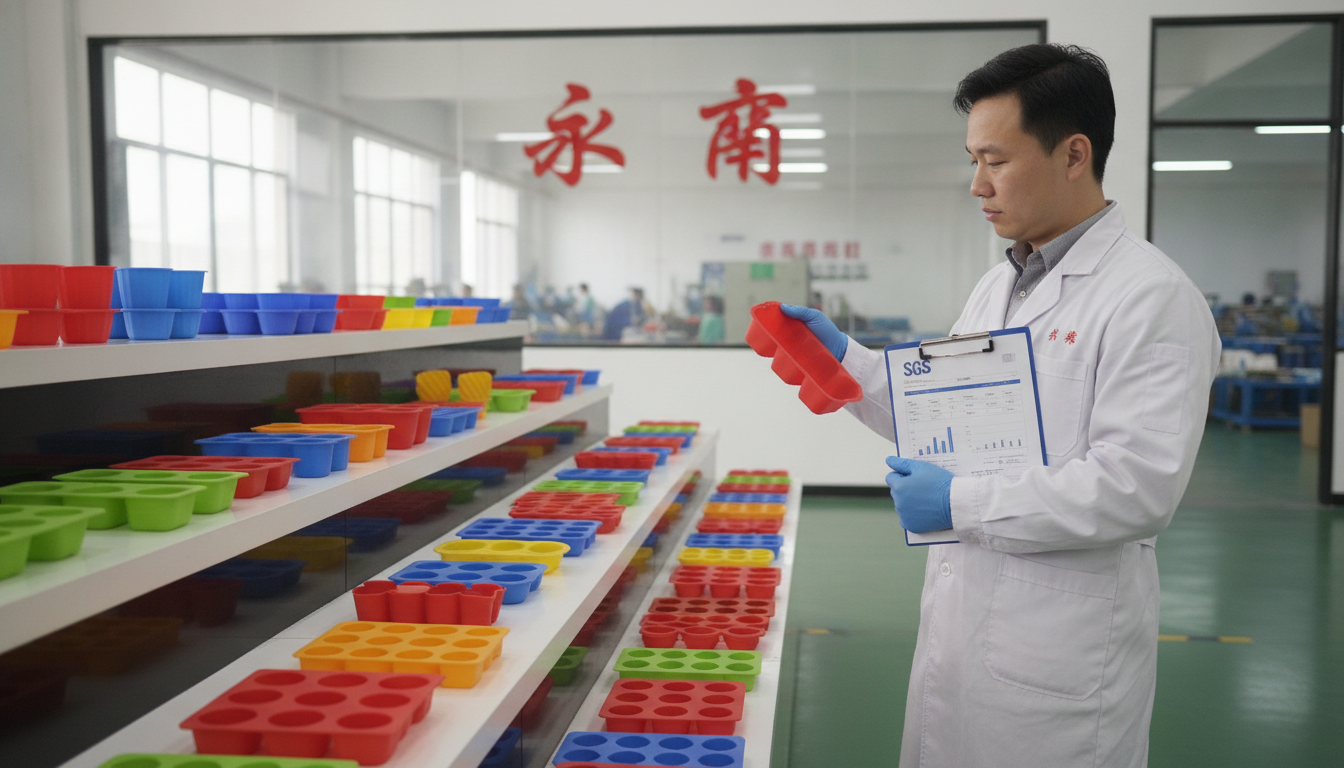
Suppliers with a physical showroom, such as at Yiwu International Trade Market, allow you or your agent to handle molds, check flexibility, and see color consistency before placing an order. This reduces the risk of receiving brittle or poorly finished molds.
Different African countries enforce their own food-contact regulations. A mold that clears FDA testing may still fail a KEBS or SANS check if it was not formulated for high-temperature stability.
The Kenya Bureau of Standards requires silicone kitchenware to undergo migration testing with 3% acetic acid and 50% ethanol at 70°C for 2 hours. A 2024 KEBS market surveillance report found that 18% of imported silicone molds failed due to excessive volatile organic compounds, highlighting the need for supplier pre-screening.
SANS 1828 aligns with EU regulations but adds a specific requirement for heat resistance at 230°C for 2 hours without deformation. Molds that warp at this temperature will be rejected, even if they pass chemical migration tests.
Countries like Côte d’Ivoire and Senegal often accept EU 1935/2004 test reports when importing from China. However, customs officials may request a certificate of free sale or a lab report issued by an ISO 17025-accredited lab. Requesting a dual FDA/EU SGS report covers this requirement.
African importers often encounter two supplier types: large factories that demand 500-1,000 unit MOQs and small workshops that offer flexibility but lack consistent quality control. Understanding the trade-offs helps you avoid supply chain interruptions.
A factory with in-house silicone molding lines can produce 500,000 units per month, ensuring consistent lead times of 25-35 days for repeat orders. In-house QC labs test every batch for shore hardness (typically 40-50A for baking molds) and dimensional accuracy. The downside is that many large factories are reluctant to accept small trial orders, but vertically integrated suppliers like Shansen Bakeware bridge this gap by offering MOQ starting at 1 piece per SKU for initial sampling, then scaling to 30-50 pieces for small-batch production.
Small workshops in Yiwu or Guangdong can produce molds with intricate designs and lower tooling costs. However, they rarely invest in SGS testing, and batch-to-batch color and flexibility can vary. If you choose this route, always request a third-party test report before shipping and be prepared to inspect every shipment at the port.
Sample MOQ: 1 piece. Bulk MOQ: 30-50 pieces per SKU. Sampling time: 7-10 days. Full production lead time: 25-35 days.
Shipping from Ningbo port to African ports requires careful planning to avoid demurrage and customs delays. Container loading optimization is especially critical for distributors serving multiple countries.
Mixing heavy items like wholesale bakeware sets with lightweight silicone molds maximizes container utilization. A 20-foot container can hold approximately 12,000-15,000 silicone molds (depending on size) when properly palletized. Overloading by weight can trigger surcharges at African ports, so work with a supplier that provides load plans in advance.
Industrial bakeries and commercial kitchens use silicone molds at temperatures up to 230°C (446°F). A mold that passes food-contact tests at 70°C may still warp or emit odors when used in a 220°C convection oven. When sourcing, specify the intended use temperature and ask for heat-aging test data.
Baking molds typically require a shore hardness of 40-50A to provide easy release without tearing. Softer molds (below 30A) can deform under batter weight, while harder molds (above 60A) may crack when flexed. Request a durometer reading on the production sample.
Food-grade silicone should withstand temperatures from -40°C to 230°C without permanent deformation. Specify a minimum of 1,000 cycles of thermal shock testing (alternating between -20°C and 230°C) if you are supplying commercial bakeries. This data is available from SGS or TÜV.
African retailers and institutional buyers increasingly ask for proof of ethical and sustainable manufacturing. While silicone itself is not biodegradable, sourcing from factories that use platinum-cured silicone (which produces no harmful byproducts) and that recycle production scrap can strengthen your brand’s position.
Platinum-cured silicone is inherently food-safe because the curing process does not leave chemical residues. Peroxide-cured silicone can release volatile organic compounds if not post-cured properly. Ask your supplier to confirm the curing method and provide a VOC test report.
Factories with in-house regrinding systems can recycle silicone sprue and flash back into production, reducing waste by up to 30%. This practice lowers the carbon footprint per mold and can be highlighted in your marketing to eco-conscious buyers.
Yes, when manufactured to FDA 21 CFR 177.2600 or EU 1935/2004 standards. Food-grade silicone molds are tested for extractable substances and heavy metals. SGS certification ensures they are PFAS-free and Pb-free. Always verify that the specific mold you purchase has a current test report, not just a general factory certificate.
Food-grade silicone uses platinum-cured compounds that leave no chemical residues, while regular silicone may use peroxide curing that can release volatile organic compounds. Food-grade molds also pass migration tests for lead and total extractives. Non-food-grade molds may contain fillers that degrade at baking temperatures, posing health risks.
Yes, food-grade silicone molds can be used for resin, soap, or candle making, but they should not be returned to food use after contact with non-food materials. The mold’s non-porous surface makes it easy to clean, but cross-contamination risk means you should dedicate molds to either food or craft use, not both.
Wash with warm soapy water and a soft sponge. Avoid abrasive cleaners that can scratch the surface. For stubborn residue, soak in a baking soda solution and rinse thoroughly. Dishwasher-safe molds should be placed on the top rack. Always dry completely before storing to prevent mold growth.
African importers can buy directly from Chinese factories like Shansen Bakeware, which ships from Ningbo to Lagos, Mombasa, and West African ports. You can request 1-piece samples for testing, then place bulk orders with MOQs as low as 30 pieces per SKU. Visit the Yiwu showroom or contact the factory for SGS-certified molds.
Ready to test food-grade silicone molds for your market?
Request 1-Piece Samples →
MOQ 1 set on stock configurations. Tell us what you need and we reply on WhatsApp.
Click the button below to open WhatsApp. If you're not logged in to WhatsApp Web yet, scan the QR code first — then come back here and copy the message into the chat.