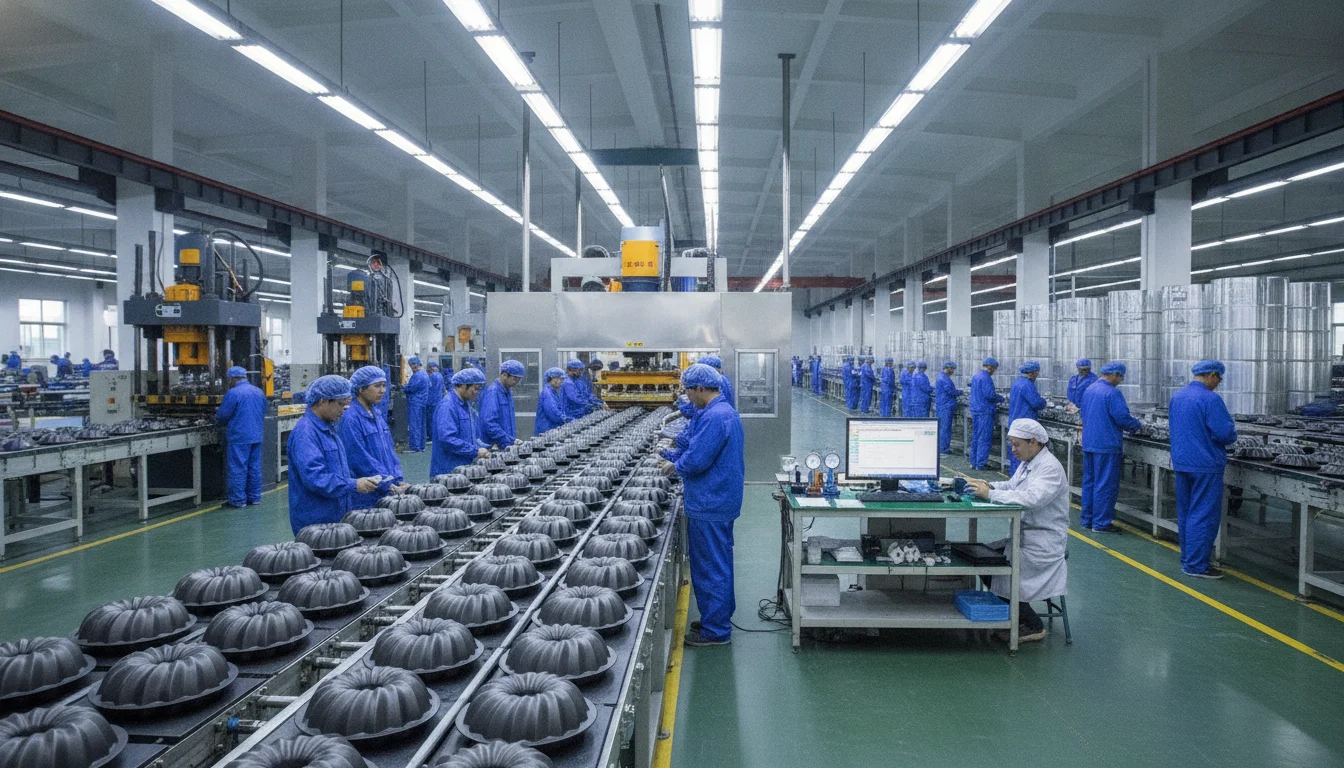
Trustworthy bundt pan factory identification West Africa begins with three verifiable checkpoints: request live production video or dated factory photos showing your SKU on the line, demand SGS or third-party test reports for food-contact compliance (FDA 21 CFR 177.2600 for non-stick coatings, LFGB for aluminum), and confirm MOQ flexibility by ordering 1-piece samples before committing to a container. A factory that refuses any of these steps is trading, not manufacturing.
📋 Table of Contents
Production verification separates factories from trading companies. A genuine bundt pan manufacturer can show you the line running your SKU, name the material supplier, and explain batch traceability. Trading companies recycle generic photos or refuse factory access.
Ask for a short video showing your specific bundt pan SKU on the production line, with visible date stamp or a handwritten sign matching your inquiry number. A real factory can film this in 10 minutes. Trading companies stall, offer stock photos, or claim “confidentiality” to avoid exposure.
Shansen Bakeware runs 7 in-house bakeware lines at 500,000 units per month capacity in Yongkang, Zhejiang, with a sourcing showroom at Yiwu International Trade Market. Our team provides dated production photos for every sample order, showing carbon-steel, aluminum, stainless-steel, and silicone bundt pans moving through stamping, coating, and QC stations.
In practice: Requesting a dated factory video showing your bundt pan SKU on the line eliminates trading-company risk and confirms the supplier controls the production schedule.
A factory names its aluminum-coil supplier, coating vendor, and silicone-compound source. It assigns batch codes to every production run for traceability. Ask where the carbon-steel sheet or food-grade silicone originates, and request a batch-code sample label. Trading companies cannot answer because they buy finished goods from multiple mills and relabel them.
Ask for lead times on three scenarios: 1-piece sample, 500-piece first order, 5,000-piece repeat order. A factory quotes specific days because it controls the schedule. A trading company quotes vague ranges or identical lead times across all volumes, revealing it waits for mill availability rather than managing its own line.
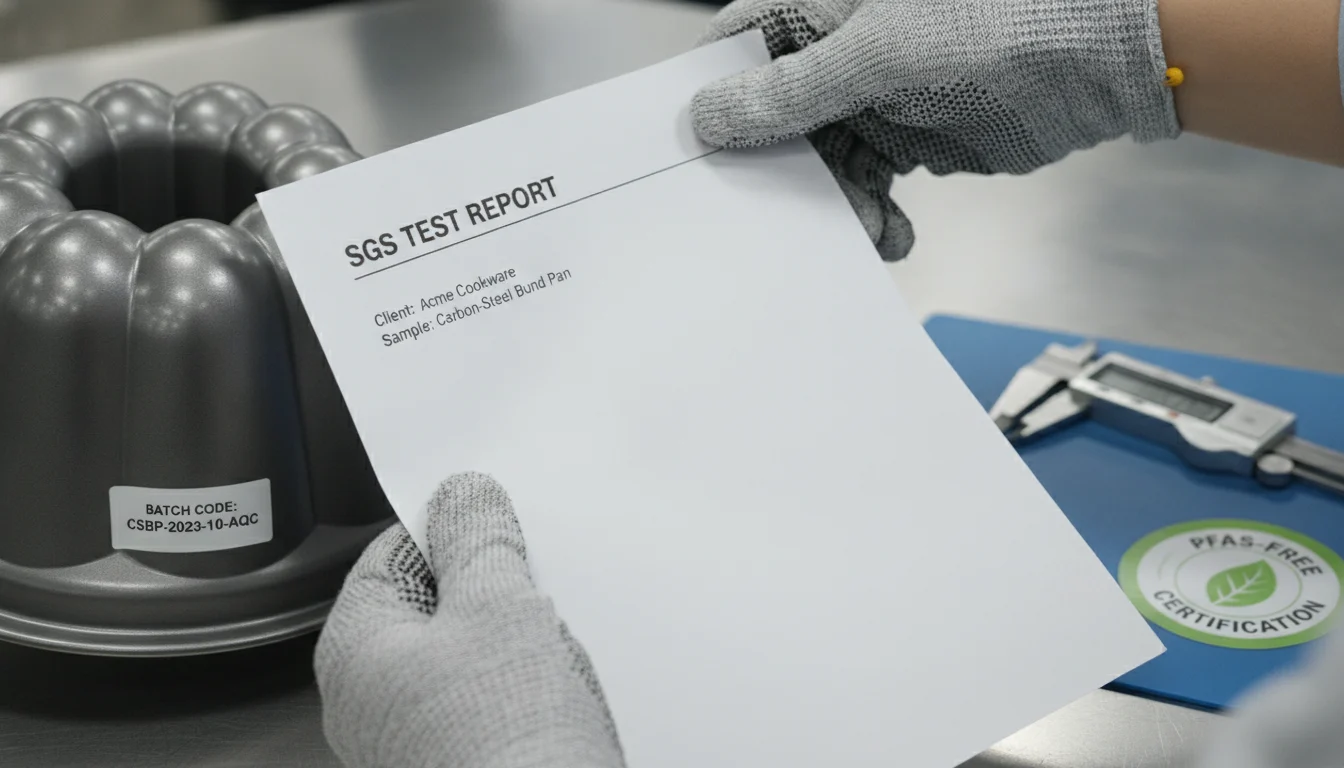
Food-contact compliance protects end-users from migration of harmful substances during baking. Buyers report that product listings claim high heat resistance or premium material quality without providing documentation, making it hard to trust the supplier. Verifiable test reports from SGS, Intertek, or Bureau Veritas close this gap.
FDA 21 CFR 177.2600 defines migration limits for resinous and polymeric coatings in repeated food contact. Carbon-steel and aluminum bundt pans with non-stick finishes must pass this standard before they can legally claim food-grade status in markets that recognize FDA guidance. Request the test report showing migration results under baking temperatures (typically 230°C for 2 hours). Shansen Bakeware holds SGS test reports dated 2020, 2021, and 2023 covering 21 CFR 175.300 for our carbon-steel non-stick line, issued per production batch and available on request.
LFGB (German Food and Feed Code) tests aluminum and stainless-steel bundt pans for heavy-metal migration (lead, cadmium, chromium) and overall migration into food simulants. European and many African buyers require LFGB compliance for metal bakeware. Ask for the test certificate showing alloy composition and migration limits. A factory provides batch-specific reports; a trader offers a years-old generic certificate or none at all.
PFAS (per- and polyfluoroalkyl substances) and lead contamination are rising concerns in bakeware. Buyers complain that some bakeware arrives with a strong odor, uneven molding, or visible residue, which raises concerns about fillers and inconsistent manufacturing quality. PFAS-free and Pb-free test data from an accredited lab confirm the coating and base metal meet current safety thresholds. Shansen badges our SGS-verified, FDA-compliant, PFAS-free, and Pb-free bakeware based on test reports on file since 2020, updated per production batch.
MOQ (minimum order quantity) flexibility reveals whether a supplier owns production or resells from other mills. A factory can run small batches because it controls the line and absorbs setup costs. A trading company imposes high MOQs because it aggregates orders to meet the real factory’s minimum.
West Africa buyers need to validate bundt pan size, coating durability, and fit with local ovens before committing cash to a container. A factory offering 1-piece samples per SKU (one 6-cup aluminum bundt pan, one 12-cup carbon-steel bundt pan, one silicone mini-bundt set) lets you test the product against your market without tying up capital. Shansen Bakeware ships 1-set samples on our wholesale bakeware sets and 1-piece samples on individual metal SKUs, with sampling time of 7 to 10 days from Yongkang to Ningbo port.
Trading companies demand 100-piece or 500-piece minimums even for sampling because they cannot order fractional quantities from their upstream mill. This forces you to buy inventory before you know whether the product sells in Lagos, Nairobi, or Abidjan.
After sample approval, a 500-piece MOQ per SKU balances factory setup costs with distributor cash flow. This volume fills a quarter-container (roughly 7 cubic meters for bundt pans), leaving room for mixed SKUs or other bakeware categories. Shansen runs 500-piece OEM production batches on our carbon-steel and aluminum lines, allowing West Africa importers to test two or three bundt pan sizes in a single shipment without overcommitting to one SKU.
Once a bundt pan SKU proves demand, scaling to 5,000 pieces per SKU unlocks better per-unit pricing and fills a full 20-foot container. A factory quotes transparent tier pricing (500 pcs, 2,000 pcs, 5,000 pcs) because it knows its own cost structure. A trading company quotes opaque “contact for price” terms because margins shift with upstream mill availability.
Sample MOQ: 1 piece (metal SKUs) or 1 set (bakeware sets). First-order MOQ: 500 pieces per SKU. Repeat-order MOQ: 2,000 pieces per SKU for tier-2 pricing. Sampling time: 7 to 10 days Yongkang to Ningbo.
Shipping expertise reveals whether a factory understands your market or treats Africa as an afterthought. Factories optimized for West Africa quote FOB Ningbo, name your destination port (Lagos Apapa, Mombasa, Tema, Abidjan, Luanda), and explain container-loading strategy to minimize damage and customs delays.
Bundt pans nest poorly due to fluted walls and center tubes. A factory experienced in African exports stacks them in cartons with dividers, calculates cubic meterage per SKU, and recommends mixed loading (bundt pans + flat baking sheets + silicone molds) to maximize container utilization. Shansen optimizes container loading for African distributors shipping from Ningbo to Lagos, Mombasa, and Francophone/Lusophone African ports, mixing our 7 bakeware lines to fill dead space and reduce per-unit freight.
Nigeria (Lagos Apapa) requires a SONCAP certificate for regulated goods, a packing list matching the Bill of Lading, and a Form M for foreign-exchange allocation. Kenya (Mombasa) requires a Certificate of Conformity (CoC) from Intertek or SGS, plus a detailed commercial invoice. Francophone markets (Abidjan, Douala) require French-language documentation and often a pre-shipment inspection. A factory familiar with your port provides the correct paperwork format; a generic supplier ships with incomplete docs, triggering clearance delays and demurrage fees.
A factory with African shipping experience works directly with freight forwarders who handle Lagos, Mombasa, and West/Lusophone routes. It quotes CIF (cost, insurance, freight) or DDU (delivered duty unpaid) terms, not just FOB, and explains how long clearance typically takes at your port. Our team coordinates with Ningbo-based forwarders who specialize in African routes, providing realistic landed-cost estimates and flagging potential customs issues before the container sails.
Trading companies mimic factory language to capture buyer inquiries, then outsource production to the cheapest available mill. Spotting these red flags early saves you from quality inconsistency, communication delays, and margin erosion.
When you request a factory video or dated photos, a trading company stalls with excuses: “Our factory is confidential,” “We protect our suppliers,” “Photos are not allowed for IP reasons.” A real factory shows you the line because transparency builds trust and demonstrates capacity. Refusal to provide production proof is the single strongest signal you are dealing with a middleman.
Trading companies use the same bundt pan photos across multiple Alibaba or Global Sources listings, often with inconsistent backgrounds or watermarks from other brands. A factory shoots its own product photos in a consistent setting (factory floor, QC station, showroom) and can provide additional angles or close-ups on request. Check image metadata or reverse-image-search the photos; if they appear on competitor listings, you are talking to a reseller.
Ask the same capacity question three times across two weeks: “How many bundt pans can you produce per month?” A factory gives the same answer every time because capacity is fixed by line count and shift hours. A trading company gives different answers (50,000 units one week, 200,000 the next) because it checks upstream availability rather than quoting its own line.
Commercial buyers worry that low-price factory listings hide weak after-sales support, unclear specifications, and poor durability under repeated use. When you ask for aluminum alloy grade, coating thickness, or silicone-compound shore hardness, a factory provides exact specs (3003 aluminum, 25-micron PTFE coating, 40-shore-A silicone). A trading company answers with marketing language (“premium material,” “high-quality coating,” “durable silicone”) because it does not control the formulation.
A factory emails SGS or third-party test reports within 24 hours of your request, with batch codes matching the production run. A trading company delays, offers expired certificates, or sends generic reports that do not match the SKU you are buying. Some traders Photoshop test reports or attach documents from unrelated products. Always verify the report date, batch code, and testing lab contact before trusting compliance claims.
Request a short video showing your specific bundt pan SKU on the production line, with a visible date stamp or handwritten sign matching your inquiry number. A real factory can film this in 10 minutes and will show stamping, coating, or molding equipment. Trading companies stall, offer stock photos, or claim confidentiality to avoid exposure. Also ask for the aluminum-coil supplier name, coating vendor, and batch-code format; factories name sources and assign traceability codes, while traders cannot answer because they buy finished goods from multiple mills.
Demand SGS or third-party test reports for FDA 21 CFR 177.2600 if the bundt pan has a non-stick coating, covering migration limits under baking temperatures. For aluminum and stainless-steel base metal, request LFGB reports showing heavy-metal migration (lead, cadmium, chromium) results. Also ask for PFAS-free and Pb-free test data from an accredited lab to confirm the coating and base metal meet current safety thresholds. Verify the report date, batch code, and testing lab contact before trusting compliance claims, and reject expired or generic certificates that do not match the SKU you are buying.
Low MOQ (1-piece sampling, 500-piece production runs) signals that the supplier owns the production line and can run small batches without aggregating orders. This lets West Africa buyers validate bundt pan size, coating durability, and fit with local ovens before committing cash to a container. Trading companies impose high minimum order quantities because they resell from upstream mills and cannot order fractional quantities. A factory offering flexible MOQ absorbs setup costs and demonstrates direct manufacturing control, reducing your inventory risk during market testing.
Written by the Shansen Bakeware Export Team.
Ready to verify production proof, test food-grade compliance, and request 1-piece bundt pan samples?
Request Samples & Factory Video →
MOQ 1 set on stock configurations. Tell us what you need and we reply on WhatsApp.
Click the button below to open WhatsApp. If you're not logged in to WhatsApp Web yet, scan the QR code first — then come back here and copy the message into the chat.