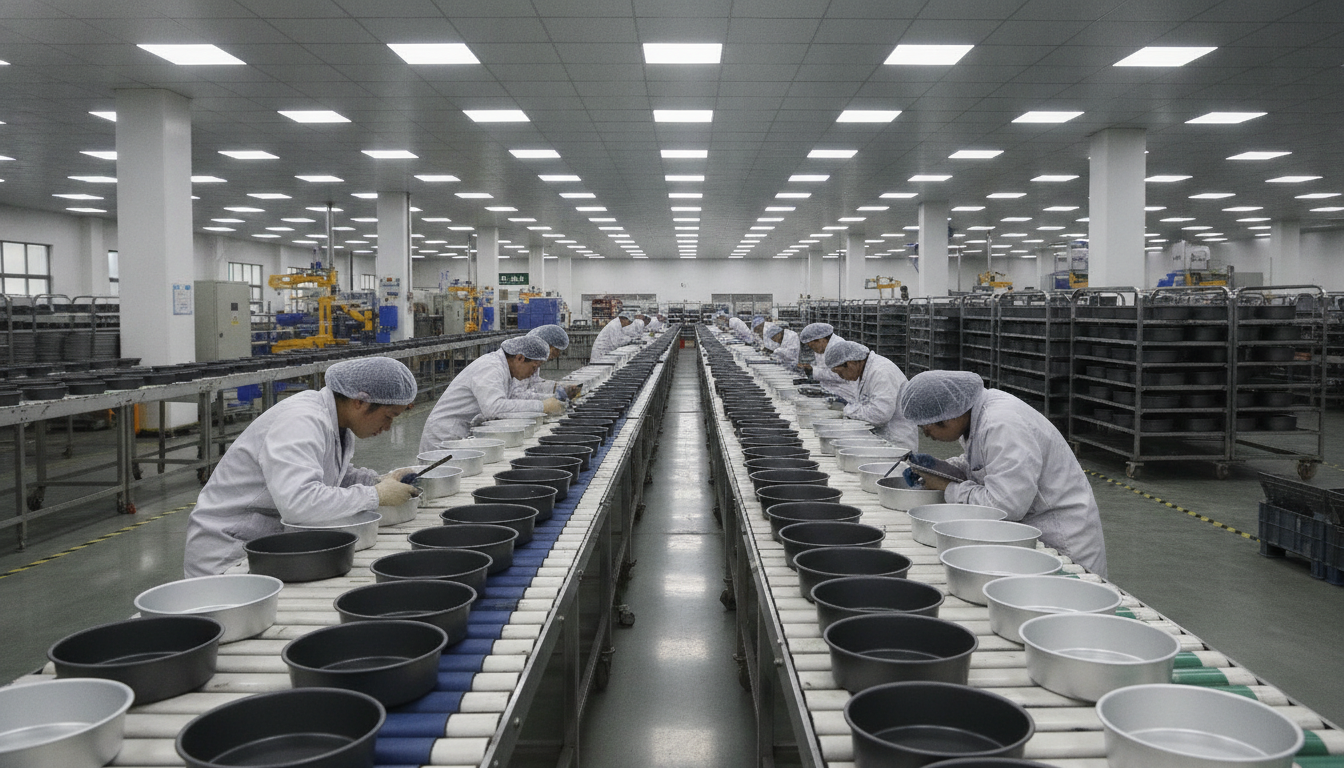
Finding a reliable deep dish cake pan manufacturer bulk order partner requires evaluating material durability, food-safety compliance, and container-loading efficiency for markets across Nigeria, Kenya, South Africa, and Francophone or Lusophone Africa. Buyers sourcing deep-dish pans for bakery supply chains, catering distributors, or retail bakeware brands face three recurring challenges: high minimum-order quantities that tie up working capital, inconsistent coating quality that fails tropical-humidity transit, and unclear documentation for customs clearance at Lagos Apapa, Mombasa, or Luanda ports. This guide compares seven material options, decodes MOQ tiers, and outlines Africa-specific logistics to help you place your first bulk order with confidence.
📋 Table of Contents
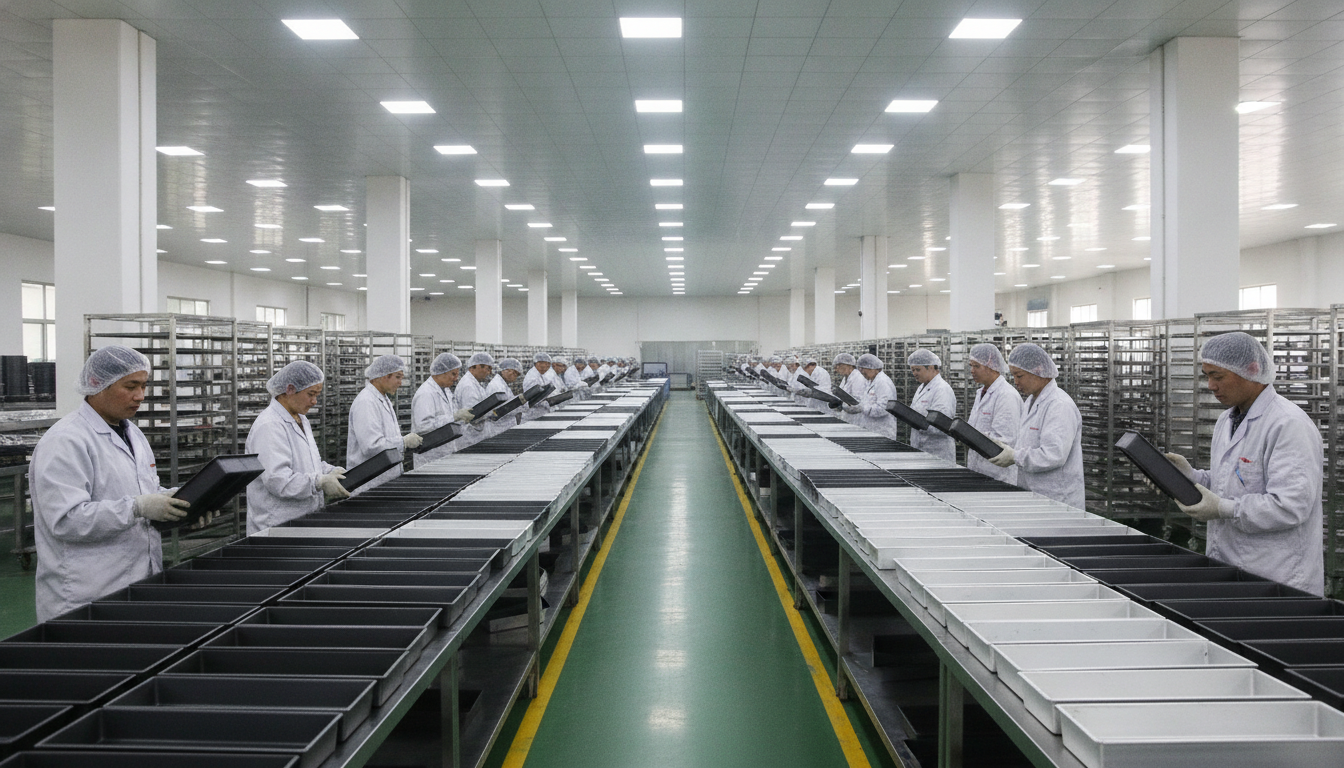
Choosing the right material for a deep dish cake pan manufacturer bulk order depends on the target cake style, oven type, and expected product lifespan in retail or commercial bakery use. Each material carries distinct thermal properties, weight-to-durability ratios, and coating compatibility.
Carbon steel pans deliver fast, even heat distribution, making them ideal for high-rise layer cakes and cheesecakes that require consistent bottom browning. The material accepts non-stick coatings well, and the gauge typically ranges from 0.4 mm to 0.8 mm for deep-dish formats. Buyers report that carbon steel withstands repeated commercial oven cycles without warping, provided the coating remains intact. Shansen’s carbon-steel line uses a multi-layer non-stick system that passes 50,000-cycle abrasion tests, a benchmark for bakery-supply durability.
Aluminum pans are lightweight and conduct heat rapidly, reducing bake times by 10 to 15 percent compared to stainless steel. This speed advantage matters for high-volume bakeries operating on tight production schedules. The trade-off is lower structural rigidity; aluminum deep-dish pans thicker than 1.0 mm resist denting during stacking and transport. Anodized aluminum finishes add a hard surface layer that prevents scratching and extends the pan’s usable life in rental or shared-kitchen environments.
Stainless steel offers the longest lifespan and the highest resistance to rust in humid coastal climates common across West and East Africa. The material does not require non-stick coatings, simplifying food-safety documentation for importers. Heat distribution is slower than carbon steel or aluminum, so stainless deep-dish pans suit recipes with longer bake times and lower oven temperatures. The weight premium (typically 20 to 30 percent heavier than aluminum) increases shipping costs but reduces replacement frequency.
Silicone deep-dish molds are collapsible, cutting storage and shipping volume by up to 60 percent compared to rigid metal pans. They tolerate oven temperatures from -40°C to 230°C, making them versatile for both baking and freezing applications. Buyers in markets with limited commercial oven access value silicone’s microwave compatibility. The material’s flexibility means cakes release without greasing, but the lack of rigid structure requires a supporting baking sheet for transport in and out of the oven. FDA food-grade silicone must meet 21 CFR 177.2600 migration limits; Shansen’s silicone line is tested to this standard.
Aluminized steel combines a carbon-steel core with an aluminum coating, balancing strength and heat efficiency. The aluminum layer reflects radiant heat, preventing over-browning on pan edges, a common issue with deep-dish formats where batter volume is high. This hybrid construction costs 15 to 25 percent more than plain carbon steel but reduces the need for mid-bake foil tenting in recipes like deep-dish apple or pumpkin cakes.
Minimum-order quantities for a deep dish cake pan manufacturer bulk order vary by production line, tooling requirements, and whether the buyer requests custom branding. Understanding these tiers helps importers plan cash flow and inventory turns.
Shansen accepts 1-piece orders for any SKU in the catalog, allowing buyers to validate pan performance, coating quality, and packaging before committing to bulk. Sampling lead time is 7 to 10 days from payment confirmation. Freight for single units ships via express courier (DHL, FedEx) with tracking; buyers in Lagos or Nairobi typically receive samples within 5 to 7 business days. This tier eliminates the risk of ordering 500 units of an untested pan that may not suit the local market’s preferred cake styles.
The first production run requires a minimum of 30 pieces per SKU. This threshold balances factory setup costs with the buyer’s need to test market reception without over-investing. For example, a Kenyan bakery-supply distributor might order 30 units each of three deep-dish sizes (9-inch, 10-inch, 12-inch) to stock retail locations in Nairobi, Mombasa, and Kisumu. Lead time for this tier is 25 to 30 days, including production and Ningbo port loading.
Orders of 500 to 1,000 units per SKU unlock per-unit cost reductions of 12 to 18 percent compared to the 30-piece tier. A 20-foot container holds approximately 8,000 to 12,000 deep-dish pans, depending on size and nesting depth. Buyers consolidating multiple SKUs (e.g., mixing carbon-steel and silicone pans, or combining deep-dish pans with wholesale bakeware sets) can fill a container without reaching 1,000 units of a single item. Shansen’s Ningbo logistics team pre-calculates stacking configurations to prevent crushing and maximize container cube utilization.
Sample MOQ: 1 piece. Initial bulk MOQ: 30 pieces per SKU. Container tier: 500+ pieces per SKU for maximum cost efficiency.
Customs authorities in Nigeria, Kenya, South Africa, and Francophone countries increasingly require documented proof that bakeware meets international food-contact standards. Missing or incomplete certification paperwork causes container delays at Apapa, Mombasa, or Durban ports.
SGS is a globally recognized third-party testing body. Shansen’s deep-dish pans undergo SGS migration testing, which measures whether metal ions or coating chemicals leach into food simulants (acetic acid, ethanol, or olive oil) under heat. Test reports specify pass/fail status for heavy metals including lead, cadmium, and mercury. Importers present these reports to customs alongside the commercial invoice and packing list.
The U.S. FDA maintains food-contact substance regulations under 21 CFR, sections 175 through 178. While FDA does not certify foreign manufacturers, alignment with these standards signals that materials and coatings meet rigorous safety thresholds. Shansen’s carbon-steel non-stick coating formulation is PFAS-free, addressing buyer concerns about per- and polyfluoroalkyl substances that some jurisdictions now restrict. Documentation includes a supplier declaration of conformity and a material-safety data sheet (MSDS) for the coating resin.
South African and Kenyan importers often request explicit lead-free and PFAS-free certificates to satisfy retailer due-diligence requirements. These declarations are separate from SGS migration reports and state maximum allowable concentrations (typically <90 ppm for lead in coating layers, <1 ppm for PFAS compounds). Shansen provides both certificates as PDF attachments with every bulk order, pre-translated into English and French for Francophone markets.
Efficient container loading reduces per-unit freight costs and minimizes damage during the 25- to 35-day ocean voyage from Ningbo to African ports. Deep-dish pans, because of their height and nesting limitations, require careful stacking protocols.
Carbon-steel and aluminum deep-dish pans nest inside one another, but only to a depth of 8 to 12 units before the stack becomes unstable. Shansen’s warehouse team uses cardboard dividers every 10 pans to distribute weight and prevent the bottom unit from deforming. Silicone pans collapse flat, so 50 units occupy the same vertical space as 10 rigid metal pans. Mixing silicone and metal SKUs in a single container improves cube utilization by 15 to 20 percent.
Shansen ships from Ningbo port, with direct vessel services to Lagos Apapa (Nigeria), Mombasa (Kenya), Durban (South Africa), Tema (Ghana), Luanda (Angola), and Maputo (Mozambique). Transit times vary: Lagos is 28 to 32 days, Mombasa 25 to 30 days, Durban 30 to 35 days. Buyers in Francophone West Africa (Abidjan, Dakar) often route through Tema and arrange onward trucking, adding 3 to 5 days. The factory coordinates with freight forwarders who handle customs pre-clearance and telex release of bills of lading, reducing port demurrage risk.
Tropical humidity inside containers can cause surface rust on carbon-steel or aluminized-steel pans during transit. Shansen wraps each pan in VCI (vapor-corrosion-inhibitor) film and places silica-gel desiccant packs in master cartons. A 20-foot container receives 40 to 60 desiccant units, replaced if the voyage exceeds 30 days. This protocol keeps relative humidity below 50 percent, the threshold at which rust formation accelerates.
Requesting samples before placing a deep dish cake pan manufacturer bulk order lets buyers verify pan dimensions, coating adhesion, and packaging quality. The workflow below outlines the steps from inquiry to sample receipt.
Buyers email or submit a contact form listing the desired pan sizes (e.g., 9-inch round, 3-inch depth), material preference (carbon steel, aluminum, silicone), and coating type (non-stick, uncoated stainless). Shansen’s product team responds within 24 hours with SKU codes, unit weight, and carton dimensions. If the buyer needs a size not in the standard catalog, the team quotes tooling cost and lead time for a custom mold.
Sample orders are invoiced at the per-unit catalog price plus express shipping. Payment is by PayPal, wire transfer, or Alibaba Trade Assurance. Once payment clears, the Yongkang factory pulls the SKU from finished-goods inventory or schedules a short production run if the item is made-to-order. Production for non-stock items takes 5 to 7 days; stock items ship the same day.
Before dispatch, the QC team inspects each sample pan for coating uniformity, edge smoothness, and dimensional accuracy. Pans are wrapped in bubble film, boxed with foam inserts, and labeled with the buyer’s reference number. DHL or FedEx tracking numbers are emailed within 2 hours of pickup. Buyers in Lagos, Nairobi, or Johannesburg clear customs using a pro-forma invoice; duty rates for bakeware samples are typically zero or minimal under HS code 7323 (table or kitchen articles of iron or steel).
In practice: A South African bakeware retailer ordered 1-piece samples of five deep-dish pan sizes, tested them in a commercial bakery for two weeks, then placed a 150-unit mixed-SKU order that filled half a 20-foot container shared with other kitchenware lines.
Bakeware destined for African markets faces temperature swings, high humidity, and rough handling during last-mile distribution. Testing these conditions before bulk orders prevents costly returns or warranty claims.
Deep-dish pans used in bakeries often move from refrigerated storage (4°C) directly into preheated ovens (180°C to 200°C). This 175-degree temperature differential can cause warping in thin-gauge aluminum or poorly tempered carbon steel. Shansen’s QC protocol includes a 20-cycle thermal-shock test: pans are chilled to 0°C, then placed in a 200°C oven for 30 minutes, then returned to the chiller. Pans that remain flat within 2 mm tolerance pass the test. Buyers can request video documentation of this test for their specific SKU.
Non-stick coatings can delaminate when exposed to sustained humidity above 80 percent, common in coastal cities like Lagos, Mombasa, or Luanda. The factory’s humidity chamber simulates 90 percent RH at 40°C for 72 hours, then subjects pans to a cross-hatch adhesion test per ASTM D3359. Coatings rated 4B or 5B (less than 5 percent area removed) are approved for tropical markets. This test is documented in the SGS report and available on request.
Retail stockrooms and distributor warehouses often stack cartons 6 to 8 high. A master carton of 24 deep-dish pans weighs 8 to 12 kg; stacking eight cartons applies 64 to 96 kg of load to the bottom unit. Shansen’s packaging uses double-wall corrugated board rated for 200 kg stacking load, and internal dividers prevent pan-to-pan contact. The factory performs a 7-day stacking test with full-weight simulation to verify that pans emerge undented.
Buyers sourcing low-MOQ bakeware for startups benefit from these tests because they validate product durability without requiring the buyer to conduct expensive in-market trials.
Carbon steel is the most popular choice for deep-dish cake pans because it delivers even heat distribution and accepts durable non-stick coatings. Aluminum is lighter and heats faster, making it ideal for high-volume bakeries, while stainless steel offers the longest lifespan in humid climates. Silicone is best for space-limited kitchens due to its collapsible design. The optimal material depends on your oven type, production volume, and local climate conditions.
Evaluate the manufacturer’s production capacity, MOQ flexibility, and food-safety certifications. Request 1-piece samples to verify coating quality and dimensional accuracy before placing bulk orders. Check whether the factory provides SGS testing reports, PFAS-free declarations, and proper packaging for ocean transit. Manufacturers with Africa-optimized container loading and experience shipping to Lagos, Mombasa, or Durban reduce the risk of port delays and damage.
MOQ varies by factory and product line. Shansen Bakeware accepts orders from 1 piece per SKU for sampling and 30 pieces per SKU for initial bulk production. Container-tier orders of 500 to 1,000 units per SKU unlock cost reductions of 12 to 18 percent. Buyers can mix multiple SKUs in a single container to reach cost-efficient order volumes without over-investing in one pan size.
Yes, when the coating is PFAS-free and passes SGS migration testing. Modern non-stick formulations use silicone-based or ceramic-reinforced resins that withstand repeated oven cycles up to 230°C without releasing harmful chemicals. Request a supplier declaration of conformity and an MSDS (material safety data sheet) to verify that the coating meets FDA 21 CFR 175.300 standards. Avoid pans with unknown or untested coatings, especially for food-contact applications.
Work with a manufacturer that ships from a major Chinese port (Ningbo, Shenzhen, Guangzhou) with direct vessel services to your destination. Obtain SGS test reports, FDA-aligned certifications, and PFAS-free declarations before the container ships. Use a freight forwarder experienced in African customs to handle telex release of the bill of lading and pre-clearance documentation. Budget 25 to 35 days for ocean transit plus 5 to 10 days for port clearance and inland delivery.
Ready to request samples or place your first deep dish cake pan manufacturer bulk order?
Request a Quote and Sample Pack →
Written by the Shansen Bakeware Export Team.
MOQ 1 set on stock configurations. Tell us what you need and we reply on WhatsApp.
Click the button below to open WhatsApp. If you're not logged in to WhatsApp Web yet, scan the QR code first — then come back here and copy the message into the chat.