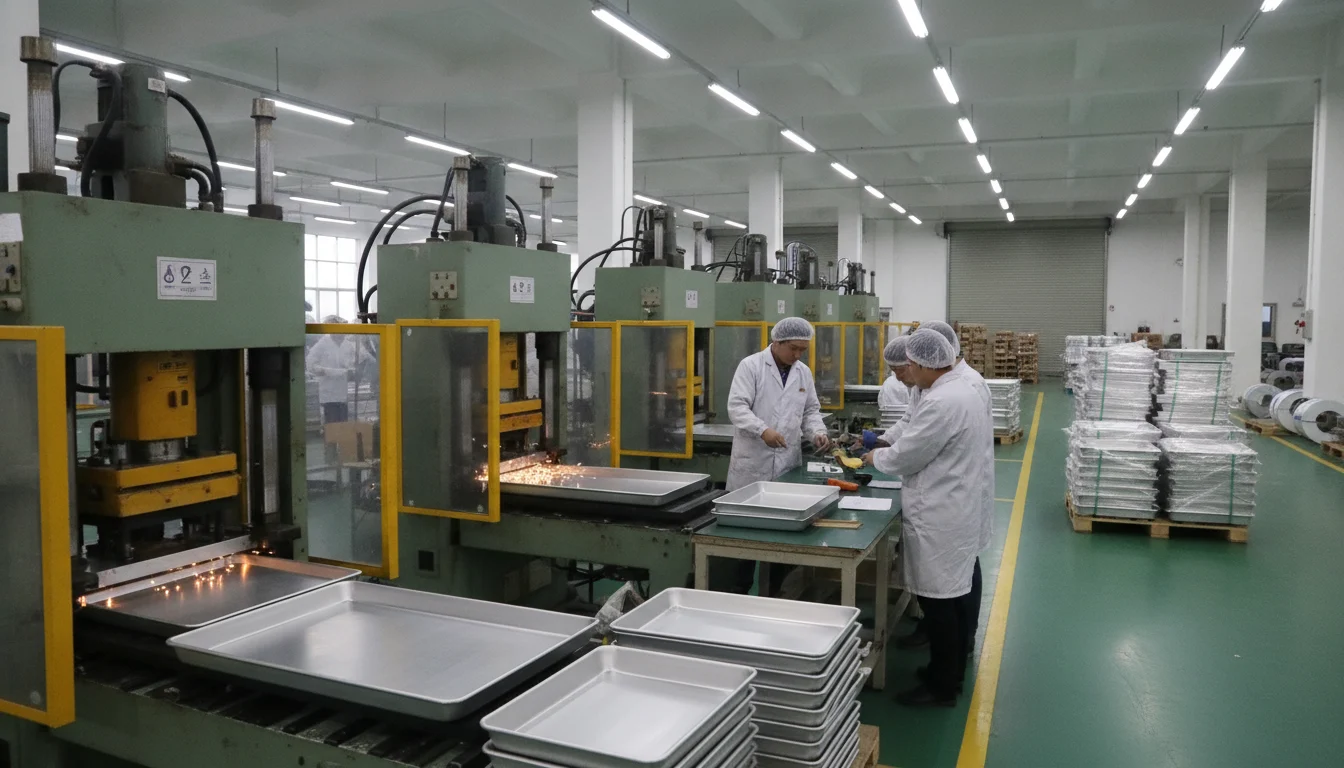
To find reliable aluminized steel sheet pan factory Africa suppliers, start by verifying food-contact certifications (SGS, FDA 21 CFR 175.300 for non-stick coatings), auditing factory production lines via video or third-party inspection, and confirming MOQ flexibility-Shansen Bakeware’s carbon-steel line offers 1 pc sampling and 500 pcs per SKU for OEM runs, with container loading optimized for Lagos Apapa, Mombasa, and West/Lusophone African ports.
📋 Table of Contents
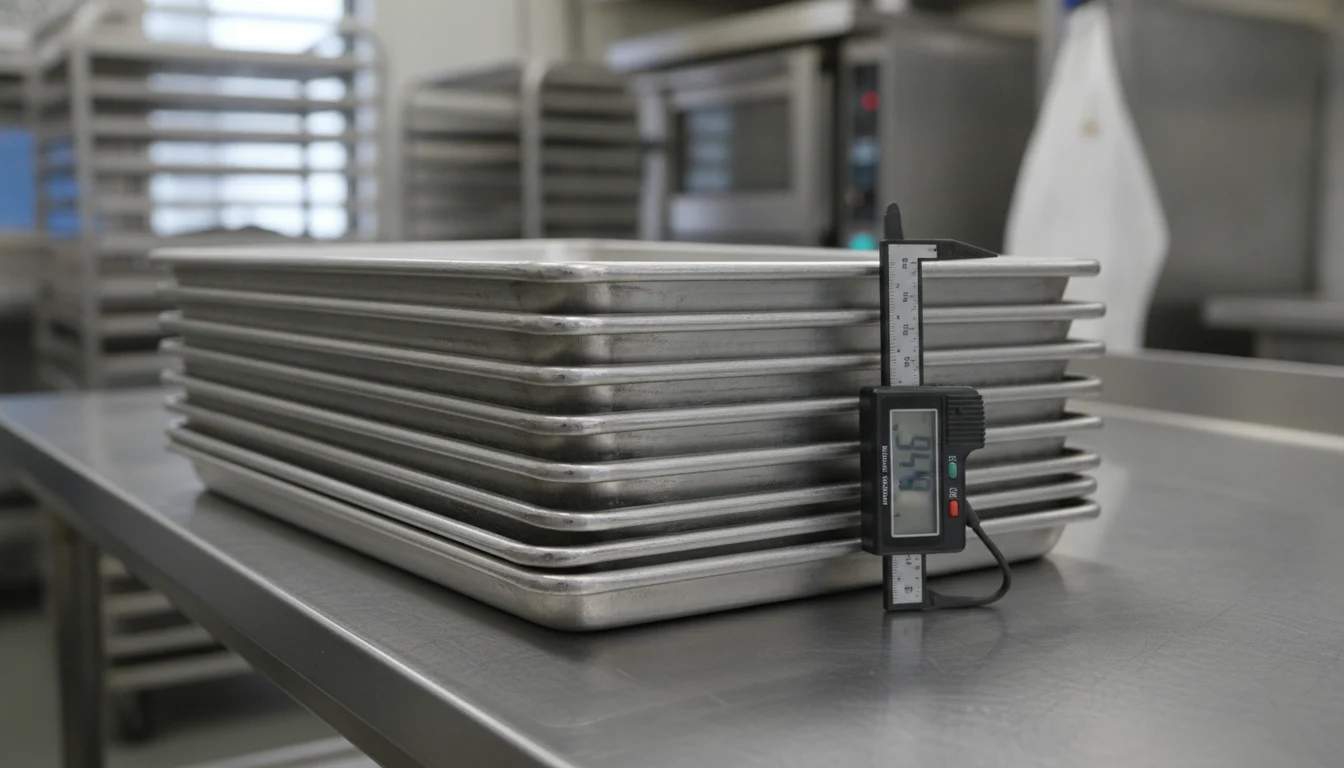
Aluminized steel is a carbon-steel substrate hot-dipped in an aluminum-silicon alloy, creating a metallurgically bonded coating that resists oxidation and distributes heat more evenly than bare steel. The aluminum layer provides thermal conductivity, while the steel core maintains rigidity under load, making the material suitable for high-volume commercial baking where pans cycle through ovens multiple times per day.
The aluminum-silicon coating on aluminized steel typically ranges from 20 to 40 microns thick. This layer reflects radiant heat more uniformly than bare steel, reducing hot spots that cause uneven browning on cookies, pastries, or roasted vegetables. Steel’s higher tensile strength compared to pure aluminum means the pan maintains flatness even when loaded with heavy dough or when thermal expansion occurs during baking.
African coastal cities such as Lagos, Mombasa, and Luanda experience high humidity year-round. Bare carbon steel rusts quickly in these conditions. The aluminum coating acts as a sacrificial barrier, oxidizing slowly and protecting the steel core from moisture penetration. Buyers report that aluminized pans outlast uncoated steel by two to three replacement cycles in coastal bakeries, lowering long-term replacement costs.
Some factories apply an additional non-stick coating (PTFE-based or ceramic-based) over the aluminized substrate. Coated versions simplify release and cleaning but introduce temperature limits. Buyers note that non-stick coatings can emit odors above 375°F and may flake if scraped with metal utensils. Bare aluminized steel tolerates higher oven temperatures and aggressive cleaning but requires light greasing or parchment paper to prevent sticking, particularly with sugar-rich batters.
Food-contact certifications confirm that a pan’s materials and coatings do not leach harmful substances into food. African importers face liability if a product fails a downstream safety audit or causes a health incident, so verifying certifications before the first deposit protects both brand reputation and legal standing.
Ask the factory for SGS, Intertek, or Bureau Veritas test reports dated within the past three years. The report should list the specific SKU tested, the standard applied (FDA 21 CFR 175.300 for non-stick coatings on bakeware, or equivalent EU or national standards), and pass/fail results for heavy metals (lead, cadmium), PFAS compounds, and migration limits. Shansen Bakeware maintains SGS test reports dated 2020, 2021, and 2023; the 2020 report covers FDA 21 CFR 175.300 compliance for the carbon-steel line’s non-stick coating. Reports are issued per order on request, ensuring batch traceability.
PFAS (per- and polyfluoroalkyl substances) are persistent chemicals used in some older non-stick coatings. California Proposition 65 and AB 1200 restrict PFAS in cookware sold in the United States, and African buyers serving export markets or international hotel chains must meet the same standards. Confirm that the factory’s test report explicitly states “PFAS not detected” or lists individual PFAS compounds below detection limits. Similarly, lead-free certification is critical because lead can leach from low-quality coatings into acidic foods.
A common mistake is assuming that a factory-wide ISO 9001 certificate guarantees food-contact safety. ISO 9001 covers quality-management systems, not material safety. Similarly, SGS factory audits verify production processes but do not test individual product lines for food-contact compliance. Always request product-specific test reports that name the exact SKU and coating system you intend to order.
Production-capacity claims on a factory’s website often exceed actual output. An audit confirms that the supplier can meet your order volume, maintain consistent quality across batches, and handle peak-season demand without delaying shipments or cutting corners on QC.
Request a live video call during working hours. Ask the factory contact to walk through the stamping line, coating application area, and final inspection station. Observe the number of presses running, the speed of the coating line, and the size of the QC team. A factory claiming 500,000 units per month should show multiple stamping presses operating simultaneously and a dedicated QC station with calibrated thickness gauges and coating-adhesion testers.
If the order value justifies the cost, hire an independent inspection company (SGS, Bureau Veritas, Intertek) to visit the factory before you place a deposit. The inspector will verify machine counts, measure workshop square footage, interview the QC manager, and photograph equipment. Third-party reports are harder to falsify than supplier-provided photos. Inspection fees typically range from $300 to $600 per visit, confirmed at quotation.
Ask how the factory tracks batches from raw-material receipt through final packing. A system assigns a unique lot number to each production run and records coating-thickness measurements, oven-cure times, and inspector initials. If a customer later reports a quality issue, batch traceability allows the factory to isolate the affected lot and investigate root causes. Factories lacking traceability cannot perform effective corrective action, increasing the risk of recurring defects.
Request contact details for two or three current clients, ideally distributors in African or Middle Eastern markets who face similar logistics and quality requirements. Ask those references about on-time delivery rates, how the factory handles quality claims, and whether production capacity matched the initial promise during peak seasons. A factory unwilling to provide references may be hiding a poor track record.
Coating performance and warping resistance determine whether a pan survives daily commercial use or requires replacement within months. Buyers report that warped pans rock on work surfaces, making them unsafe for hot product, and that flaking coatings contaminate food.
Aluminized steel sheet pans are commonly available in 18-gauge (1.2 mm) and 16-gauge (1.5 mm) thicknesses. Thicker gauges resist warping under high heat but cost more and add shipping weight. Buyers note that 18-gauge pans warp when loaded heavily and placed in ovens above 400°F, then spring back during cooling, creating an unstable base. Wire-rolled or beaded rims add rigidity by folding the edge back on itself, distributing stress more evenly and reducing the likelihood of warping. Confirm that the factory uses wire-rolled rims on commercial-grade pans rather than simple folded edges.
Non-stick coatings bond to the aluminized substrate through a curing process. Poor adhesion causes the coating to flake when scraped or washed. Ask the factory for the coating’s maximum continuous-use temperature. PTFE-based coatings typically tolerate 450°F to 500°F, while ceramic-based coatings may handle slightly higher temperatures but are more brittle. Buyers describe a noticeable coating smell above 375°F with some lower-quality non-stick systems, which can transfer odors to baked goods. If your bakery routinely bakes at high temperatures (pizza, artisan bread), specify bare aluminized steel or a high-temperature coating system.
Coated pans require gentle handling. Metal spatulas, wire brushes, and abrasive scouring pads scratch non-stick surfaces, exposing the aluminized substrate and creating rust initiation points. Buyers report that deep scratches reduce coating lifespan and make replacement necessary within six to twelve months in high-volume bakeries. Hand washing with soft sponges extends coating life, but many commercial kitchens use mechanical dishwashers. Confirm whether the factory’s coating is dishwasher-safe or requires hand washing, and communicate that requirement to your end customers.
Warping mitigation: 16-gauge or heavier substrate + wire-rolled rim + oven temperature kept below the coating’s rated limit reduces warping incidents. Bare aluminized steel tolerates higher temperatures than coated versions.
MOQ (minimum order quantity) and sampling flexibility determine whether a new distributor can validate product-market fit before committing to a full container. High MOQs tie up working capital in untested inventory, while restrictive sampling policies prevent hands-on evaluation.
Some factories quote a blanket MOQ (e.g., “500 pieces”) without specifying whether that applies per SKU or per order. A 500-piece total order MOQ allows you to mix sizes (100 pieces of five different sizes), while a 500-piece per-SKU MOQ forces you to order 500 of each size, multiplying inventory risk. Shansen Bakeware’s carbon-steel line requires 500 pieces per SKU for an OEM production run, but sampling starts at 1 piece, letting distributors test each size before scaling. Low-MOQ programs reduce the financial barrier for startups and small importers entering the African bakery-supply market.
Factories typically charge for samples to cover material and labor costs. Sample pricing ranges from full retail price down to cost-plus-handling, depending on the supplier’s sales strategy. Lead time for samples is usually shorter than production runs because samples skip the queue. Confirm sample lead time, shipping method (air or sea), and whether sample costs are refundable against a future production order. Shansen offers 1-piece sampling on the metal and carbon-steel lines, with sample lead time and refund terms confirmed at quotation.
Private labeling allows you to sell pans under your own brand name, building customer loyalty and preventing direct competition with the factory. Ask whether the factory offers custom packaging (printed boxes, hang tags, inserts), laser etching or embossing of your logo on the pan itself, and custom coating colors. Tooling fees for custom embossing or unique molds typically range from $200 to $2,000 per design, confirmed at quotation, and are amortized across the first few production runs. OEM and private-label services let African distributors differentiate their product line without investing in manufacturing infrastructure.
A detailed spec sheet lists gauge thickness, rim style (wire-rolled, beaded, or simple fold), coating type and thickness, oven-safe temperature, and outer dimensions. Comparing spec sheets from multiple factories highlights differences in material quality and helps you explain product features to retail buyers or bakery customers.
Landed cost includes the FOB (free on board) factory price plus international freight, customs duties, port handling, and inland transport to your warehouse. Underestimating any of these components erodes your margin or forces you to raise retail prices mid-season.
FOB price covers manufacturing, domestic transport to the Chinese export port (Ningbo, Shanghai, or Shenzhen), and export customs clearance. International freight depends on container type (20′ or 40′), shipping line, fuel surcharges, and port congestion. Customs duties in Nigeria, Kenya, and South Africa vary by HS code and trade agreements; bakeware typically falls under HS code 7323 (table, kitchen, or other household articles of iron or steel), with duty rates ranging from 10% to 25% of CIF (cost, insurance, freight) value, confirmed at quotation. Port handling fees at Lagos Apapa, Mombasa, or Luanda cover container discharge, storage, and terminal handling, adding $150 to $400 per container.
A 20′ container holds approximately 10 to 12 pallets, while a 40′ container holds 20 to 24 pallets, depending on carton dimensions and stacking height. Factories experienced in African exports design carton sizes that maximize pallet density and minimize wasted space. Shansen Bakeware optimizes container loading for Lagos, Mombasa, and West/Lusophone African ports, reducing per-unit freight cost by fitting more cartons per container. Request a container-loading plan during the quotation phase to verify that the factory’s carton dimensions align with standard pallet sizes.
After clearing customs, goods move by truck from the port to your warehouse or distribution center. Inland freight in Nigeria, Kenya, or South Africa depends on distance, road conditions, and fuel prices. Warehousing costs include rent, labor, and inventory insurance. If you lack warehouse space, some freight forwarders offer bonded warehouse services, allowing you to clear goods in smaller batches and defer duty payment until each batch is withdrawn.
Payment terms balance the factory’s need for working capital against your need to protect the deposit until goods are inspected and shipped. Poor payment structures leave buyers with no recourse if the factory delivers defective goods or disappears after receiving a full advance payment.
A common structure is 30% deposit upon order confirmation and 70% balance before shipment. The deposit covers raw-material purchase and production setup, while the balance is held until you receive inspection photos or a third-party QC report confirming that goods meet specifications. Factories with strong cash flow may accept a smaller deposit (20% or 25%), while smaller suppliers often require 40% to 50% upfront. Avoid paying 100% in advance unless you have an established relationship and verified past performance.
A letter of credit (LC) is a bank-issued guarantee that the factory receives payment only after presenting specified documents (bill of lading, inspection certificate, packing list) proving that goods were shipped and inspected. LCs protect buyers from non-delivery and protect factories from non-payment. Banks charge LC fees (typically 0.5% to 2% of order value), and both parties must agree on the exact documents required. LCs work best for orders above $20,000 where the fee is justified by the risk reduction.
Trade escrow platforms (Alibaba Trade Assurance, Payoneer Escrow) hold the buyer’s payment until the buyer confirms receipt and inspection of goods. Escrow protects against fraud and non-delivery but adds processing fees and extends the payment timeline. Factories may resist escrow because funds are released only after the buyer’s approval, which can be delayed if the buyer is slow to inspect or disputes minor issues.
If your order requires custom molds or embossing dies, split the tooling cost into milestones: 50% upon design approval, 50% upon first-article inspection. This structure ensures that the factory completes each phase before receiving the next payment, reducing the risk that tooling is abandoned mid-project.
Aluminized steel uses a steel core coated with aluminum-silicon alloy, providing greater rigidity and resistance to warping under heavy loads compared to pure aluminum. Pure aluminum pans are lighter and conduct heat faster but dent more easily and may warp when loaded with dense dough. Aluminized steel costs less than heavy-gauge aluminum while delivering comparable heat distribution, making it a cost-effective choice for commercial bakeries that cycle pans through ovens multiple times daily.
Request the full PDF report directly from the factory, then contact the issuing SGS office (listed on the report header) to confirm the report number, test date, and client name. SGS and other testing bodies maintain online verification portals where you can enter the report number to check authenticity. Forged reports often contain formatting inconsistencies, missing watermarks, or report numbers that do not exist in the testing body’s database. If the factory hesitates to provide the full report or refuses to share the report number, treat that as a red flag.
Factories with multiple in-house product lines often allow mixed-material containers, letting you combine aluminized steel sheet pans, silicone molds, stainless steel cooling racks, and cake-decorating tools in one shipment. This approach reduces per-SKU MOQ pressure and lets you test a broader product range with a single order. Confirm that the factory has experience packing mixed loads to avoid carton-size mismatches that waste container space. Shansen Bakeware runs seven in-house lines (silicone, carbon steel, stainless steel, aluminum, cake-decorating tools, strainers, multi-piece sets) and optimizes mixed-material container loading for African distributors.
Sourcing aluminized steel sheet pans for the African bakery-supply market requires verifying food-contact certifications, auditing factory production capacity, evaluating coating performance and warping risk, confirming MOQ and sampling flexibility, calculating landed cost for Lagos, Mombasa, or Francophone/Lusophone ports, and structuring payment terms that protect your deposit. Shansen Bakeware’s Yongkang factory produces wholesale bakeware sets across seven in-house lines at 500,000 units per month, with SGS/FDA test reports on request and container loading optimized for African distributors. The carbon-steel line offers 1-piece sampling and 500-piece per-SKU OEM runs, letting startups and small importers validate product-market fit before scaling. Food-grade SGS/FDA-certified bakeware ensures compliance with international safety standards, while baking-tools wholesale programs support distributors entering the Nigerian and broader African markets.
In practice: Sampling 1 piece of each size before placing a 500-piece per-SKU OEM order allows a distributor to test coating adhesion, warping resistance, and fit with local bakery ovens without tying up working capital in untested inventory.
Ready to find reliable aluminized steel sheet pan factory Africa suppliers and request SGS/FDA test reports for your first order?
Request Your Sample and Quotation →
Written by the Shansen Bakeware Export Team.
See the range: every size we make, with specs and MOQ, is on our baking trays and sheet pans page.
MOQ 1 set on stock configurations. Tell us what you need and we reply on WhatsApp.
Click the button below to open WhatsApp. If you're not logged in to WhatsApp Web yet, scan the QR code first — then come back here and copy the message into the chat.