
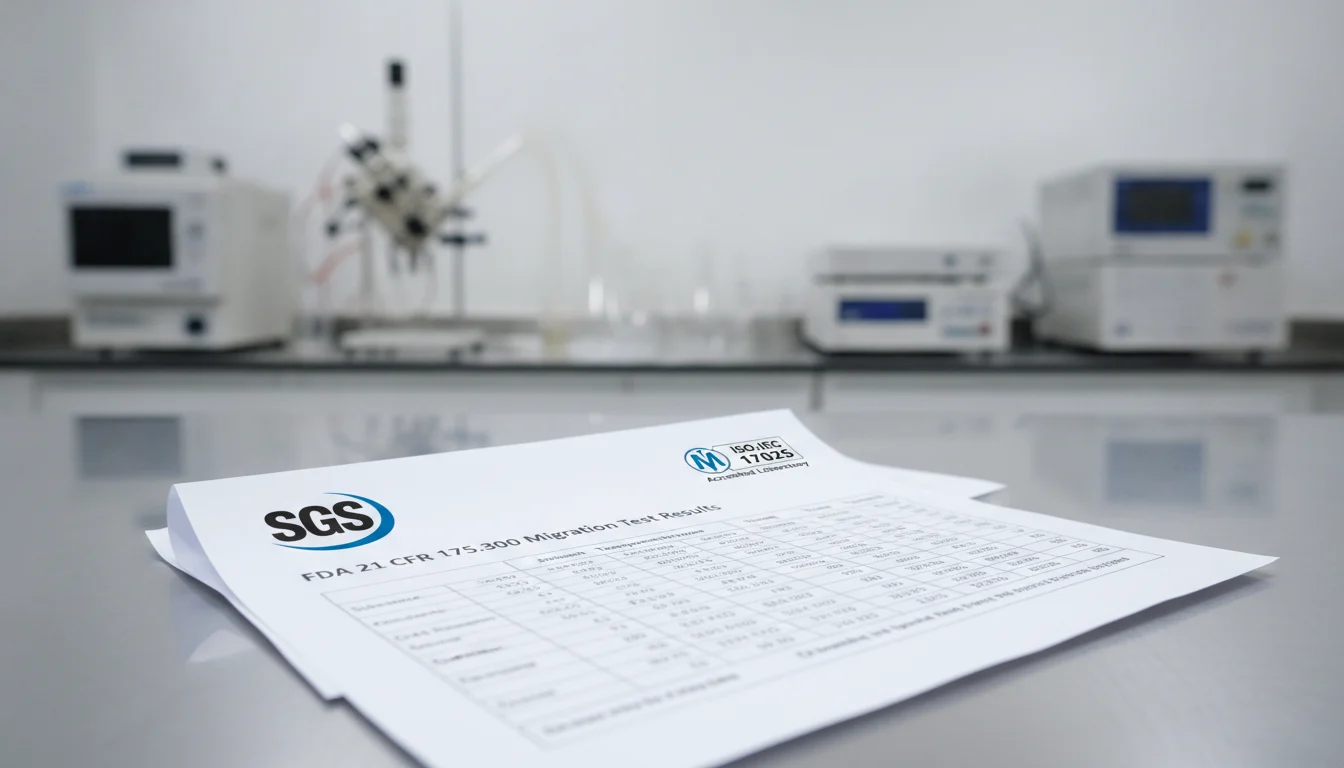
The food grade certificate documentation bakeware import Accra requires five core documents: a commercial invoice, FDA Ghana permit (for food-contact articles), Ghana Standards Authority Certificate of Analysis (CoA) from an ISO/IEC 17025 laboratory, a migration-test report covering overall and specific migration under FDA 21 CFR 177.2600 (silicone) or 21 CFR 175.300 (non-stick coatings), and a manufacturer’s declaration of compliance stating material composition and intended-use temperature. Shansen Bakeware supplies SGS-verified test reports dated 2020, 2021, and 2023 covering FDA 21 CFR 175.300 for the carbon-steel line; reports are issued per production batch on request.
📋 Table of Contents
Ghana classifies empty bakeware as a food-contact article rather than prepackaged food, which shifts the regulatory pathway from the Ghana Food and Drugs Authority’s food-import track to the Ghana Standards Authority’s product-conformity track. The distinction matters because food-contact articles require migration-test evidence showing that the material does not transfer harmful substances into food under normal baking conditions, whereas prepackaged food requires microbiological and nutritional analysis. Bakeware made from silicone, carbon steel with non-stick coatings, stainless steel, or aluminum must demonstrate compliance with FDA food-contact regulations (21 CFR 170-189) and pass Ghana Standards Authority inspection at Tema or Takoradi port before release to the importer.
Ghana’s Integrated Customs Management System (ICUMS) categorizes bakeware under HS code 7323 (table, kitchen, or household articles of iron or steel) or 3924 (tableware and kitchenware of plastics), depending on the primary material. Empty bakeware is not considered a food product, so it bypasses the Ghana Food and Drugs Authority’s premarket-approval process for edible goods. Instead, the Ghana Standards Authority evaluates whether the material meets food-contact safety standards, focusing on heavy-metal migration (lead, cadmium, chromium), overall migration limits (typically 10 mg/dm² or 60 mg/kg simulant), and specific-migration limits for additives or coatings. Importers must submit a Certificate of Analysis or Certificate of Conformity from an ISO/IEC 17025 accredited laboratory, plus a manufacturer’s declaration of compliance, to satisfy GSA’s documentary requirements before physical inspection.
The Ghana Food and Drugs Authority issues permits for products that come into direct contact with food, including bakeware. The permit application requires proof that the material complies with FDA food-contact substance regulations (21 CFR 170-189), a Certificate of Free Sale from the country of manufacture (if available), and a signed declaration that the product is manufactured under good manufacturing practice. Bakeware distributors importing wholesale bakeware sets often consolidate the FDA permit application across multiple SKUs in a single shipment to reduce administrative overhead. The permit is valid for one year and must be renewed if the importer continues to bring in the same product line.
Every bakeware shipment arriving at Tema or Takoradi port requires four baseline customs documents before Ghana Revenue Authority officers will initiate clearance: a commercial invoice detailing unit prices and total FOB or CIF value, a packing list showing carton count and gross/net weight, a bill of lading (ocean freight) or air waybill (air freight), and an importer identification number issued by the Ghana Revenue Authority. These documents are uploaded into the Integrated Customs Management System within 24 hours of vessel arrival, triggering an automated risk-assessment scan that flags high-risk product categories (including food-contact articles) for physical inspection or laboratory testing.
The commercial invoice must state the Harmonized System code (7323 for metal bakeware, 3924 for silicone), the country of origin (China for Shansen Bakeware), and the Incoterm (typically FOB Ningbo or CIF Tema). Unit prices are cross-checked against Ghana’s customs valuation database; significant deviations trigger a valuation query that delays clearance by 3-5 business days. The packing list must match the invoice line-by-line, showing how many pieces of each SKU are packed in each carton, because GSA inspectors physically count a random sample of cartons during the conformity inspection. Discrepancies between the packing list and the physical count result in a hold until the importer provides a revised packing list and pays any applicable penalty.
The bill of lading serves as proof of ownership and is surrendered to the shipping line’s Accra office in exchange for a delivery order, which authorizes the importer to collect the container from the port. The importer identification number (also called the Tax Identification Number or TIN) links the shipment to the importer’s customs account in ICUMS, ensuring that all duties, VAT, and inspection fees are correctly allocated. New importers must register with the Ghana Revenue Authority and obtain a TIN before their first shipment; the registration process takes 2-3 business days and requires a business-registration certificate, a Ghana card (national ID), and proof of a physical business address in Ghana.
The Ghana Food and Drugs Authority requires a permit for bakeware only when the product is classified as a food-contact article. The permit application is submitted online through the FDA Ghana portal and requires four attachments: a Certificate of Analysis from an ISO/IEC 17025 laboratory, a manufacturer’s declaration of compliance, a copy of the commercial invoice, and a product photograph showing the item and its labeling. The FDA reviews the application within 5-7 business days and either issues the permit or requests additional evidence (typically a more detailed migration-test report or a clarification of the material composition). The permit fee is GHS 500 for a single SKU and GHS 1,200 for a product family (up to 10 related SKUs), payable via mobile money or bank transfer.
Importers sourcing from China often request a Certificate of Free Sale from the manufacturer’s local chamber of commerce, which states that the product is legally sold in the country of manufacture. The Ghana Food and Drugs Authority accepts a Certificate of Free Sale as supporting evidence but does not waive the requirement for a migration-test report or a manufacturer’s declaration of compliance. The certificate is most useful when the manufacturer has already exported the same SKU to another African market (Nigeria, Kenya, South Africa) and can provide a copy of the previous FDA approval or NAFDAC registration, which the Ghana FDA reviews as precedent. Shansen Bakeware’s factory in Yongkang, Zhejiang, can arrange a Certificate of Free Sale through the Zhejiang Council for the Promotion of International Trade; the document takes 3-5 business days to issue and is valid for one year.
The Ghana Food and Drugs Authority requires a signed statement from the manufacturer confirming that the bakeware is produced under good manufacturing practice (GMP), with documented quality-control procedures covering raw-material inspection, in-process testing, and finished-goods testing. The declaration does not require third-party certification (ISO 9001 or HACCP are optional but not mandatory), but it must include the name and signature of the factory’s quality manager, the date of the declaration, and a company stamp or seal. Distributors importing food-grade SGS FDA certified bakeware often request this declaration at the sampling stage, before placing a full production order, to confirm that the manufacturer has the documentation infrastructure in place.
The Ghana Standards Authority (GSA) requires a Certificate of Analysis or Certificate of Conformity for all food-contact articles entering Ghana, regardless of whether the importer has obtained an FDA permit. The certificate must be issued by an ISO/IEC 17025 accredited laboratory and must cover the specific material line (silicone, carbon steel with non-stick coating, stainless steel, aluminum) and the intended-use temperature (typically 230°C for bakeware). The laboratory report must state the test method (ISO 4531 for overall migration, EN 1186 for specific migration, ASTM F963 for heavy metals), the simulant used (3% acetic acid for acidic foods, 10% ethanol for aqueous foods, olive oil for fatty foods), and the migration result in mg/dm² or mg/kg. Results must fall below the regulatory limit (10 mg/dm² for overall migration, 0.01 mg/kg for lead, 0.002 mg/kg for cadmium) to pass GSA inspection.
Ghana Standards Authority only accepts test reports from laboratories accredited to ISO/IEC 17025 by a signatory to the International Laboratory Accreditation Cooperation (ILAC) mutual-recognition arrangement. Shansen Bakeware’s SGS reports are issued by SGS-CSTC Standards Technical Services (Guangzhou) Co., Ltd., which holds ISO/IEC 17025 accreditation from the China National Accreditation Service for Conformity Assessment (CNAS), an ILAC signatory. The accreditation scope covers food-contact materials testing under FDA 21 CFR 175.300, 21 CFR 177.2600, and European Union Regulation 10/2011, ensuring that the test methods and equipment meet international standards. Importers must verify that the laboratory name on the Certificate of Analysis appears in the ILAC directory before submitting the report to GSA, because reports from non-accredited laboratories are rejected at the document-review stage.
A Certificate of Analysis reports the quantitative test results (migration values, heavy-metal concentrations, temperature stability) without making a pass/fail judgment, whereas a Certificate of Conformity states that the product meets a specific standard (Ghana GS 952 for food-contact plastics, Ghana GS 1030 for stainless-steel cookware) and includes the test results as supporting evidence. Ghana Standards Authority accepts both formats, but a Certificate of Conformity is preferred because it explicitly confirms compliance with Ghana’s national standards. Manufacturers that do not have direct access to Ghana GS standards can issue a Certificate of Analysis based on FDA 21 CFR or EU 10/2011 and include a statement that the test results meet or exceed the Ghana GS limits, which GSA officers cross-check against the Ghana standards database during inspection.
Each bakeware material line requires a different set of migration tests and regulatory references, because the potential contaminants and intended-use conditions vary. Silicone bakeware must demonstrate compliance with FDA 21 CFR 177.2600, which specifies extractables limits for hexane-soluble material (not more than 6.0% by weight) and a maximum use temperature of 260°C. Carbon-steel bakeware with non-stick coatings must comply with FDA 21 CFR 175.300, covering perfluorocarbon resins, and must show that the coating does not release PFAS (per- and polyfluoroalkyl substances) above detection limits when heated to 230°C for 2 hours. Stainless-steel bakeware falls under FDA 21 CFR 177.2450 (iron-modified polyethylene terephthalate polymers) if it has a polymer lining, or 21 CFR 177.2420 (stainless steel) if uncoated, and must demonstrate chromium and nickel migration below 0.1 mg/kg. Aluminum bakeware must comply with FDA 21 CFR 175.300 if anodized or coated, or 21 CFR 177.2400 (perfluorocarbon resins) if PTFE-coated, and must show aluminum migration below 1.0 mg/kg in acidic simulants.
FDA 21 CFR 177.2600 defines food-contact silicone as rubber articles intended for repeated use, composed of dimethylpolysiloxane with or without silicon dioxide filler. The regulation requires an extractables test using hexane as the solvent, heated to reflux for 7 hours, with the hexane-soluble fraction measured gravimetrically. The limit is 6.0% by weight for silicone rubber with fillers and 4.5% for silicone rubber without fillers. Ghana Standards Authority requires this test for all silicone bakeware, plus an additional overall-migration test using 3% acetic acid at 100°C for 2 hours (simulating acidic baked goods like lemon cake) and 10% ethanol at 40°C for 10 days (simulating aqueous baked goods). The overall-migration result must be below 10 mg/dm² to pass. Shansen Bakeware’s silicone line uses platinum-cured liquid silicone rubber, which typically shows hexane extractables between 2.5% and 3.5%, well below the FDA limit.
FDA 21 CFR 175.300 covers resinous and polymeric coatings on metal substrates, including PTFE (polytetrafluoroethylene), PFOA-free non-stick coatings, and ceramic sol-gel coatings. The regulation specifies extractables limits for various food-simulating solvents: 8% ethanol (aqueous foods), 50% ethanol (acidic foods), heptane (fatty foods), and distilled water (non-acidic aqueous foods). For bakeware, the critical test is heptane extraction at 66°C for 2 hours, repeated three times, with the total extractables measured by evaporating the heptane and weighing the residue. The limit is 0.5 mg/in² (77.5 mg/dm²). Shansen Bakeware’s 2020 SGS report on the carbon-steel line shows heptane extractables at 12.3 mg/dm², well below the FDA limit, and confirms that the coating is PFAS-free (no PFOA, PFOS, or other C4-C14 perfluoroalkyl acids detected by liquid chromatography-mass spectrometry).
Stainless-steel bakeware without a polymer coating is generally recognized as safe (GRAS) under FDA 21 CFR 177.2420, provided that chromium migration does not exceed 0.1 mg/kg and nickel migration does not exceed 0.14 mg/kg when tested in 3% acetic acid at 100°C for 2 hours. Ghana Standards Authority requires this test for all stainless-steel bakeware, plus a visual inspection to confirm that the steel is austenitic (300-series stainless, typically 304 or 316) rather than ferritic or martensitic, which have higher chromium-migration potential. Aluminum bakeware is tested under FDA 21 CFR 177.2400 if PTFE-coated, or under FDA 21 CFR 175.300 if anodized, with aluminum migration measured in 3% acetic acid at 100°C for 2 hours. The FDA limit is 1.0 mg/kg for aluminum, which is easily met by anodized aluminum but sometimes exceeded by bare aluminum in prolonged contact with acidic foods. Distributors importing custom OEM private label bakeware often request anodized aluminum or stainless steel for product lines targeting health-conscious buyers, because these materials have the lowest migration potential.
Ghana Standards Authority requires a signed declaration from the manufacturer stating that the bakeware complies with FDA food-contact regulations and Ghana national standards. The declaration must include the manufacturer’s legal name and address, the product name and SKU, the material composition (percentage of each component), the test-method standards used (ISO 4531, EN 1186, ASTM F963), the intended-use temperature and contact-time limits, and the batch or lot number for traceability. The declaration must be signed by a company officer (typically the quality manager or export manager) and dated within 90 days of the shipment date. Ghana Standards Authority cross-checks the batch number on the declaration against the batch number on the Certificate of Analysis to ensure that the test report corresponds to the actual production batch being imported.
The material-composition section of the declaration must list every component that comes into contact with food, including the base material (silicone, carbon steel, stainless steel, aluminum), any coatings or surface treatments (non-stick, anodizing, ceramic), and any additives or colorants (pigments, stabilizers, release agents). For silicone bakeware, the declaration must specify whether the silicone is peroxide-cured or platinum-cured, because peroxide-cured silicone has higher extractables and is not suitable for high-temperature baking. For carbon-steel bakeware with non-stick coatings, the declaration must state whether the coating is PTFE-based, ceramic sol-gel, or another polymer, and must confirm that the coating is PFOA-free and PFOS-free. Ghana Standards Authority rejects declarations that use vague terms like “food-grade coating” or “non-stick finish” without specifying the chemical composition.
The declaration must state the maximum safe-use temperature and the maximum recommended contact time with food, because these parameters determine which simulant and test conditions the laboratory uses for migration testing. Silicone bakeware is typically rated for continuous use up to 230°C and short-term use up to 260°C, with no contact-time limit because silicone is chemically inert. Carbon-steel bakeware with non-stick coatings is rated for continuous use up to 230°C, with a recommended maximum contact time of 2 hours per baking cycle, because prolonged heating above 230°C can degrade the coating and increase extractables. Stainless-steel and aluminum bakeware have no practical temperature limit for baking (both materials are stable up to 500°C), but the declaration must specify the intended food type (acidic, aqueous, fatty) to guide the choice of simulant for migration testing. Importers sourcing low MOQ bakeware for startups often request a conservative temperature rating (200°C maximum) to simplify the declaration and reduce the risk of a GSA query during inspection.
Every bakeware piece must carry a permanent batch code (stamped, embossed, or laser-etched) that links the product to the production date, raw-material lot, and quality-control records. The batch code format varies by manufacturer, but it typically includes a two-digit year code, a three-digit Julian day code, and a single-letter line code (e.g., 26-147-C for a product made on day 147 of 2026 on production line C). Ghana Standards Authority inspectors check a random sample of products during the conformity inspection to verify that the batch code on the product matches the batch code on the manufacturer’s declaration and the Certificate of Analysis. Missing or illegible batch codes result in a hold until the importer provides photographic evidence that the batch code is present on all products in the shipment, or until the manufacturer issues a revised declaration with a different batch code that matches the actual products.
In practice: Requesting a 1-set sample with the full documentation pack (Certificate of Analysis, manufacturer’s declaration, SGS test report) before placing a 500-piece OEM run lets a distributor verify that the batch code, material composition, and migration-test results meet Ghana Standards Authority requirements, reducing the risk of a customs hold on the first production shipment.
Ghana Food and Drugs Authority accepts a Certificate of Free Sale as supporting evidence but does not waive the requirement for a migration-test report or a manufacturer’s declaration of compliance. The certificate is most useful when the manufacturer has already exported the same SKU to another African market and can provide a copy of the previous FDA approval or NAFDAC registration, which the Ghana FDA reviews as precedent. The certificate is issued by the manufacturer’s local chamber of commerce and takes 3-5 business days to obtain.
A Certificate of Analysis reports the quantitative test results without making a pass/fail judgment, whereas a Certificate of Conformity states that the product meets a specific standard and includes the test results as supporting evidence. Ghana Standards Authority accepts both formats, but a Certificate of Conformity is preferred because it explicitly confirms compliance with Ghana’s national standards. Manufacturers that do not have direct access to Ghana GS standards can issue a Certificate of Analysis based on FDA 21 CFR or EU 10/2011 and include a statement that the test results meet or exceed the Ghana GS limits.
The Ghana Food and Drugs Authority reviews permit applications within 5-7 business days and either issues the permit or requests additional evidence, typically a more detailed migration-test report or a clarification of the material composition. The permit fee is GHS 500 for a single SKU and GHS 1,200 for a product family (up to 10 related SKUs), payable via mobile money or bank transfer. The permit is valid for one year and must be renewed if the importer continues to bring in the same product line.
Request the full documentation pack (Certificate of Analysis, manufacturer’s declaration, SGS test report) with your first sample order to verify compliance before your production run.
Request Documentation Pack →
Written by the Shansen Bakeware Export Team.
MOQ 1 set on stock configurations. Tell us what you need and we reply on WhatsApp.
Click the button below to open WhatsApp. If you're not logged in to WhatsApp Web yet, scan the QR code first — then come back here and copy the message into the chat.